All species › Passerines › Wrens › Spotted Wren
Position in the tree Birds Aves › Birds with a flexible palate Neognathae › All other modern birds Neoaves › Landbirds Telluraves › Falcons, parrots and passerines Australaves › Falcons and passerines Eufalconimorphae › Parrots and passerines Psittacopasserae
Spotted Wren | Campylorhynchus gularis
Gevlekte winterkoning | Matraca serrana
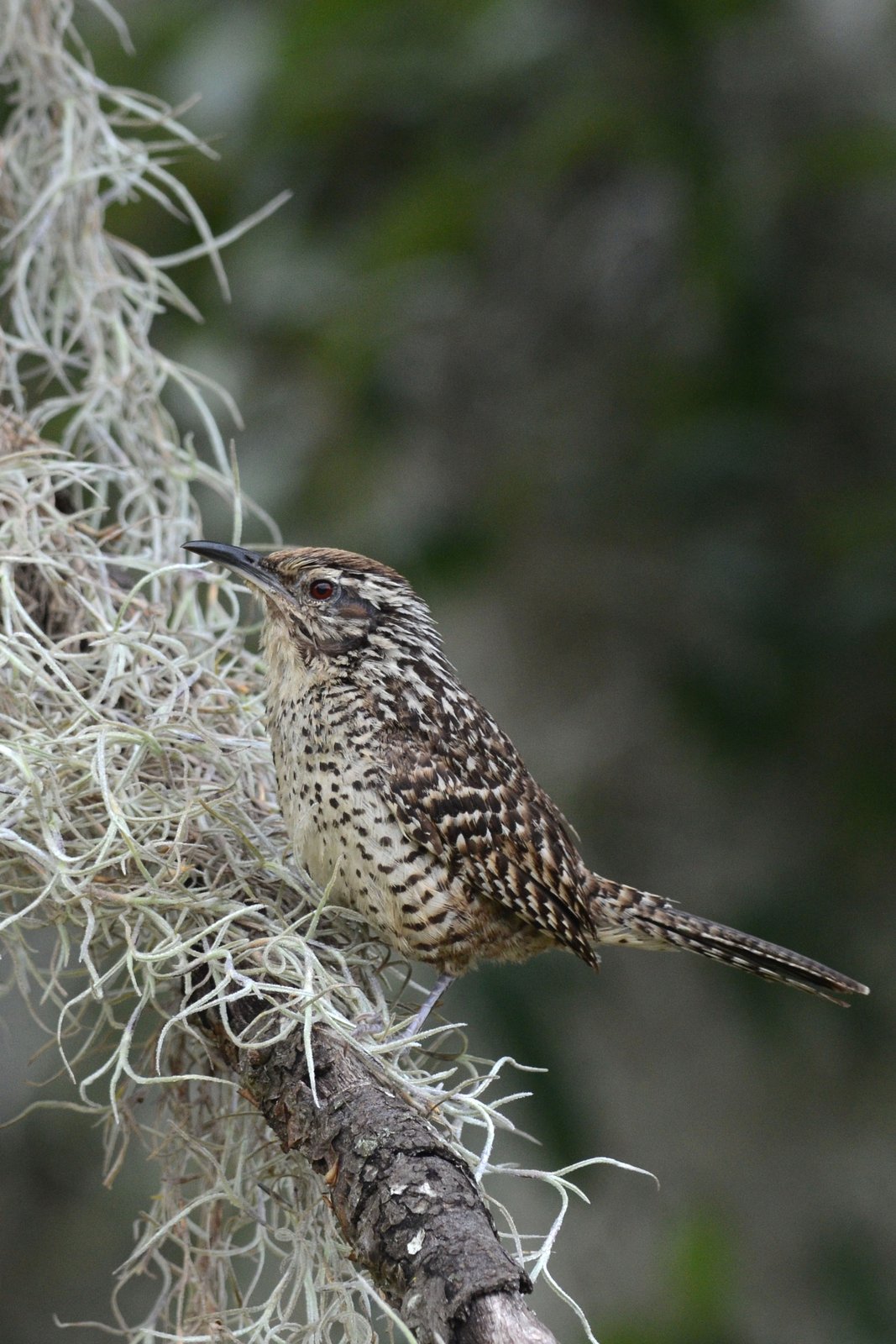
The Spotted Wren is a medium-sized Campylorhynchus with a streaked back, a striking supercilium and round black spots on the breast. It lives in pairs or small groups in oak and pine-oak woodland of Mexico's mountain ranges and is endemic to Mexico.
Voice
Harsh, rasping calls and a rattling, scratchy song of repeated phrases, often in duet.
Recording: Richard E. Webster — CC BY-NC-SA 4.0 · converted to mono · xeno-canto
Identification
16–18 cm. Crown rufous-brown, broad white supercilium, blackish eyestripe and a narrow black malar stripe. Back brown with black and white streaks. Wings and tail barred. Throat white, breast whitish with round black spots; flanks and lower belly warm ochre. Juveniles have an almost unspotted breast.
Confusion species
Cactus Wren Campylorhynchus brunneicapillus is larger, with denser spotting extending onto the belly, and lives in desert and dry scrub. Boucard's Wren Campylorhynchus jocosus of southern Mexico is more heavily spotted on breast and flanks. Grey-barred Wren Campylorhynchus megalopterus is larger and has a barred back.
Habitat
Oak and pine-oak woodland and brushy slopes in the mountains, roughly between 1000 and 2500 m, locally also drier scrub at the foot of the mountains. Searches branches, foliage and epiphytes for insects and spiders. Builds a domed nest in a tree or bush.
Where the bird is most at home, classified by the vegetation units of Mexico and Central America.




Range and movements
Endemic to Mexico: the Sierra Madre Occidental from southern Sonora and Chihuahua south to Jalisco and Michoacán, parts of the central highlands, and the Sierra Madre Oriental from southern Tamaulipas to Hidalgo. Does not occur outside the guide area.
- Resident
- dark = core range, pale = thinly spread
How and when to look
In oak woodland watch for pairs or small groups moving through the canopy with rasping calls; the spotted breast and white supercilium are the best features.
Conservation status
Not threatened. Fairly common in suitable montane woodland.
Scientific name
Campylorhynchus gularis | Sclater, 1861
Sclater described the species in 1861 and placed it straight away in the genus where it still stands. The genus Campylorhynchus was introduced in 1824 by Spix. Campylorhynchus is Greek, from kampulos 'curved' and rhunkhos 'bill', after the slightly decurved bill. gularis is Latin for 'of the throat' (from gula 'throat'), after the pale throat bordered by a dark moustachial stripe. The specimen the first description was based on came from Bolaños, Jalisco, Mexico.