All species › Passerines › Wrens › Boucard's Wren
Position in the tree Birds Aves › Birds with a flexible palate Neognathae › All other modern birds Neoaves › Landbirds Telluraves › Falcons, parrots and passerines Australaves › Falcons and passerines Eufalconimorphae › Parrots and passerines Psittacopasserae
Boucard's Wren | Campylorhynchus jocosus
Boucards winterkoning | Matraca del Balsas
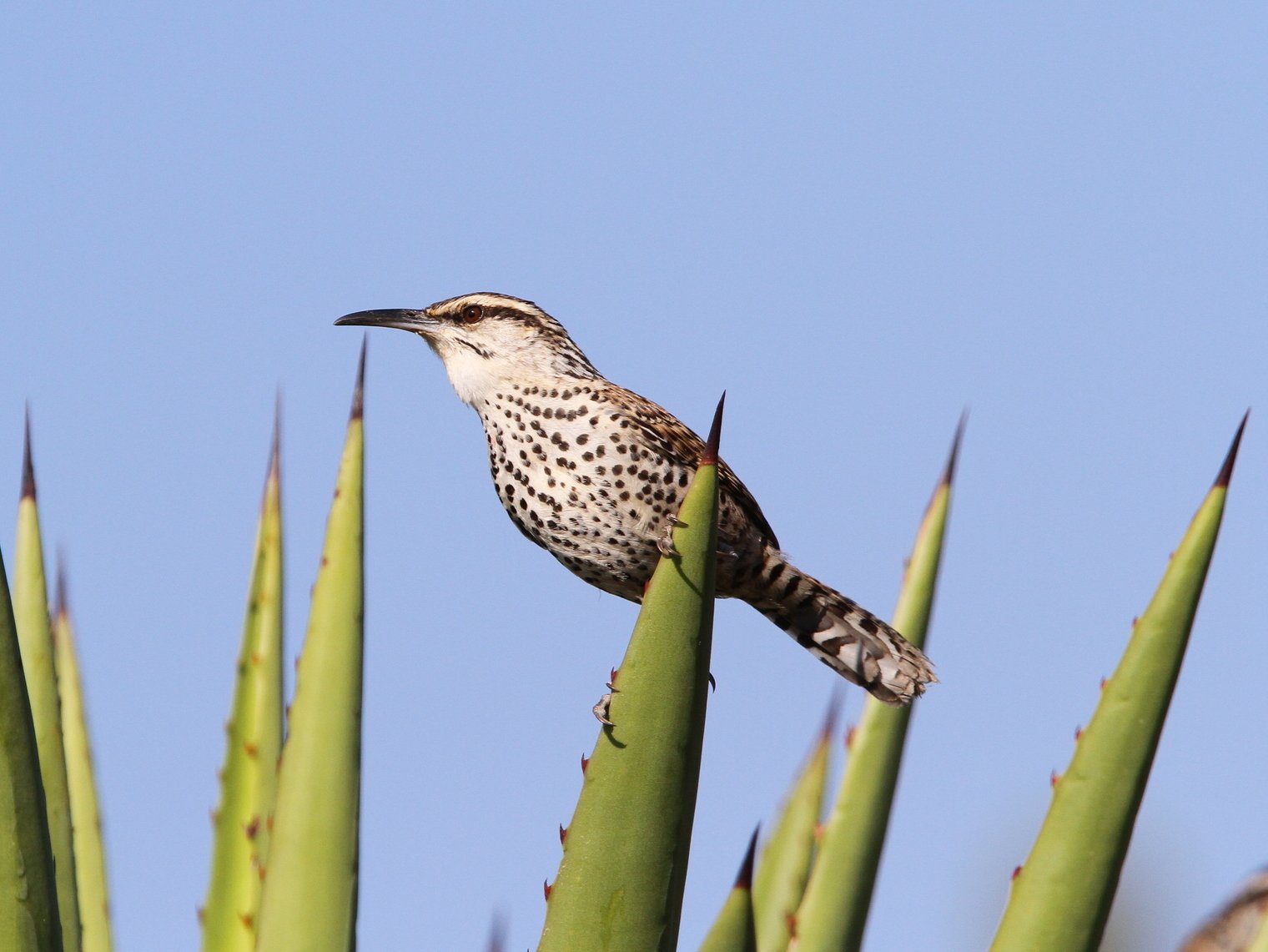
Boucard's Wren is a large, spotted Campylorhynchus wren found only in the interior of southern Mexico, mainly in the Balsas drainage. It lives in dry, open scrub and woodland and gives itself away with loud, grating duets. Small groups forage together.
Voice
Loud, rasping and grating series, often as a duet by a pair or in chorus by a group. Also a dry, scratchy cherr call.
Recording: Manuel Grosselet — CC BY-NC-SA 4.0 · converted to mono · xeno-canto
Identification
16–18 cm. Crown brown, with a broad white supercilium and a dark eyestripe. Upperparts grey-brown with black and white streaks and spots. Underparts white to pale buff, with black spots on the breast becoming bars on the flanks. Wings and tail barred; outer tail feathers with white. Bill fairly long and slightly curved. The sexes are alike.
Confusion species
Spotted Wren Campylorhynchus gularis lives in the mountains of western and central Mexico, usually in more humid oak and pine-oak forest; it has a more rufous crown and pale buff underparts with fewer spots. Cactus Wren Campylorhynchus brunneicapillus has a denser black patch of spots on the breast and occurs further north; the two hardly overlap.
Habitat
Dry thorn scrub, scrub with cacti and open oak and pine-oak woodland on interior slopes, roughly between 600 and 2500 m; also scrub along fields and pastures. It searches for insects and other invertebrates on the ground and in shrubs. The nest is a ball with a side entrance in a shrub or cactus.
Where the bird is most at home, classified by the vegetation units of Mexico and Central America.




Range and movements
Endemic to southern Mexico: the interior of Michoacán, México, Morelos, Puebla and Guerrero to Oaxaca, mainly in the Balsas drainage. Does not occur outside the guide area.
- Resident
- dark = core range, pale = thinly spread
How and when to look
In the Valley of Oaxaca one of the conspicuous birds of dry scrub, for example at Yagul. It is usually heard before it is seen.
Conservation status
Not threatened. Locally fairly common in dry scrub; it has a small range but tolerates semi-open country.
Scientific name
Campylorhynchus jocosus | Sclater, 1860
Sclater described the species in 1860 and placed it straight away in the genus where it still stands. The genus Campylorhynchus was introduced in 1824 by Spix. Campylorhynchus is Greek, from kampulos 'curved' and rhunkhos 'bill', after the slightly decurved bill. jocosus is Latin for 'playful, merry', presumably after its lively behaviour and noisy song. The specimen the first description was based on came from Oaxaca, Mexico.