All species › Passerines › Finches, euphonias and allies › Spot-crowned Euphonia
Position in the tree Birds Aves › Birds with a flexible palate Neognathae › All other modern birds Neoaves › Landbirds Telluraves › Falcons, parrots and passerines Australaves › Falcons and passerines Eufalconimorphae › Parrots and passerines Psittacopasserae
Spot-crowned Euphonia | Euphonia imitans
Vlekkruinorganist | Eufonia coronipinta
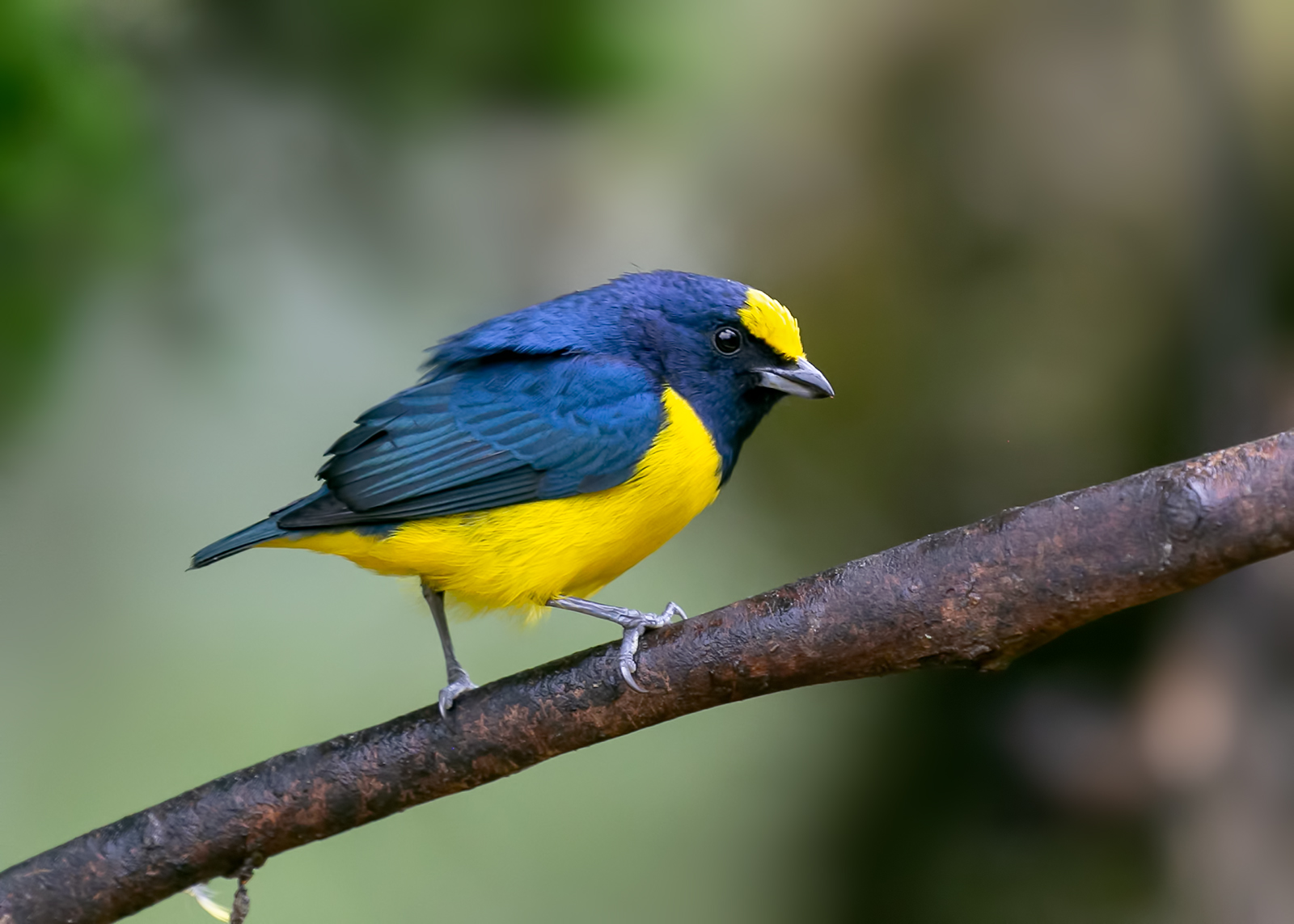
The Spot-crowned Euphonia is a euphonia with a small range in the humid forest of south-western Costa Rica and western Panama. The male owes its name to the dark spots in its yellow forecrown, which can be seen only at close range. The female is identified by her rufous forehead and ochre-yellow belly.
Voice
The song consists of clear, whistled notes, often in short series of two or three, interspersed with chirps. The call is a rapidly repeated, somewhat nasal chee-chee. Descriptions of the voice of this species vary.
Recording: Johan Chaves — CC BY-NC-SA 4.0 · converted to mono · xeno-canto
Identification
9–10 cm. Small and stocky, with a short, thick bill. Male: upperparts, sides of head and throat dark steel-blue; forecrown yellow with fine dark spots, the yellow not reaching behind the eye. Breast and belly yellow to orange-yellow, undertail yellow; outer tail feathers with white on the underside. Female: upperparts olive-green with a rufous forehead; underparts olive-yellow, tinged warm ochre to rufous-brown on the belly and undertail.
Confusion species
The male Thick-billed Euphonia Euphonia laniirostris has a yellow throat. Yellow-crowned Euphonia Euphonia luteicapilla has a dark throat, but a plain yellow crown extending to the hindcrown. The male Orange-bellied Euphonia Euphonia xanthogaster has a plain yellow forecrown without spots and a deeper orange belly. Females with a rufous forehead also occur in Orange-bellied, Fulvous-vented Euphonia Euphonia fulvicrissa and Tawny-capped Euphonia Euphonia anneae; the female Spot-crowned stands out mainly by the ochre-yellow tone of the underparts. Range helps here.
Habitat
Humid lowland and foothill forest, mainly in the canopy and along forest edges, also in tall secondary forest and shade plantations bordering forest; from sea level to about 1200 m. It lives in pairs or small groups, often in mixed flocks with tanagers. It feeds mainly on mistletoe berries and small fruit.
Where the bird is most at home, classified by the vegetation units of Mexico and Central America.




Range and movements
Endemic to the guide area. Pacific side of southern Costa Rica, including the Osa Peninsula and the Golfo Dulce area, into western Panama (Chiriquí).
- Resident
- dark = core range, pale = thinly spread
How and when to look
The female with rufous forehead and ochre-yellow belly is often the quickest to identify; in mixed flocks in south-western Costa Rica it pays to check every euphonia carefully.
Conservation status
Not threatened (LC). Small range, but locally fairly common, including in protected forest on the Osa Peninsula. Forest loss in the lowlands of south-western Costa Rica and western Panama is the main threat.
Scientific name
Euphonia imitans | (Hellmayr, 1936)
Hellmayr described the species in 1936 as Tanagra imitans; because it was later moved to another genus, the author and year stand in brackets. The genus Euphonia was introduced in 1806 by Desmarest, A-G. Euphonia is Greek, from eu 'good' and phōnē 'sound': 'sweet-voiced', after the pleasing calls. imitans is Latin for 'imitating, copying', after its close resemblance to related euphonias. The specimen the first description was based on came from El Pozo, Río Térraba, Costa Rica.