All species › Passerines › Tanagers and allies › Speckled Tanager
Position in the tree Birds Aves › Birds with a flexible palate Neognathae › All other modern birds Neoaves › Landbirds Telluraves › Falcons, parrots and passerines Australaves › Falcons and passerines Eufalconimorphae › Parrots and passerines Psittacopasserae
Speckled Tanager | Ixothraupis guttata
Spikkeltangare | Tangara moteada
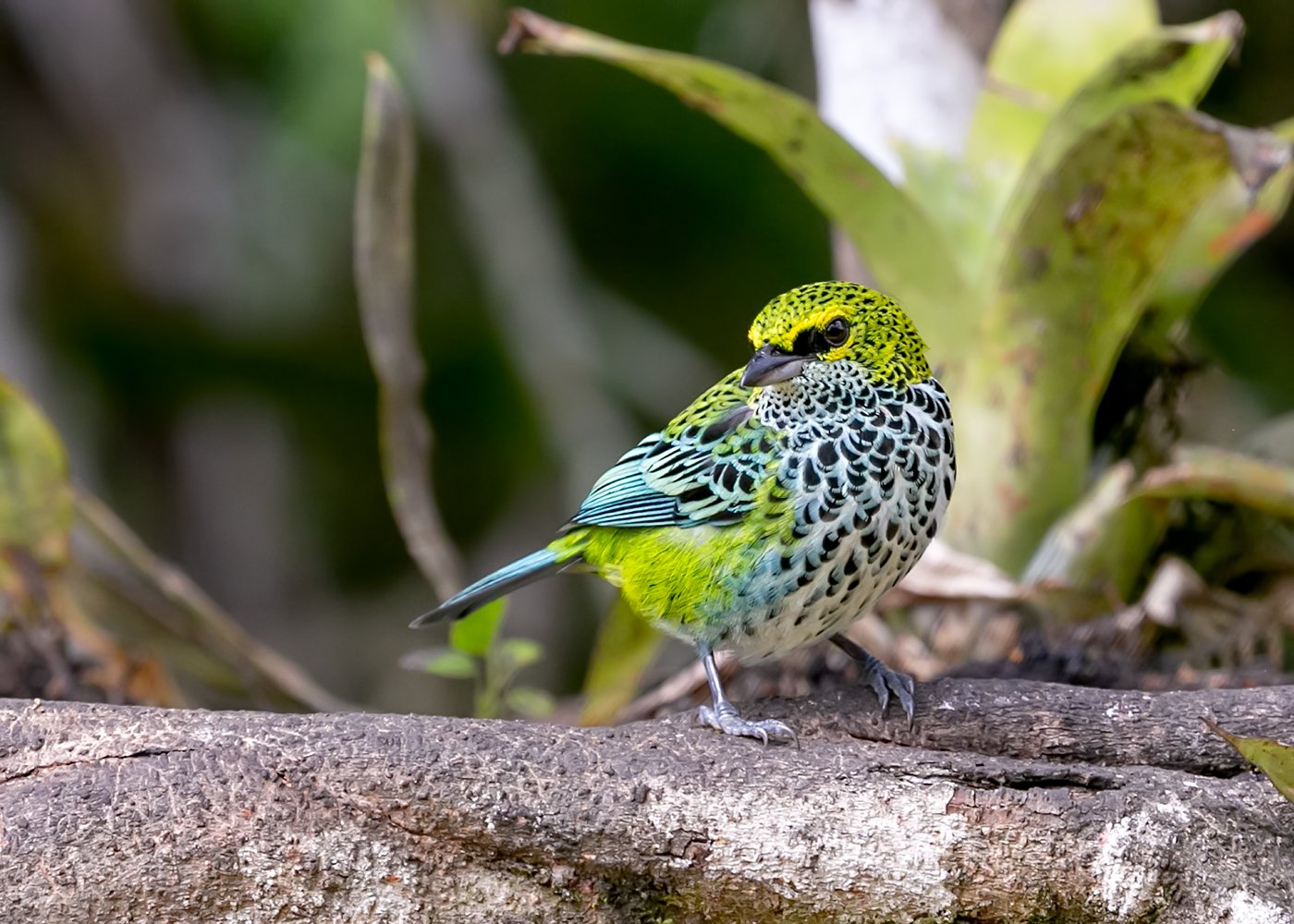
The Speckled Tanager is a small green-and-white tanager densely marked with black spots from crown to belly. It lives in pairs or small groups in the canopy of humid hill forest, often in mixed flocks with other tanagers. In the guide area it occurs in Costa Rica and Panama.
Voice
Rather quiet; calls are thin, high tseet notes and a short, dry chatter, mainly when a group is moving.
Recording: Mauricio Cuéllar-Ramírez — CC BY-NC-SA 4.0 · converted to mono · xeno-canto
Identification
13–14 cm. A small, compact tanager with a short, dark bill. Upperparts bright green, densely spotted black on the crown, mantle and back. Underparts white, spotted black on the throat, breast and flanks; the flanks greenish. Lores black with yellowish in front and around the eye, giving the face a yellow tinge. Wings and tail black with blue-green feather edges. Male and female are alike; young birds are duller and less sharply spotted.
Confusion species
No other small tanager in the guide area has black-spotted underparts. Emerald Tanager Tangara florida is bright yellowish green with a black ear patch and unspotted underparts. Spangle-cheeked Tanager Tangara dowii (mountains of Costa Rica and western Panama) is dark, with pale spots on the head and breast and a cinnamon belly. Grey-and-gold Tanager Poecilostreptus palmeri (eastern Panama) is larger and grey and gold, with only a band of black spots across the breast.
Habitat
Canopy and edges of humid evergreen forest in hills and foothills, mostly between about 400 and 1500 m, locally lower or higher; also tall secondary forest and clearings with fruiting trees. It joins mixed tanager flocks. It eats mainly small fruits and searches for insects on thin branches and under leaves.
Where the bird is most at home, classified by the vegetation units of Mexico and Central America.




Range and movements
Caribbean slope of Costa Rica, locally also the Pacific side in the south, and in Panama the hills on both slopes east to Darién. Outside the guide area in the Andes and other hill and mountain areas of Colombia and Venezuela, in the Guianas, locally in northern Brazil and Peru, and on Trinidad. Resident.
- Resident
- dark = core range, pale = thinly spread
How and when to look
Regularly seen in mixed flocks in the Caribbean foothills of Costa Rica, such as at Braulio Carrillo and Rara Avis, and in Panama on Cerro Azul.
Conservation status
Not threatened (LC). Fairly common in suitable forest; sensitive to deforestation in the foothill belt.
Scientific name
Ixothraupis guttata | (Cabanis, 1851)
Cabanis described the species in 1851 as C[allispiza] guttata; because it was later moved to another genus, the author and year stand in brackets. The genus Ixothraupis was introduced in 1851 by Bonaparte. Ixothraupis combines Greek ixos 'mistletoe' with thraupis, an unidentified small bird. guttata is Latin for 'spotted', after the black spots on the head and breast. The specimen the first description was based on came from Cerro Roraima, Bolívar, Venezuela.