All species › Passerines › Tanagers and allies › Palm Tanager
Position in the tree Birds Aves › Birds with a flexible palate Neognathae › All other modern birds Neoaves › Landbirds Telluraves › Falcons, parrots and passerines Australaves › Falcons and passerines Eufalconimorphae › Parrots and passerines Psittacopasserae
Palm Tanager | Thraupis palmarum
Palmtangare | Tangara palmera
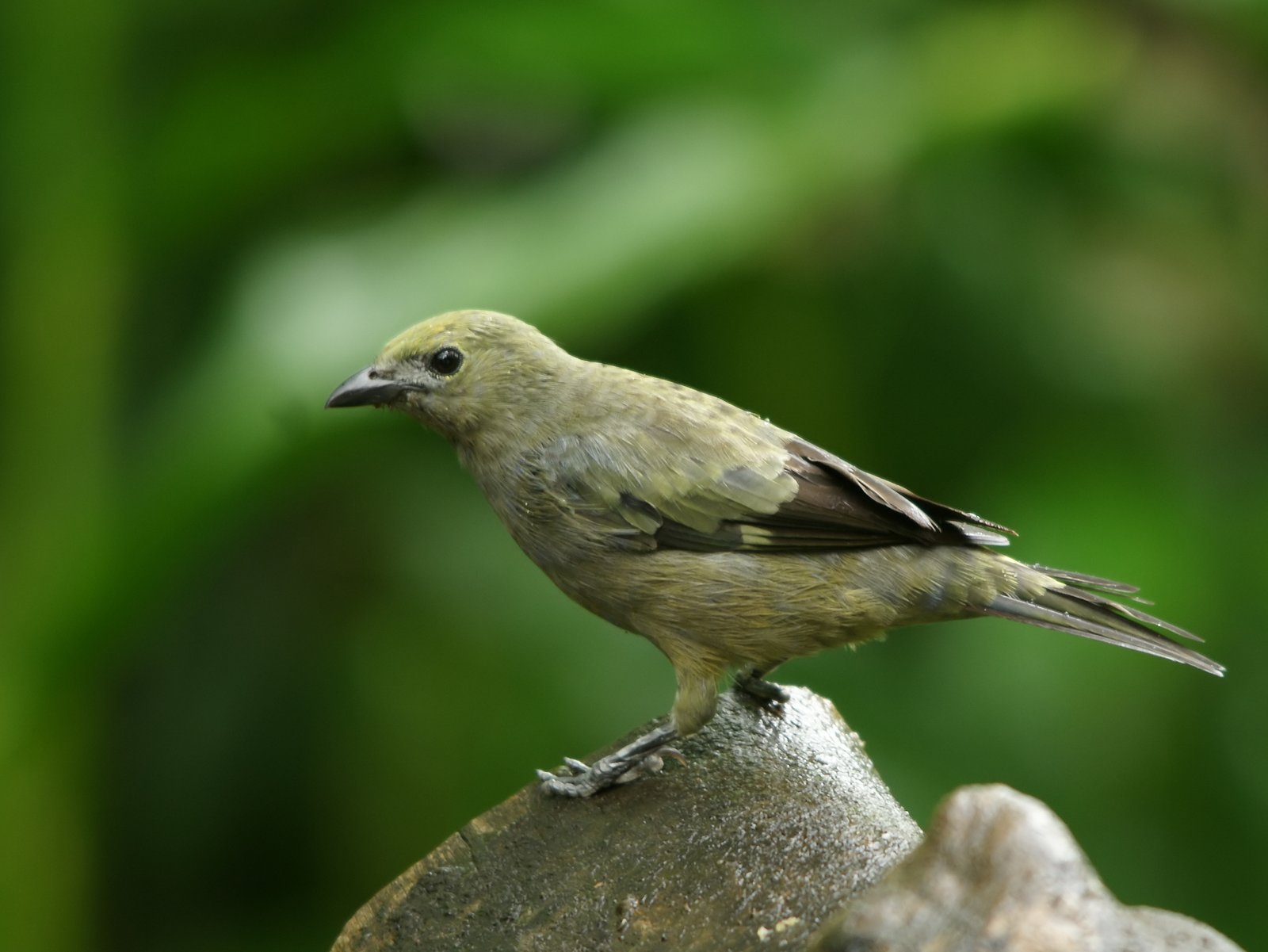
The Palm Tanager is a slender, greyish-olive tanager closely tied to palms. It lives in pairs or small groups in forest edges, plantations, gardens and villages, and does much of its feeding in palm crowns. In the guide area it occurs from south-eastern Nicaragua to Panama.
Voice
Calls are sharp, thin tsee and chip notes. The song is a rapid, squeaky series of twittering notes, very like that of Blue-grey Tanager.
Recording: Juan Freile — CC BY-NC-SA 4.0 · converted to mono · xeno-canto
Identification
17–19 cm. A slender tanager with a fairly long tail and a short, dark bill. Entirely greyish olive with a silky, sometimes purplish sheen; forehead and forecrown yellowish olive. Wing two-toned: the front half, with the coverts and the bases of the flight feathers, pale yellowish olive, the rear half black, so that the folded wing has a black rear part. Tail dark. Male and female are alike.
Confusion species
Blue-grey Tanager Thraupis episcopus has the same shape but is blue-grey without black in the wing; the two species often feed together. Yellow-winged Tanager Thraupis abbas (southern Mexico to Nicaragua) has a lilac-blue head and a yellow patch in the black wing. Plain-colored Tanager Tangara inornata is smaller and darker grey, with a blackish mask.
Habitat
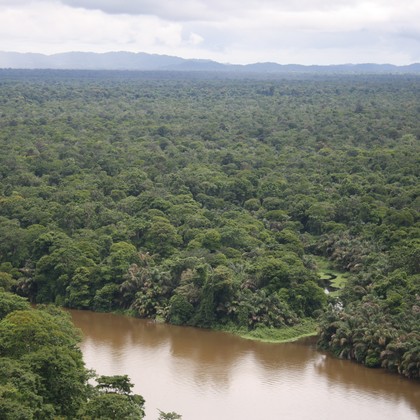
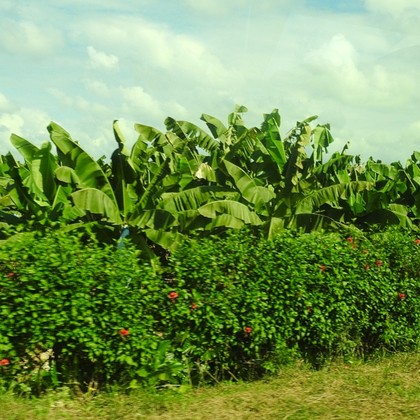
Open and semi-open country with palms: forest edges, secondary forest, palm swamp, pasture with scattered trees, plantations, gardens and villages, mainly in lowlands up to about 1500 m. It often hangs upside down beneath palm fronds to search for insects, and also eats fruit and nectar. The nest is often placed at the base of a palm frond.
Where the bird is most at home, classified by the vegetation units of Mexico and Central America.




Range and movements
Caribbean lowlands of south-eastern Nicaragua and of Costa Rica, where it is also spreading to the Pacific side, and throughout Panama. Outside the guide area across much of tropical South America, south to Bolivia, Paraguay and south-eastern Brazil, and on Trinidad. Resident.
- Resident
- dark = core range, pale = thinly spread
How and when to look
Common in coconut palms along the coast and in villages in Costa Rica and Panama; groups are mostly found in palm crowns.
Conservation status
Not threatened (LC). Common; benefits from deforestation and from the planting of palms.
Scientific name
Thraupis palmarum | (Wied-Neuwied, 1821)
Wied-Neuwied described the species in 1821 as Tanagra palmarum; because it was later moved to another genus, the author and year stand in brackets. The genus Thraupis was introduced in 1826 by Boie. Thraupis is the Ancient Greek word for an unidentified small bird mentioned by Aristotle. palmarum is Latin for 'of the palms', after the bird's fondness for palm trees. The specimen the first description was based on came from Canavieiras, Bahia, Brazil.