All species › Waders, gulls and terns › Plovers and lapwings › Southern Lapwing
Position in the tree Birds Aves › Birds with a flexible palate Neognathae › All other modern birds Neoaves › Birds of the elements Elementaves › Cranes and waders Gruimorphae
Southern Lapwing | Vanellus chilensis
Chileense kievit | Avefría tero
The Southern Lapwing is a large, noisy lapwing of short grassland. Over recent decades it has spread from South America through Panama northwards across Central America and has now reached southern Mexico. On pastures, sports fields and airfields in Panama and Costa Rica it is now a familiar sight. The birds in the guide area belong to the subspecies Vanellus chilensis cayennensis.
Voice
Very noisy. A harsh, strident, repeated kek-kek-kek, persistent when disturbed and around the nest, and often given in flight. Pairs and groups also call at night.
Recording: JAYRSON ARAUJO DE OLIVEIRA — CC BY-NC-SA 4.0 · converted to mono · xeno-canto
Identification
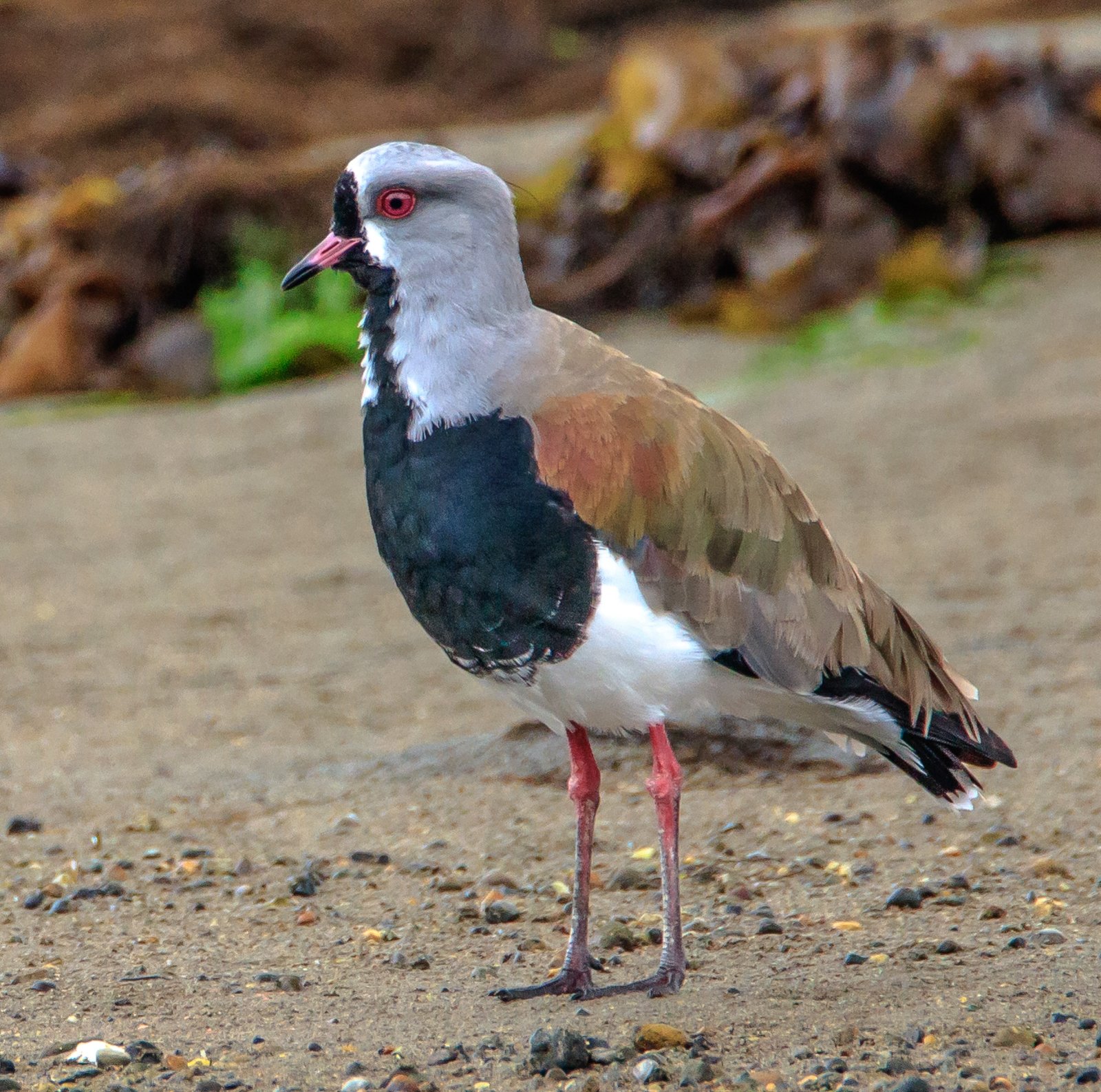
32–38 cm. A bulky lapwing with long pink legs and a thin, pointed black crest on the hindcrown. Head and neck are grey, with a black forehead and a black throat that continues into a broad black breast patch; the belly is white. The back is grey-brown, with a bronze-green glossed patch on the shoulders. The eye and the base of the bill are red, the bill tip black. The bend of the wing carries a sharp red spur, sometimes visible on a standing bird. In flight the broad, rounded wings stand out: black flight feathers, a broad white band across the wing coverts, a white rump and a black tail band. Juveniles are duller, with a shorter crest and pale feather fringes.
Confusion species
Hardly confusable in the guide area. Killdeer Charadrius vociferus is much smaller and brown, with two narrow black breast bands and an orange rump. Double-striped Thick-knee Hesperoburhinus bistriatus lives in the same open country, but is streaked brown, with large yellow eyes, a white supercilium and no crest.
Habitat
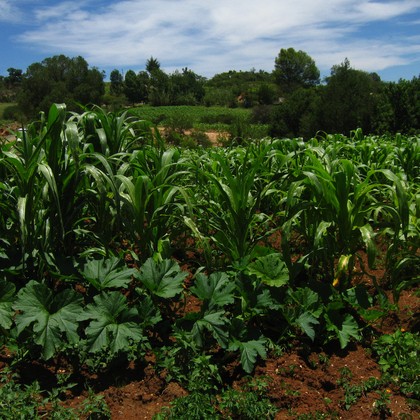
Short grassland in the lowlands and at middle elevations: pastures, savanna, sports fields, golf courses, parks, the grass strips of airfields and roadsides; also the drier edges of marshes and rice fields. Forages on foot for insects, worms and other invertebrates. Nests on the ground in a bare scrape and defends nest and young fiercely against people, dogs and raptors.
Where the bird is most at home, classified by the vegetation units of Mexico and Central America.




Range and movements
Common in Panama and Costa Rica, where the species became established from Colombia. Expansion followed into Nicaragua, Honduras, El Salvador, Guatemala and Belize. In Mexico it has been seen regularly since the mid-2010s, mainly in Chiapas, with scattered records in Oaxaca, Campeche and Quintana Roo. Outside the guide area across almost all of South America to Tierra del Fuego.
- Resident
- dark = core range, pale = thinly spread
How and when to look
Regularly seen on the grass of airfields, sports fields and grazed plains in Panama and Costa Rica, often in pairs or small groups; the birds are usually heard first. Breeding pairs attack intruders with loud calls; keeping a distance prevents eggs or young being left unguarded.
Conservation status
Not threatened. The species benefits from deforestation and the creation of pasture and is still extending its range northwards through Central America.
Scientific name
Vanellus chilensis | (Molina, 1782)
Molina described the species in 1782 as Parra Chilensis; because it was later moved to another genus, the author and year stand in brackets. The genus Vanellus was introduced in 1760 by Brisson. Vanellus is Latin for 'little fan', the diminutive of vannus 'winnowing fan'. chilensis means 'of Chile', the country from which the species was described. The specimen the first description was based on came from Chile.