All species › Passerines › Tyrant flycatchers and allies › Southern Bentbill
Position in the tree Birds Aves › Birds with a flexible palate Neognathae › All other modern birds Neoaves › Landbirds Telluraves › Falcons, parrots and passerines Australaves › Falcons and passerines Eufalconimorphae › Parrots and passerines Psittacopasserae
Southern Bentbill | Oncostoma olivaceum
Colombiaanse krombektiran | Mosquerito piquicurvo sureño
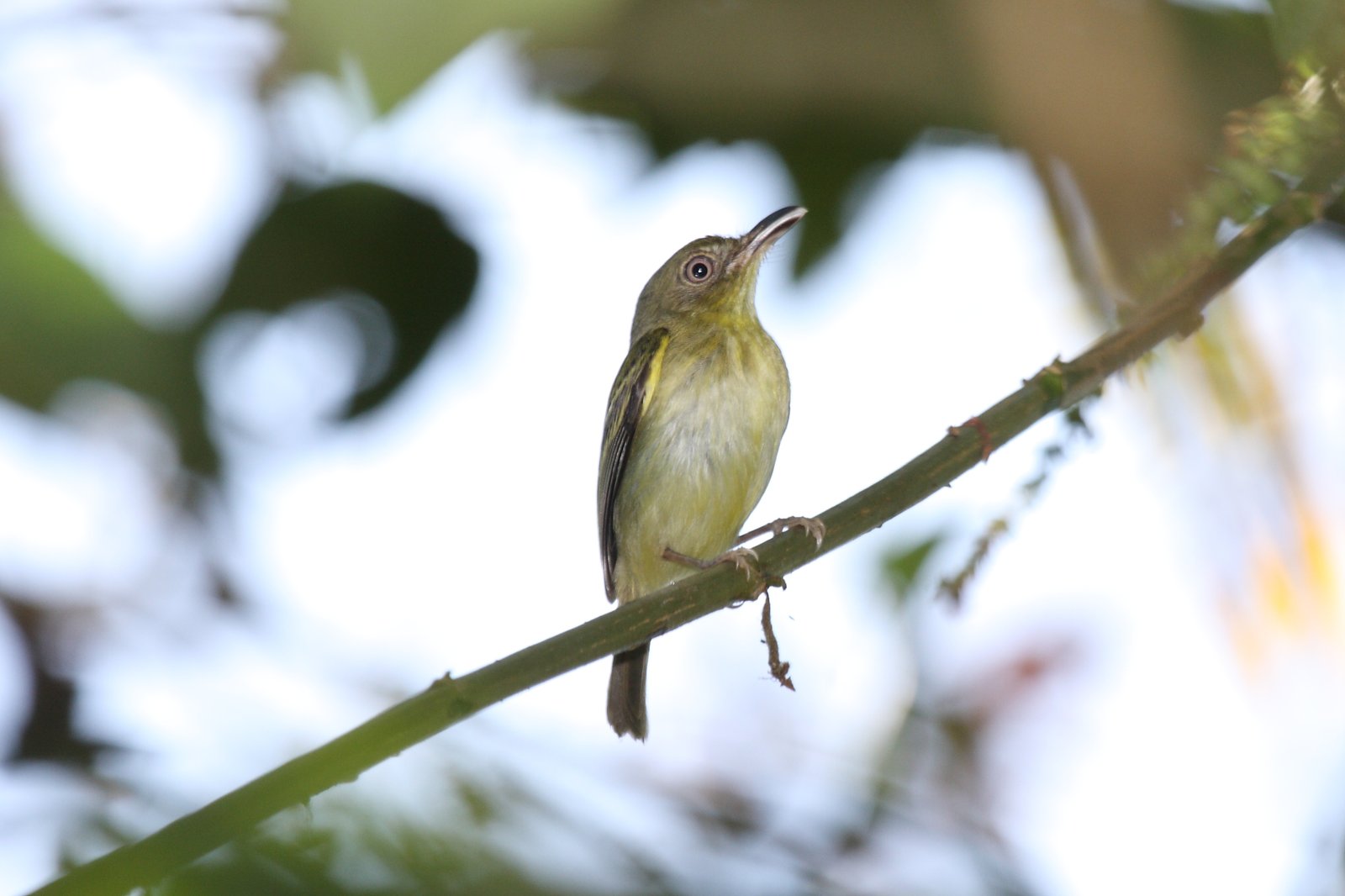
The Southern Bentbill is a small, stocky tyrant flycatcher of the undergrowth of humid forest, olive-green above and yellowish below, with a thick bill that is distinctly bent downwards. It usually sits quietly in dense vegetation and is noticed mainly by its low, frog-like trill. In the guide area it lives only in central and eastern Panama.
Voice
A low, dry, rather frog-like trill, grrrrrr, repeated at intervals and often the first sign of the bird.
Recording: Jerome Fischer — CC BY-NC-SA 4.0 · converted to mono · xeno-canto
Identification
9 cm, with a short tail and a large head. Bill short, broad at the base and with a characteristic downward bend. Upperparts olive-green; wings darker with two narrow yellowish wing-bars and yellow edges to the flight feathers. Throat and breast yellowish-olive, belly pale yellow. Iris pale. Male and female are alike.
Confusion species
Northern Bentbill Oncostoma cinereigulare, which ranges into central Panama, has a grey throat and a greyer head that contrast with the yellow belly. Scale-crested Pygmy Tyrant Lophotriccus pileatus has a straight bill and a crest with rufous feather edges. Common Tody-Flycatcher Todirostrum cinereum has a long, flat, straight bill and a blackish-grey head.
Habitat
Lower levels of humid lowland and foothill forest, especially dense growth at forest edges, in secondary forest and in clearings. It takes insects with short sallies to the undersides of leaves.
Where the bird is most at home, classified by the vegetation units of Mexico and Central America.




Range and movements
In the guide area in central and eastern Panama, from the Canal area east to Darién. Outside the guide area in northern and north-western Colombia.
- Resident
- dark = core range, pale = thinly spread
How and when to look
Regularly heard along Pipeline Road (Camino del Oleoducto) and elsewhere in Soberanía National Park. The low trill from the undergrowth gives it away; finding it in the vegetation then takes patience.
Conservation status
Not threatened. Fairly common in suitable forest within its small range.
Scientific name
Oncostoma olivaceum | (Lawrence, 1862)
Lawrence described the species in 1862 as Todirostrum olivaceum; because it was later moved to another genus, the author and year stand in brackets. The genus Oncostoma was introduced in 1862 by Sclater. Oncostoma is Greek, from onkos 'bulk' and stoma 'mouth', after the thick, downcurved bill. olivaceum is Latin for 'olive-coloured', after the olive-green upperparts. The specimen the first description was based on came from Lion Hill, former Canal Zone, Panama.