All species › Passerines › Tyrant flycatchers and allies › Northern Bentbill
Position in the tree Birds Aves › Birds with a flexible palate Neognathae › All other modern birds Neoaves › Landbirds Telluraves › Falcons, parrots and passerines Australaves › Falcons and passerines Eufalconimorphae › Parrots and passerines Psittacopasserae
Northern Bentbill | Oncostoma cinereigulare
Mexicaanse krombektiran | Mosquero pico curvo
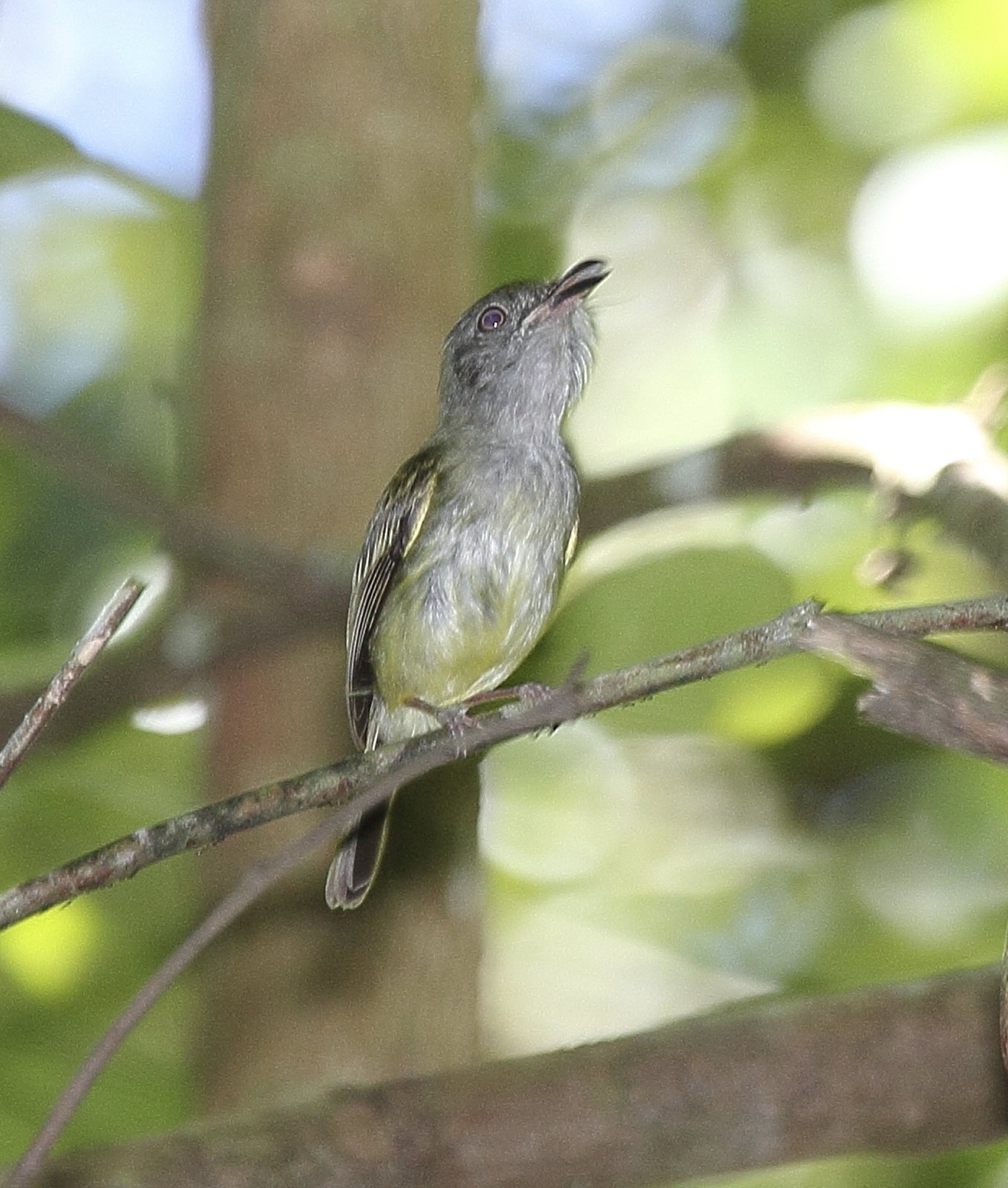
The Northern Bentbill is a small, olive tyrant flycatcher of the forest understorey, recognised by its thick, distinctly down-curved bill. It often sits motionless for long periods in dense growth and gives itself away with a low, growling trill. In the guide area it lives from south-eastern Mexico to western Panama.
Voice
A low, growling, frog-like trill, like a soft grrrrr, repeated at regular intervals.
Recording: Johan Chaves — CC BY-NC-SA 4.0 · shortened to the first 60 s, mono · xeno-canto
Identification
9–10 cm. Bill fairly thick, broad at the base and distinctly bent downwards, dark with a paler lower mandible. Iris pale, yellowish to whitish. Upperparts olive-green, head slightly greyer. Wings dark with two yellowish wing-bars. Throat and breast greyish-white with faint grey streaks, belly pale yellow. Sexes alike.
Confusion species
Southern Bentbill Oncostoma olivaceum of central and eastern Panama has the same bent bill, but an olive-yellow rather than grey throat and breast; where the two species approach each other, range is an important clue. Pale-eyed Pygmy Tyrant Atalotriccus pilaris has a straight bill. Tody-flycatchers (Todirostrum, Poecilotriccus) have a long, straight, flat bill.
Habitat
Understorey and lower levels of humid and semi-humid forest, mature secondary forest, dense forest edges and thickets, also in seasonal forest; mainly in the lowlands and foothills. It perches still for long periods and catches insects with short, quick sallies to the undersides of leaves.
Where the bird is most at home, classified by the vegetation units of Mexico and Central America.





Range and movements
From south-eastern Mexico (including southern Veracruz, Oaxaca, Tabasco, Chiapas and the Yucatán Peninsula) through Belize, Guatemala, Honduras, Nicaragua and Costa Rica to western Panama. Found only in the guide area.
- Resident
- dark = core range, pale = thinly spread
How and when to look
Listen in the forest understorey for the low, growling trill; the bird then often sits motionless on a thin twig and with patience can be seen well. Common in forest reserves in the Caribbean lowlands of Costa Rica and on the Yucatán Peninsula.
Conservation status
Not threatened. Widespread and fairly common in most forest types within its range; tolerates secondary forest.
Scientific name
Oncostoma cinereigulare | (Sclater, 1857)
Sclater described the species in 1857 as Todirostrum cinereigulare; because it was later moved to another genus, the author and year stand in brackets. The genus Oncostoma was introduced in 1862 by Sclater. Oncostoma is Greek, from onkos 'bulk' and stoma 'mouth', after the thick, downcurved bill. cinereigulare is Latin, from cinereus 'ash-grey' and gula 'throat', after the grey throat. The specimen the first description was based on came from Córdoba, Veracruz, Mexico.