All species › Passerines › New World sparrows › Sooty-faced Finch
Position in the tree Birds Aves › Birds with a flexible palate Neognathae › All other modern birds Neoaves › Landbirds Telluraves › Falcons, parrots and passerines Australaves › Falcons and passerines Eufalconimorphae › Parrots and passerines Psittacopasserae
Sooty-faced Finch | Arremon crassirostris
Dikbekstruikgors | Cerquero carisucio
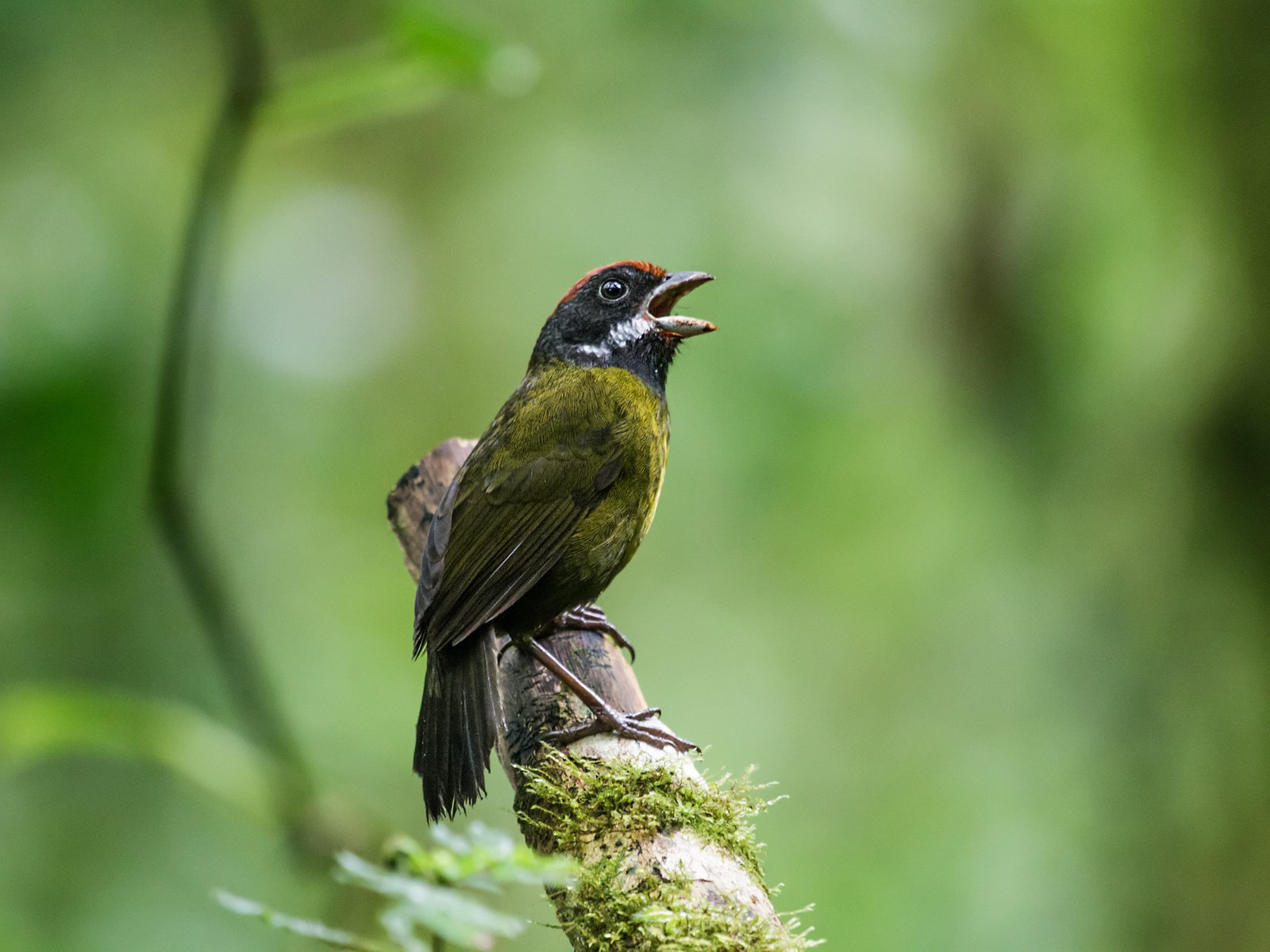
The Sooty-faced Finch is a sturdy brushfinch of the understorey of humid montane forest, with a chestnut crown, a sooty face with a white moustachial stripe and a yellow belly. It lives hidden in dense undergrowth, often along streams. In the guide area it occurs only in Costa Rica and Panama.
Voice
The song is a series of very high, thin whistles, sometimes with a short trill, which is often overlooked. Call a sharp, high tseet.
Recording: Marcelo Araya-Salas — CC BY-NC-SA 3.0 · shortened to the first 60 s, mono · xeno-canto
Identification
16–17 cm. Crown and nape chestnut; forehead, lores and cheeks sooty black, with a narrow white moustachial stripe. Throat white. Upperparts olive-green. Breast and flanks grey to olive-grey, centre of the belly yellow. Bill thick and black, legs flesh-coloured. The sexes are alike; young birds are duller and browner on the head.
Confusion species
Chestnut-capped Brushfinch Arremon brunneinucha has a black face, a white throat bordered by a black breast band and a white belly without yellow. Yellow-thighed Brushfinch Atlapetes tibialis is uniformly dark sooty grey with yellow thighs and lacks the chestnut crown. Orange-billed Sparrow Arremon aurantiirostris of lowland forest has an orange bill, a black head with a grey crown stripe and a black breast band.
Habitat
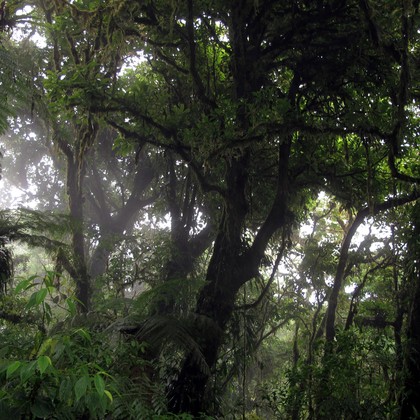
Dense undergrowth of humid foothill and montane forest, roughly from 600 to 1800 m, often in ravines and along streams; also in mature secondary forest and dense forest edges. It forages on or just above the ground in the leaf litter for insects, seeds and fruit, usually alone or in pairs.
Where the bird is most at home, classified by the vegetation units of Mexico and Central America.


Range and movements
Local in the mountains of Costa Rica, mainly on the Caribbean slope, and in western and central Panama to the east of the country. Outside the guide area only in extreme north-western Colombia.
- Resident
- dark = core range, pale = thinly spread
How and when to look
Most often seen by quietly scanning the undergrowth along streams in mid-elevation forest, for example at Tapantí in Costa Rica; usually the high calls are noticed first.
Conservation status
Not threatened (LC). Local and inconspicuous; sensitive to the loss of forest and undergrowth at middle elevations.
Scientific name
Arremon crassirostris | (Cassin, 1865)
Cassin described the species in 1865 as Buarremon crassirostris; because it was later moved to another genus, the author and year stand in brackets. The genus Arremon was introduced in 1816 by Vieillot. Arremon is Greek, from arrhēmōn 'silent, speechless', after Buffon's 'Oiseau silencieux', a bird said to be rarely heard. crassirostris is Latin, from crassus 'thick' and -rostris '-billed', after the heavy bill. The specimen the first description was based on came from Barranca, Costa Rica.