All species › Birds of prey › Kites, Old World vultures, eagles and hawks › Slender-billed Kite
Position in the tree Birds Aves › Birds with a flexible palate Neognathae › All other modern birds Neoaves › Landbirds Telluraves › Raptors, owls, kingfishers and woodpeckers Afroaves › Hawks and owls Hieraves
Slender-billed Kite | Helicolestes hamatus
Slanksnavelwouw | Caracolero plomizo
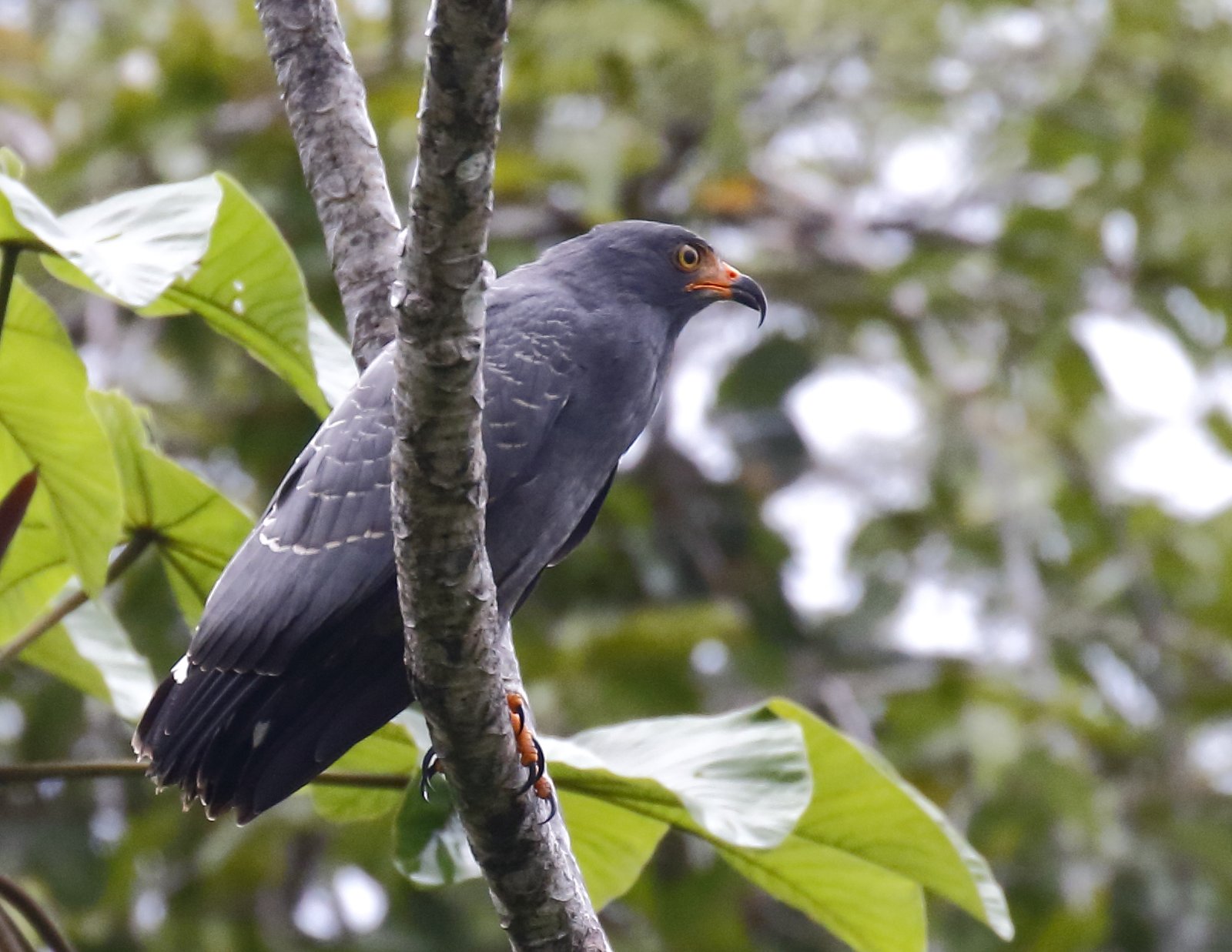
The Slender-billed Kite is a small, compact, slate-grey kite with broad, rounded wings, a short tail and a thin, strongly hooked bill. It lives in swamp forest and flooded forest along rivers, where it feeds almost exclusively on apple snails, which it extracts from their shells with its hooked bill. In the guide area it is a resident of eastern Panama, mainly Darién.
Voice
A plaintive, nasal, drawn-out wheeeaa, reminiscent of a mewing cat, often repeated from a perch.
Recording: Nando Quiroz — CC BY-NC-SA 4.0 · converted to mono · xeno-canto
Identification
36–41 cm, compact, with broad, rounded wings and a short, square tail. Adults are uniformly dark slate-grey, with a pale eye, orange lores and cere and orange legs. The bill is thin, black and strongly hooked. In adults the tail is plain dark. Young birds are slightly browner, have fine pale fringes to the feathers and two narrow white bands in the tail. Male and female are alike.
Confusion species
The Snail Kite Rostrhamus sociabilis also feeds on apple snails, but has a longer tail with a white base and white undertail coverts; the female and young birds are brown and streaked. The Plumbeous Hawk Cryptoleucopteryx plumbea is the same size and also slate-grey, but has a white band in the tail, white underwing coverts and a less hooked bill. The Plumbeous Kite Ictinia plumbea has long, pointed wings with rufous primaries.
Habitat
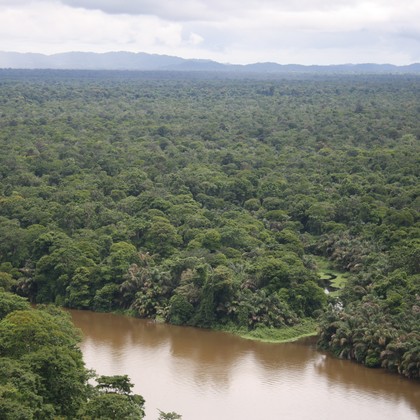
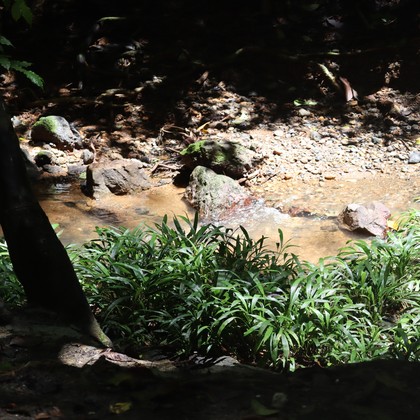
Swamp forest, flooded forest and gallery forest along slow rivers, marshes and lagoons in the lowlands. It often sits motionless for long periods on a bare branch in the shade above water and flies low between the trees to take snails. The nest is a small stick nest high in a tree.
Where the bird is most at home, classified by the vegetation units of Mexico and Central America.


Range and movements
Resident in eastern Panama, mainly in the lowlands of Darién along the Tuira, Chucunaque and Balsas rivers and in the Emberá area; elsewhere rare in the east of Panamá province. Otherwise absent from the guide area. Outside the guide area in northern and western Colombia, Venezuela, the Guianas and Amazonia south to Bolivia.
- Resident
- Passage (Mar–Apr, Oct–Nov)
- dark = core range, pale = thinly spread
How and when to look
In Darién it sits along rivers and in swamp forest, often conspicuously still on a projecting branch above the water; a boat trip on the rivers around El Real offers the best chance.
Conservation status
Not threatened. In the guide area it is confined to a small part of eastern Panama, where it depends on undisturbed swamp forest.
Scientific name
Helicolestes hamatus | (Temminck, 1821)
Temminck described the species in 1821 as Falco hamatus; because it was later moved to another genus, the author and year stand in brackets. The genus Helicolestes was introduced in 1918 by Bangs & Penard. Helicolestes is Greek, from helix 'spiral, snail shell' and lēistēs 'robber': 'snail-robber', as it feeds almost entirely on freshwater snails. hamatus is Latin for 'hooked', from hamus 'hook', after the slender, strongly hooked bill used to extract snails. The specimen the first description was based on came from Brazil.