All species › Passerines › New World warblers › Slate-throated Whitestart
Position in the tree Birds Aves › Birds with a flexible palate Neognathae › All other modern birds Neoaves › Landbirds Telluraves › Falcons, parrots and passerines Australaves › Falcons and passerines Eufalconimorphae › Parrots and passerines Psittacopasserae
Slate-throated Whitestart | Myioborus miniatus
Meniezanger | Chipe de montaña
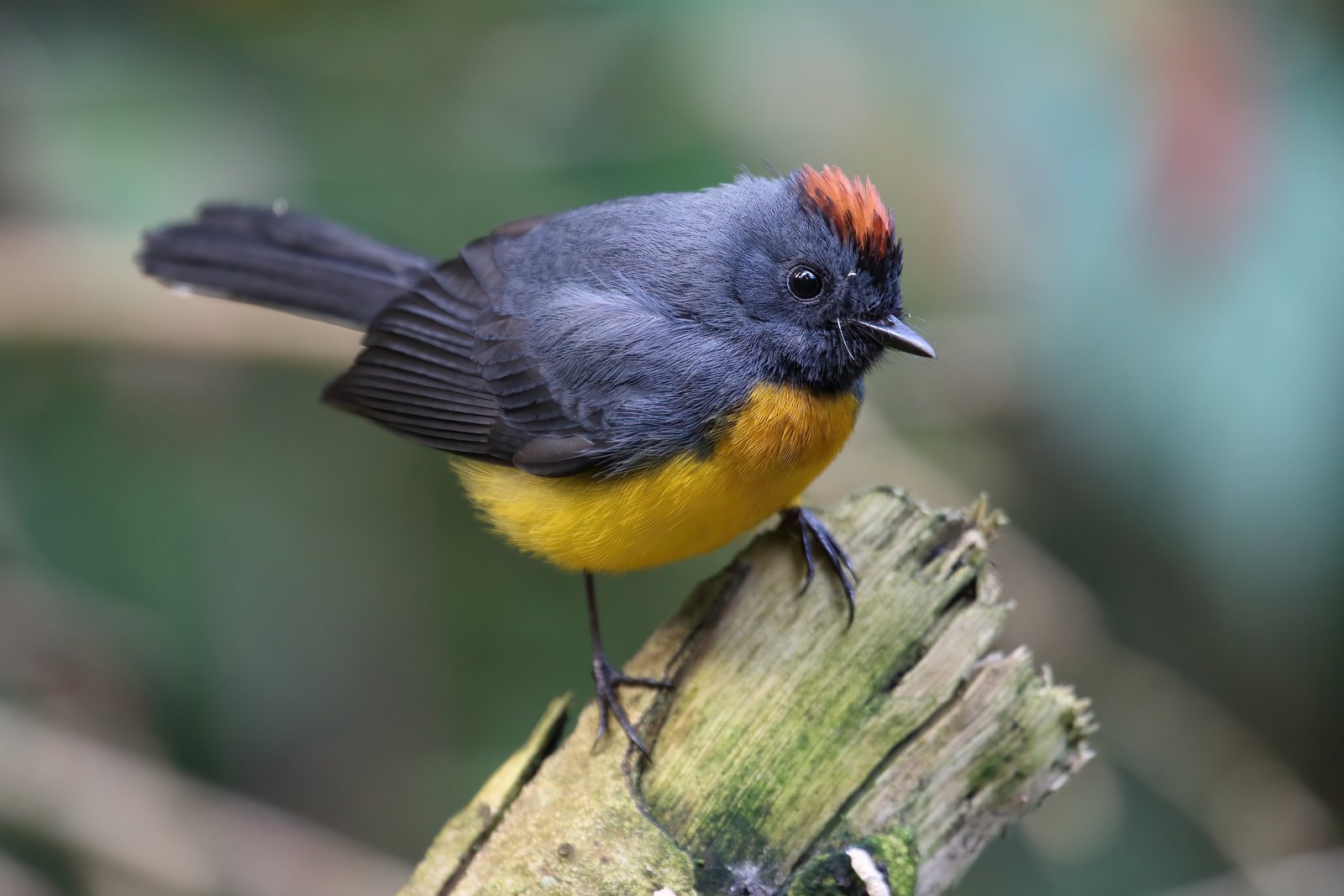
The Slate-throated Whitestart is a slate-grey warbler with a red to orange-red belly and much white in the tail. It is one of the commonest birds of humid mountain forest from Mexico to Panama and also lives in the Andes. While foraging it constantly fans its tail and droops its wings.
Voice
The song is a series of short, sweet chee notes that often speeds up or changes pitch. The call is a sharp, thin tsip.
Recording: Juan Freile — CC BY-NC-SA 4.0 · converted to mono · xeno-canto
Identification
13–14 cm. Head, throat and upperparts dark slate-grey, the face and throat slightly darker. A chestnut patch in the centre of the crown, often barely visible. Breast and belly red in the north of the guide area, more orange-red in Costa Rica and Panama; undertail coverts white. Tail black with broad white outer feathers. The sexes are alike. Young birds are duller, with a browner belly.
Confusion species
Painted Whitestart Myioborus pictus is black rather than slate-grey, with a large white wing patch and a white crescent below the eye. Collared Whitestart Myioborus torquatus (Costa Rica and western Panama) has a yellow face and yellow underparts with a grey breast band. Pink-headed Warbler Cardellina versicolor is entirely red with a silvery-pink head.
Habitat
Humid montane forest, cloud forest, pine-oak forest and foothill forest, with forest edges, clearings and mature secondary forest; mostly between 1000 and 2500 m, locally from 600 m to above 3000 m. It searches for insects in the lower and middle levels, flushing them by fanning its tail and wings, and is often a core member of mixed flocks. The nest is built on the ground, against a slope or bank.
Where the bird is most at home, classified by the vegetation units of Mexico and Central America.





Range and movements
From north-western Mexico (from southern Sonora and Chihuahua) and north-eastern Mexico (from Nuevo León and Tamaulipas) through the mountains of Mexico and all of Central America to eastern Panama. Outside the guide area in the mountains of South America, from Venezuela and Guyana to Bolivia.
- Resident
- dark = core range, pale = thinly spread
How and when to look
In mountain forest one of the first species to appear in a mixed flock, for example around Monteverde in Costa Rica and in the highlands of Chiapas and Guatemala. The white in the fanned tail gives it away in the half-light of the forest.
Conservation status
Not threatened (LC). Widespread and common; also tolerates partly logged forest and forest edges.
Scientific name
Myioborus miniatus | (Swainson, 1827)
Swainson described the species in 1827 as Setophaga miniata; because it was later moved to another genus, the author and year stand in brackets. The genus Myioborus was introduced in 1865 by Baird. Myioborus is Greek, from muia 'fly' and -boros '-devouring': 'fly-eater'. miniatus is Latin for 'vermilion-coloured' (from minium 'red lead'), after the red belly. The specimen the first description was based on came from Morelia, Michoacán, Mexico.