All species › Birds of prey › Kites, Old World vultures, eagles and hawks › Short-tailed Hawk
Position in the tree Birds Aves › Birds with a flexible palate Neognathae › All other modern birds Neoaves › Landbirds Telluraves › Raptors, owls, kingfishers and woodpeckers Afroaves › Hawks and owls Hieraves
Short-tailed Hawk | Buteo brachyurus
Kortstaartbuizerd | Aguililla cola corta
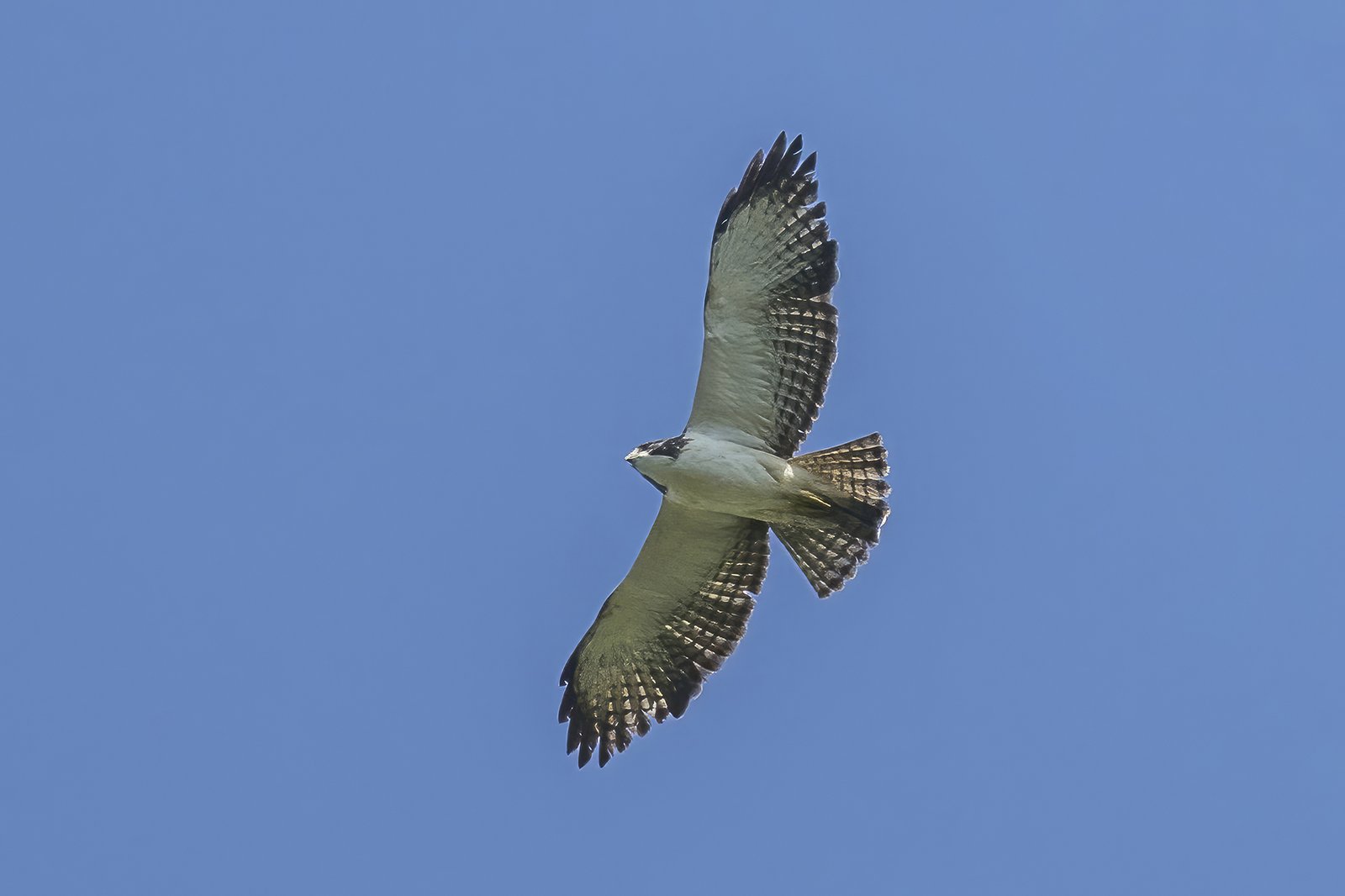
The Short-tailed Hawk is a small, compact buteo that hangs motionless in the wind high above forest edges and clearings before stooping with folded wings on a bird in the canopy. It occurs in a light and a dark morph. In the guide area it is a widespread resident of the lowlands and foothills from Mexico to Panama.
Voice
A high, thin and rather shrill kleeeeah or kee-ee-ee, mainly in flight over the breeding area; often silent outside the breeding season.
Recording: Rolf A. de By — CC BY-NC-SA 4.0 · shortened to the first 60 s, mono · xeno-canto
Identification
37–46 cm, with broad wings that taper somewhat towards the tip and a fairly short tail. The light morph is dark greyish-brown above and on the head, where the dark extends like a hood below the eye, with a white throat and white underparts; the underwing is white on the coverts and pale grey on the flight feathers, with a dark trailing edge. The dark morph is entirely blackish-brown, with grey, finely barred flight feathers and a paler patch at the base of the primaries. The tail is grey with narrow dark bands and a broader subterminal band. Juveniles have pale spots and streaks on the head and underparts. Male and female are alike; the female is larger.
Confusion species
The Broad-winged Hawk Buteo platypterus, present in the same areas in winter, has rufous-barred or brown-streaked underparts, no dark hood and a tail with broad white bands. The light morph of Swainson's Hawk Buteo swainsoni is larger, with a dark breast and dark flight feathers. The dark morph resembles the Zone-tailed Hawk Buteo albonotatus, which is larger, longer-winged and soars like a Turkey Vulture with its wings in a V. The White Hawk Pseudastur albicollis is white with black wingtips and a black tail band, and entirely white below.
Habitat
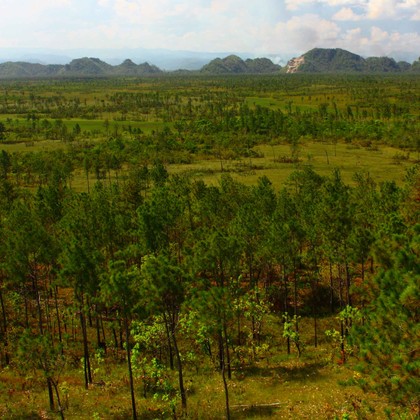
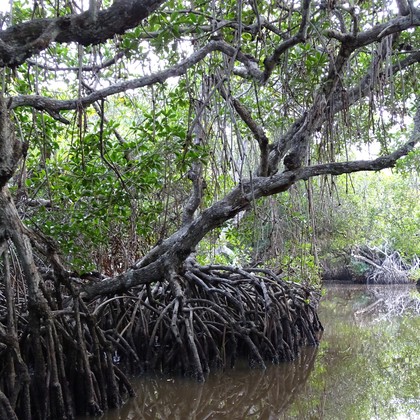
Forest edge, clearings and semi-open country with scattered woods in the lowlands and foothills, pine-oak woodland and pine savanna, seasonal forest on the Yucatán Peninsula and mangroves; mostly below 2000 metres, locally higher. Hunts mainly small birds, which it surprises from a great height. Nests high in a tree.
Where the bird is most at home, classified by the vegetation units of Mexico and Central America.





Range and movements
Resident from Mexico to Panama: in Mexico on the Pacific slope from Sonora and Sinaloa and on the Gulf slope from Tamaulipas southwards, and on the Yucatán Peninsula; then through Belize, Guatemala, El Salvador, Honduras, Nicaragua and Costa Rica to Panama. Scarce and local in northern Mexico. Outside the guide area in Florida, recently in small numbers in south-eastern Arizona, and in tropical South America to northern Argentina.
- Resident
- dark = core range, pale = thinly spread
How and when to look
In mid-morning, as thermals develop, it hangs high over forest edges and valleys, often higher than other raptors. In the Central Valley of Costa Rica, on the Yucatán Peninsula and in the Panama Canal area it is then regularly seen.
Conservation status
Not threatened. Tolerates semi-open, partly cleared country well and is fairly common in the guide area.
Scientific name
Buteo brachyurus | Vieillot, 1816
Vieillot described the species in 1816 and placed it straight away in the genus where it still stands. The genus Buteo was introduced in 1799 by De Lacépède. Buteo is the Latin word for a buzzard. brachyurus is Greek, from brakhus 'short' and oura 'tail', after the short tail. The specimen the first description was based on came from Cayenne, French Guiana (designated later).