All species › Passerines › Sharpbill › Sharpbill
Position in the tree Birds Aves › Birds with a flexible palate Neognathae › All other modern birds Neoaves › Landbirds Telluraves › Falcons, parrots and passerines Australaves › Falcons and passerines Eufalconimorphae › Parrots and passerines Psittacopasserae
Sharpbill | Oxyruncus cristatus
Scherpsnavel | Picoagudo
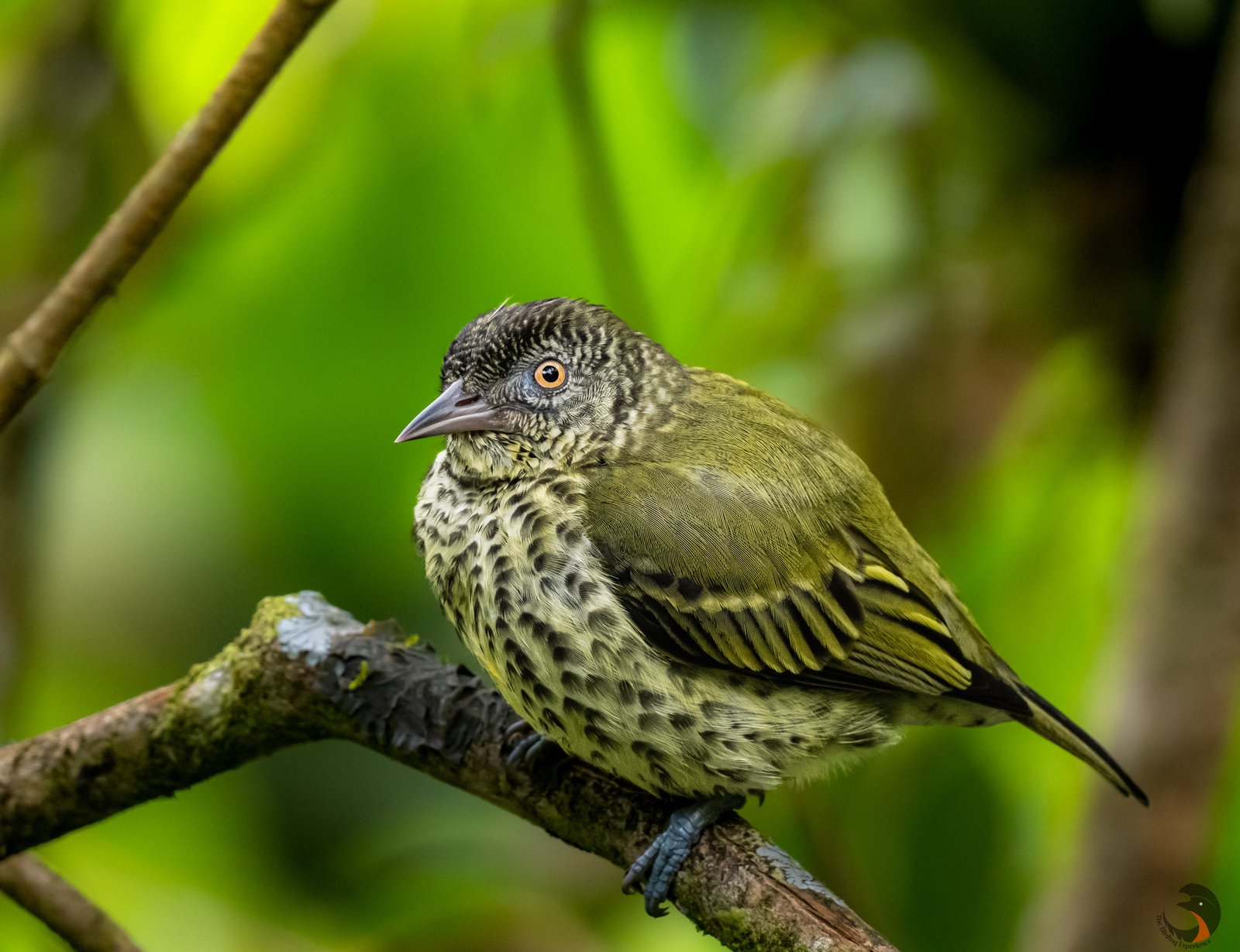
The Sharpbill is the only member of its family: a compact, olive-green canopy bird with black-spotted underparts and a short, sharply pointed bill. It is most often found by its long, descending buzzy trill from the treetops. In the guide area it lives very locally in Costa Rica and Panama.
Voice
A long buzzy trill of two to three seconds that slowly falls in pitch, often repeated at long intervals from the canopy.
Recording: Aran Rodrigues Cardoso — CC BY-NC-SA 4.0 · converted to mono · xeno-canto
Identification
17 cm. Upperparts olive-green. Head and throat pale yellow to whitish with fine black scaling and streaks; on the crown a mostly concealed red to orange crest bordered black. Underparts pale yellow to yellowish white with dense round black spots. Bill straight, short and sharply pointed, iris orange to red. Male and female are alike.
Confusion species
Speckled Tanager Ixothraupis guttata (foothills of Costa Rica and Panama) is also green with black spots, but has a yellow face with a black lore, a thicker bill and a green back with black spots. Spotted young birds of other species lack the combination of a scaly head and a pointed bill.
Habitat
Canopy and mid-storey of humid evergreen hill and foothill forest, in the guide area mainly at roughly 400–1200 m. It often joins mixed tanager flocks in the canopy. It eats fruit and small invertebrates; it regularly hangs upside down from a twig or rolled leaf to pick insects and eggs from curled leaves with its pointed bill.
Where the bird is most at home, classified by the vegetation units of Mexico and Central America.




Range and movements
In the guide area very local on the Caribbean slope of Costa Rica and in the foothills of Panama, east to Darién. Outside the guide area scattered and patchy in South America, including the tepuis of Venezuela and the Guianas, the eastern Andean foothills of Peru and Bolivia, Paraguay, south-eastern Brazil and north-eastern Argentina.
- Resident
- dark = core range, pale = thinly spread
How and when to look
Best found by listening for the descending buzzy trill in humid foothill forest and then scanning mixed tanager flocks in the canopy. Often shows only briefly.
Conservation status
Not threatened. Widespread globally, but scarce and local in the guide area and sensitive to the loss of foothill forest.
Scientific name
Oxyruncus cristatus | Swainson, 1821
Swainson described the species in 1821 and placed it straight away in the genus where it still stands. The genus Oxyruncus was introduced in 1820 by Temminck. Oxyruncus is Greek, from oxus 'sharp' and rhunkhos 'bill', after the pointed, conical bill. cristatus is Latin for 'crested', after the partly concealed orange-red crown stripe. The specimen the first description was based on came from Brazil.