All species › Passerines › Tanagers and allies › Scarlet-thighed Dacnis
Position in the tree Birds Aves › Birds with a flexible palate Neognathae › All other modern birds Neoaves › Landbirds Telluraves › Falcons, parrots and passerines Australaves › Falcons and passerines Eufalconimorphae › Parrots and passerines Psittacopasserae
Scarlet-thighed Dacnis | Dacnis venusta
Rooddijpitpit | Dacnis muslirrojo
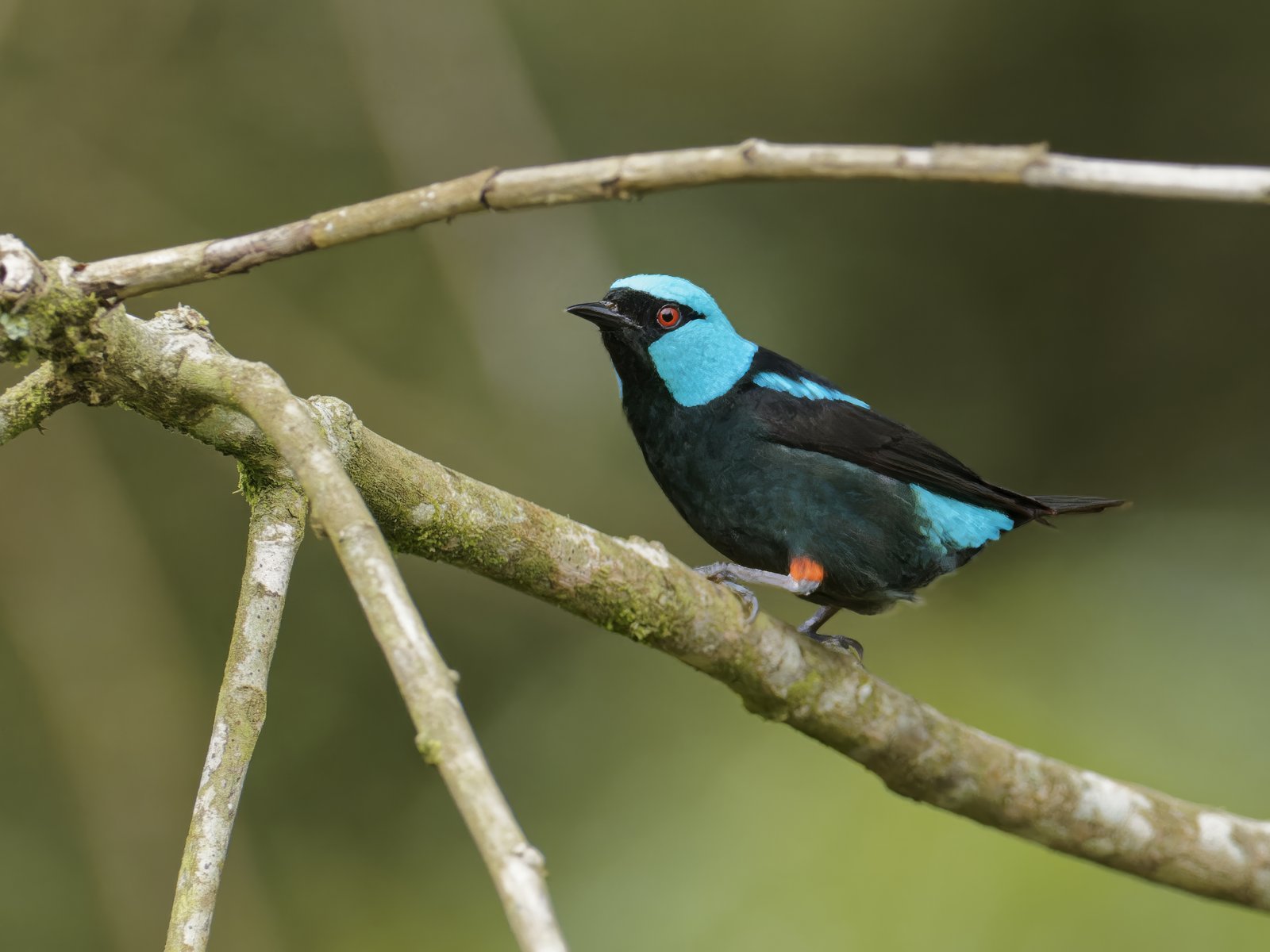
The Scarlet-thighed Dacnis is a small tanager with a short, pointed bill. The male is turquoise-blue and black, with scarlet thighs that usually stay hidden beneath the feathers. It lives in the canopy of humid forest in the foothills of Costa Rica and Panama and eats fruit and insects.
Voice
A thin, high tseet and a soft twitter; not very vocal.
Recording: William Adsett — CC BY-NC-SA 4.0 · converted to mono · xeno-canto
Identification
12–13 cm. A compact tanager with a short, pointed, dark bill and a red eye. The male has a glossy turquoise-blue crown, nape, mantle and rump and a black mask; throat, underparts, wings and tail are black, the thighs scarlet. The female is dull greenish blue above, with a bluer head, and pale grey to buff below; she too has a red eye.
Confusion species
The male Blue Dacnis Dacnis cayana has a blue belly, only a small black throat patch and no red thighs. The female Blue Dacnis is greener, with a blue-grey head. Blue-grey Tanager Thraupis episcopus is larger and uniformly pale blue-grey. Honeycreepers Cyanerpes have a long, curved bill.
Habitat
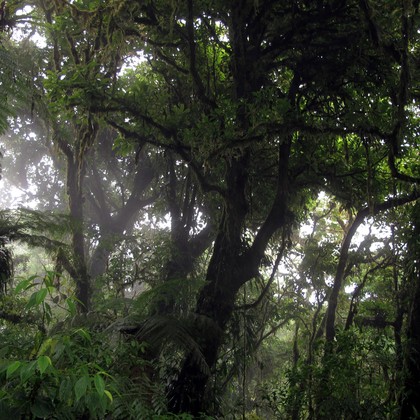
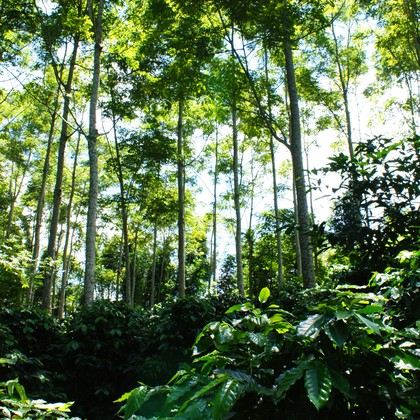
Canopy and edges of humid foothill and lower montane forest, mainly between 300 and 1500 m, outside the breeding season also lower in the lowlands; also tall trees in clearings, mature secondary forest and shade coffee.
Where the bird is most at home, classified by the vegetation units of Mexico and Central America.



Range and movements
Costa Rica, mainly on the Caribbean slope and in the south on the Pacific slope; Panama on both slopes. Outside the guide area in western Colombia and north-western Ecuador.
- Resident
- dark = core range, pale = thinly spread
How and when to look
Often found at fruiting trees and fruit feeders in the foothills of Costa Rica, for example around Sarapiquí and in the southern Pacific corner; the red thighs show only when the bird stretches.
Conservation status
Not threatened (LC). Fairly common in the foothills; dependent on forest, but also uses forest edges and shade coffee.
Scientific name
Dacnis venusta | Lawrence, 1862
Lawrence described the species in 1862 and placed it straight away in the genus where it still stands. The genus Dacnis was introduced in 1816 by Cuvier, GLCFD. Dacnis comes from the Ancient Greek daknis, an unidentified bird from Egypt. venusta is Latin for 'charming, graceful', after the male's handsome turquoise and black. The specimen the first description was based on came from along the Panama Railroad.