All species › Passerines › Tanagers and allies › Blue Dacnis
Position in the tree Birds Aves › Birds with a flexible palate Neognathae › All other modern birds Neoaves › Landbirds Telluraves › Falcons, parrots and passerines Australaves › Falcons and passerines Eufalconimorphae › Parrots and passerines Psittacopasserae
Blue Dacnis | Dacnis cayana
Blauwe pitpit | Dacnis azul
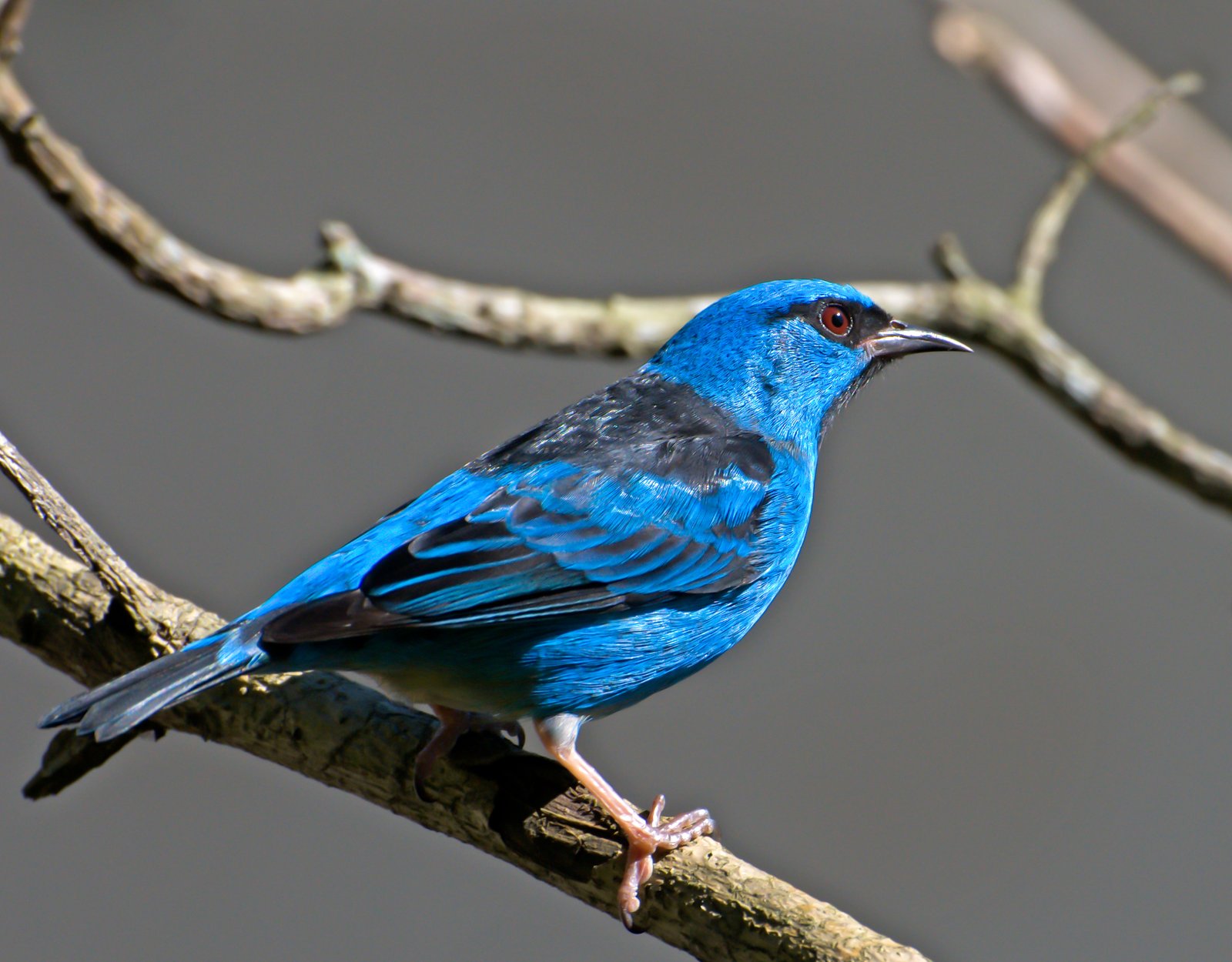
The Blue Dacnis is a small, turquoise-blue tanager with a black back and a short, pointed bill. It searches the canopy of forest edges, gardens and plantations for insects, fruit and nectar, often together with honeycreepers and other tanagers. In the guide area it occurs from Honduras to Panama.
Voice
A thin, high tsip and a soft, dry twitter; the song is little known.
Recording: Juan Freile — CC BY-NC-SA 4.0 · converted to mono · xeno-canto
Identification
12–13 cm. A slender tanager with a short, pointed, pinkish to dark bill. The male is bright turquoise-blue with black lores, a small black throat patch, a black mantle and black wings and tail edged blue. The female is grass-green, paler below, with a blue-grey head.
Confusion species
The male Scarlet-thighed Dacnis Dacnis venusta has black underparts and red thighs. The male Red-legged Honeycreeper Cyanerpes cyaneus is a deeper purple-blue, with a long, curved bill and red legs. The male Swallow Tanager Tersina viridis (eastern Panama) has a white belly and a broad bill. The female Viridian Dacnis Dacnis viguieri is more uniformly green, without a blue-grey head.
Habitat
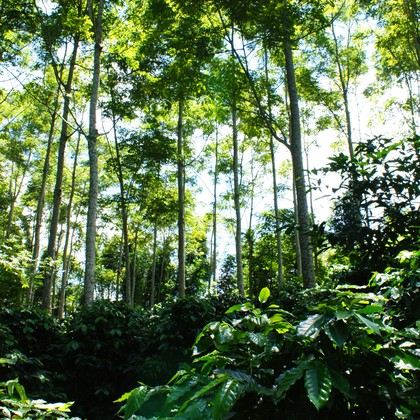
Canopy and edges of humid lowland and foothill forest up to about 1200 m, mature secondary forest, plantations, shade coffee, gardens and parks with tall trees.
Where the bird is most at home, classified by the vegetation units of Mexico and Central America.




Range and movements
Caribbean slope of eastern Honduras and Nicaragua; Costa Rica and Panama on both slopes. Outside the guide area across much of tropical South America, to north-eastern Argentina.
- Resident
- dark = core range, pale = thinly spread
How and when to look
Often seen in flowering and fruiting trees in gardens and along forest edges in Panama, for example around the Panama Canal, and at fruit feeders in Costa Rica.
Conservation status
Not threatened (LC). Common in Panama and Costa Rica; benefits from semi-open country with trees.
Scientific name
Dacnis cayana | (Linnaeus, 1766)
Linnaeus described the species in 1766 as Motacilla cayana; because it was later moved to another genus, the author and year stand in brackets. The genus Dacnis was introduced in 1816 by Cuvier, GLCFD. Dacnis comes from the Ancient Greek daknis, an unidentified bird from Egypt. cayana refers to Cayenne in French Guiana, the type locality. The specimen the first description was based on came from Cayenne, French Guiana.