All species › Passerines › Antbirds › Rusty-winged Antwren
Position in the tree Birds Aves › Birds with a flexible palate Neognathae › All other modern birds Neoaves › Landbirds Telluraves › Falcons, parrots and passerines Australaves › Falcons and passerines Eufalconimorphae › Parrots and passerines Psittacopasserae
Rusty-winged Antwren | Herpsilochmus frater
Noordelijke roodvleugelmiersluiper | Tiluchí alirrufo norteño
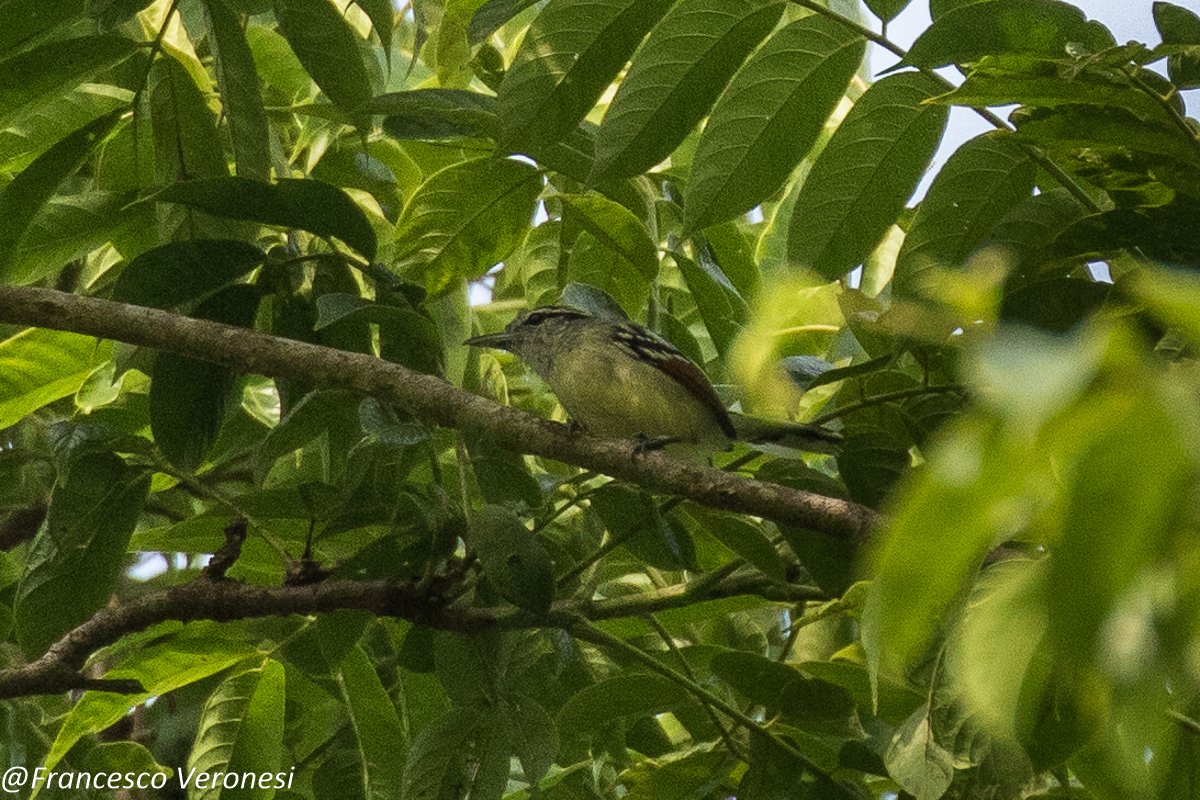
The Rusty-winged Antwren is a small antwren of the canopy of humid forest, with a black crown, a white supercilium and rufous in the wing. It was long treated together with Rufous-winged Antwren Herpsilochmus rufimarginatus of the Atlantic Forest of Brazil. Because it lives high in the canopy, it is inconspicuous. In the guide area it occurs only locally in eastern Panama.
Voice
A fast, accelerating series of short notes ending in a dry rattle.
Recording: Juan Freile — CC BY-NC-SA 4.0 · shortened to the first 60 s, mono · xeno-canto
Identification
11 cm, with a fairly long tail and a thin bill. Male crown black, broad white supercilium and a black eye-stripe; back grey with black; wings black with two white wingbars and rufous edges to the flight feathers forming a rufous panel; tail black with white tips. Underparts pale yellow to whitish. The female resembles the male but has a brown instead of black crown.
Confusion species
The combination of black crown, white supercilium and rufous wing panel is distinctive in the guide area. Dot-winged Antwren Microrhopias quixensis lacks the supercilium and the rufous in the wing; the male is black with white spots and bars on the wing and the female has rufous underparts.
Habitat
Upper middle levels and canopy of humid evergreen lowland and foothill forest, also forest edges and tall secondary forest. It searches for insects among leaves and vines, often with mixed flocks high in the trees.
Where the bird is most at home, classified by the vegetation units of Mexico and Central America.



Range and movements
In the guide area locally in eastern Panama, mainly in Darién. Outside the guide area in northern and western South America: Colombia, Venezuela and along the eastern foot of the Andes to Bolivia and western Brazil.
- Resident
- dark = core range, pale = thinly spread
How and when to look
Lives high in the canopy and is mostly found by listening for its song with mixed flocks at forest edges or from a viewpoint above the forest.
Conservation status
Not evaluated as a separate species; the IUCN includes it in Rufous-winged Antwren Herpsilochmus rufimarginatus, which is not threatened globally. In the guide area scarce and local, and dependent on continuous forest.
Scientific name
Herpsilochmus frater | Sclater & Salvin, 1880
Sclater & Salvin described the species in 1880 and placed it straight away in the genus where it still stands. The genus Herpsilochmus was introduced in 1847 by Cabanis. Herpsilochmus is Greek, from herpō 'to creep' and lokhmē 'thicket': 'thicket-creeper'. frater is Latin for 'brother', after its close relationship to the Rufous-winged Antwren (H. rufimarginatus). The specimen the first description was based on came from Sarayacu, Ecuador.