All species › Pigeons and doves › Doves and pigeons › Russet-crowned Quail-Dove
Position in the tree Birds Aves › Birds with a flexible palate Neognathae › All other modern birds Neoaves › Doves, turacos and allies Columbaves › Doves and sandgrouse Columbimorphae
Russet-crowned Quail-Dove | Zentrygon goldmani
Goldmans kwartelduif | Paloma perdiz de Goldman
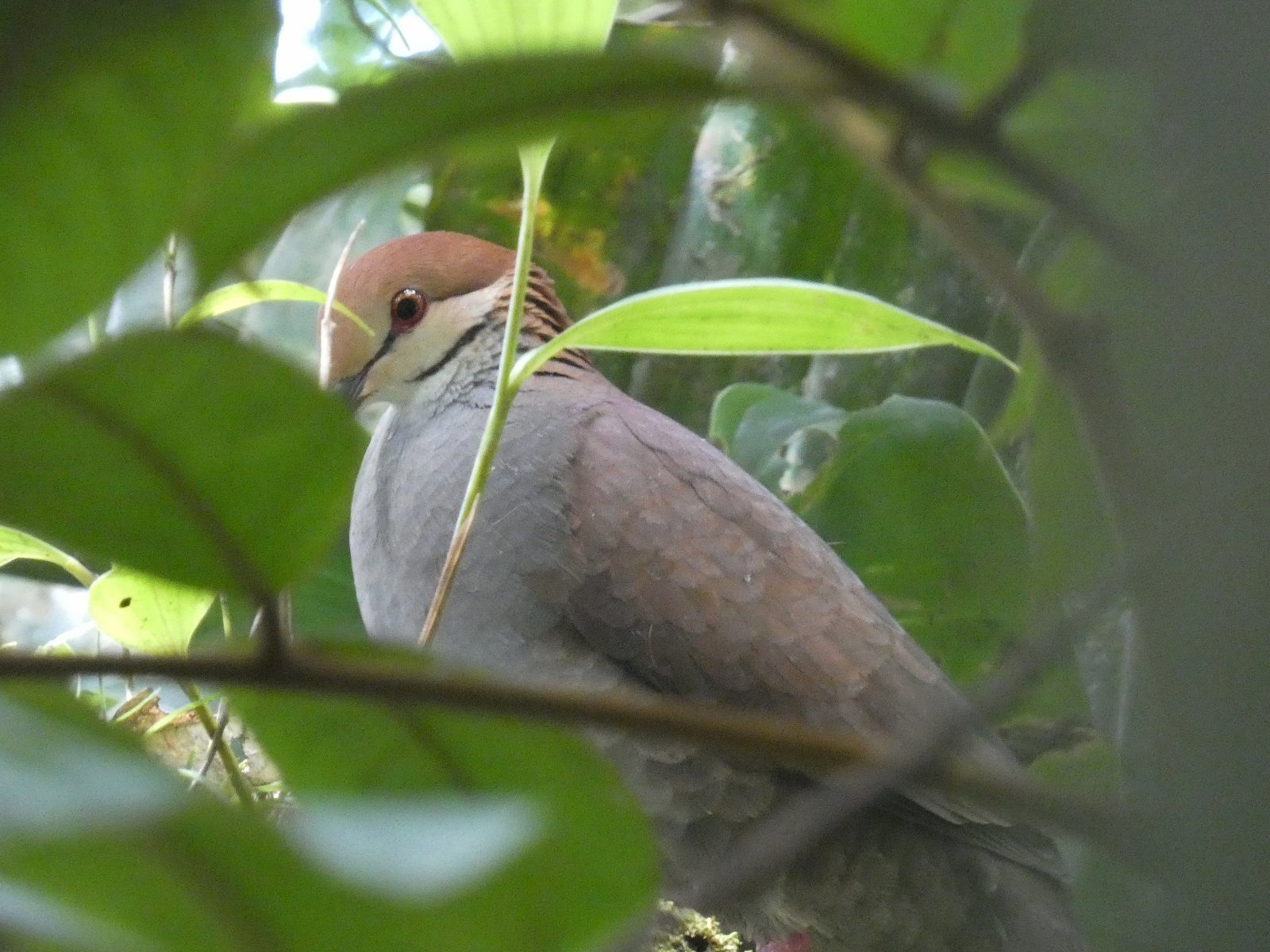
The Russet-crowned Quail-Dove is a large, stocky ground dove of montane forest in eastern Panama and adjacent north-western Colombia. It lives on the floor of humid cloud forest on a few isolated ridges in Darién and is recognised there mainly by its low call. It is one of the least known doves of the guide area.
Voice
A low, hollow, mournful whistle, whooo, repeated at regular intervals of a few seconds, usually from the forest floor or a low branch. The source of the call can scarcely be pinpointed.
Recording: George Wagner — CC BY-NC-SA 4.0 · converted to mono · xeno-canto
Identification
27–29 cm. A large, heavily built quail-dove with a short tail and long legs. The crown and hindneck are warm rufous. The face is pale greyish buff, with a narrow dark line below the eye and a dark moustachial stripe; the throat is whitish. The mantle and wings are olive-brown, with a purple to bronze sheen on the upper back. The breast is blue-grey, the belly becoming paler buff to whitish towards the rear. The legs are pink to reddish, the bill dark. The sexes are alike; young birds are duller and have rufous fringes to the feathers.
Confusion species
Purplish-backed Quail-Dove Zentrygon lawrencii, on a few mountains in eastern Panama, has a grey crown and a purple mantle and no rufous on the head. Olive-backed Quail-Dove Leptotrygon veraguensis is smaller and darker, with a white stripe below the eye, and lives lower down in lowland forest. Ruddy Quail-Dove Geotrygon montana is smaller and almost entirely rufous-brown, with a pale stripe below the eye.
Habitat
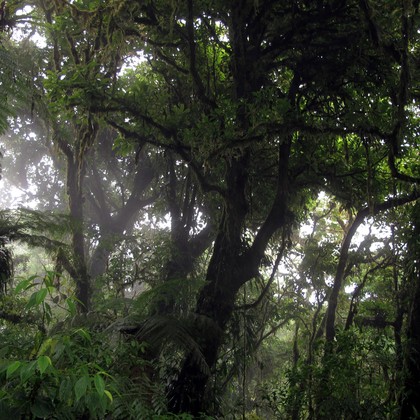
The floor of humid montane forest and cloud forest, roughly between 750 and 1600 m. Walks alone or in pairs over the leaf litter in search of seeds, fallen fruit and small invertebrates. Flushes low when disturbed. Little is known about the nest and breeding biology.
Where the bird is most at home, classified by the vegetation units of Mexico and Central America.


Range and movements
Endemic to the mountains of eastern Panama and adjacent north-western Colombia. In the guide area on the ridges of Darién, such as Cerro Pirre and the Serranía del Darién with Cerro Tacarcuna, and locally in the east of Panamá province. Outside the guide area only on the Colombian side of the Serranía del Darién.
- Resident
- dark = core range, pale = thinly spread
How and when to look
The best-known area is around Cerro Pirre in Darién National Park, which can only be reached on an organised trip. Early in the morning along quiet trails in the cloud forest, the call gives the species away more often than a sighting.
Conservation status
Near Threatened. The range is small and limited to a few ridges. Forest clearance on the edges of the mountains, among other things for cattle and farming, threatens the habitat; most of it, however, lies within Darién National Park.
Scientific name
Zentrygon goldmani | (Nelson, 1912)
Nelson described the species in 1912 as Geotrygon goldmani; because it was later moved to another genus, the author and year stand in brackets. The genus Zentrygon was introduced in 2013 by Banks, Weckstein, Remsen & Johnson. Zentrygon is a blend of the genera Zenaida and Geotrygon, reflecting these quail-doves' close relationship with Zenaida. goldmani honours the American zoologist Edward Alphonso Goldman (1873–1946) of the US Biological Survey, who collected the type on Cerro Pirre. The specimen the first description was based on came from Cerro Pirre (c. 1,500 m), Darién, Panama.