All species › Pigeons and doves › Doves and pigeons › Pale-vented Pigeon
Position in the tree Birds Aves › Birds with a flexible palate Neognathae › All other modern birds Neoaves › Doves, turacos and allies Columbaves › Doves and sandgrouse Columbimorphae
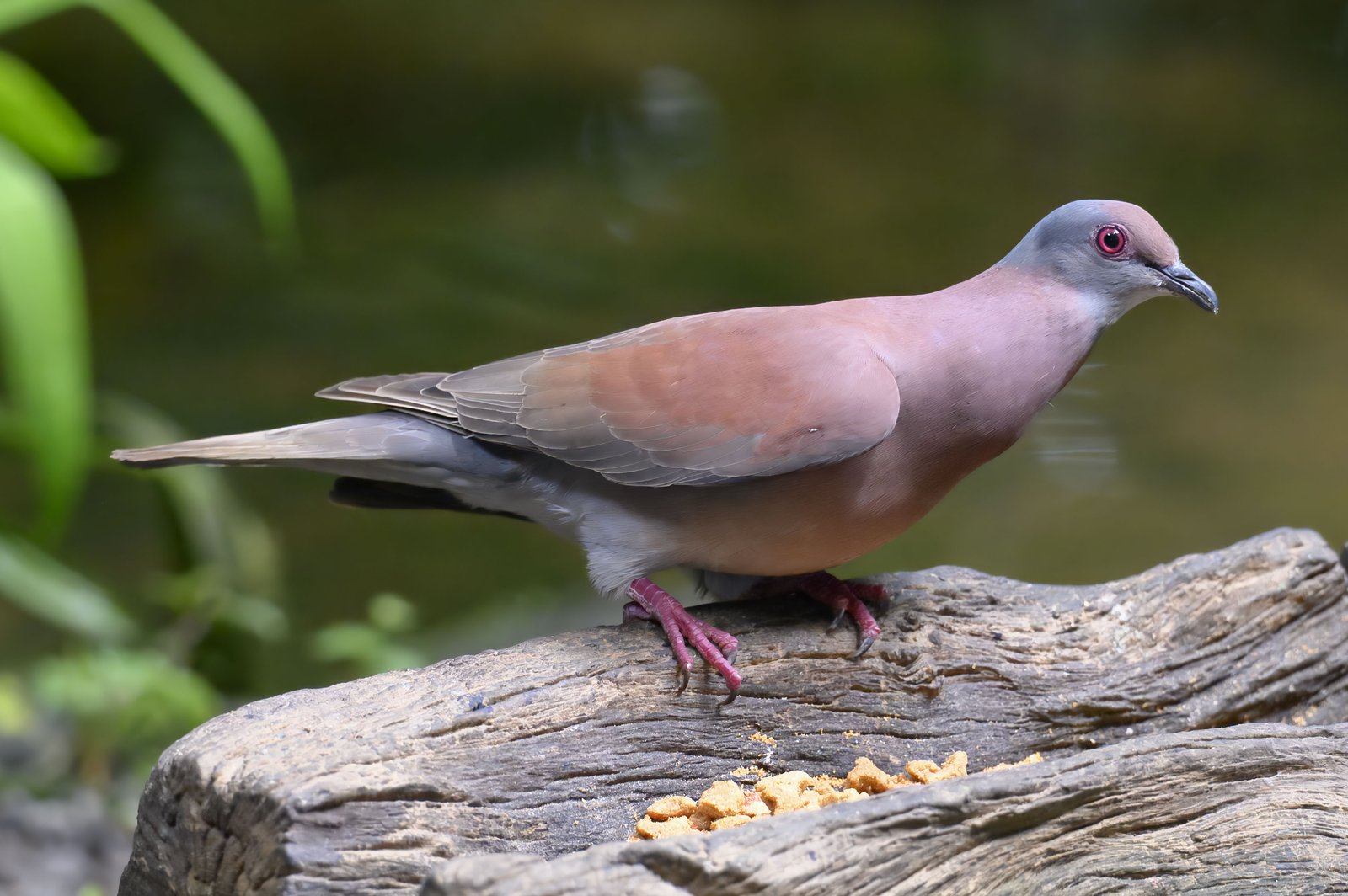
Pale-vented Pigeon | Patagioenas cayennensis
Rosse duif | Paloma colorada
The Pale-vented Pigeon is a medium-sized, vinaceous pigeon of forest edges, riverbanks and semi-open country in the humid lowlands, from south-eastern Mexico to Panama and on over much of South America. Pairs often perch high in a bare treetop and draw attention by their cooing. The name refers to the pale undertail coverts.
Voice
A soft cooing in a short series, introduced by a long, low note: whooo, coo-croo-oo, coo-croo-oo. Mainly in the morning and late afternoon from a lookout in a tall tree. In flight the clatter of the wings is sometimes audible.
Recording: JAYRSON ARAUJO DE OLIVEIRA — CC BY-NC-SA 4.0 · converted to mono · xeno-canto
Identification
28–32 cm. The head, breast, mantle and wing coverts are dull purplish red to vinaceous, the throat whitish. The hindneck has a coppery to green sheen. The lower back and rump are blue-grey, the flight feathers dark greyish brown. The belly is paler grey and the undertail coverts pale grey to whitish. The tail is greyish brown with a paler terminal band. The bill is black, the eye red with a bare red eye-ring, the legs red. The female is duller and browner than the male. Flight fast and direct, often high over forest and open country.
Confusion species
Red-billed Pigeon Patagioenas flavirostris has a pale bill with a red base, a darker grey belly and undertail and lives mainly in drier regions. Scaled Pigeon P. speciosa has a heavily scaled neck and breast and a red bill with a white tip. Short-billed Pigeon P. nigrirostris and Ruddy Pigeon P. subvinacea are smaller and uniformly dark, without a pale vent and grey rump, and keep to the canopy of closed forest.
Habitat
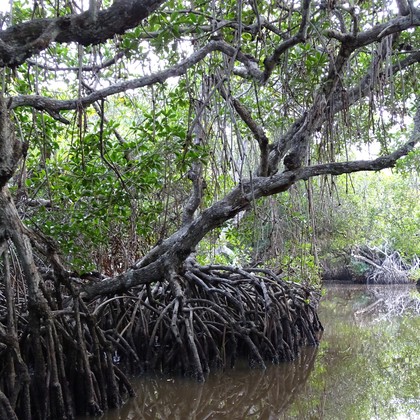
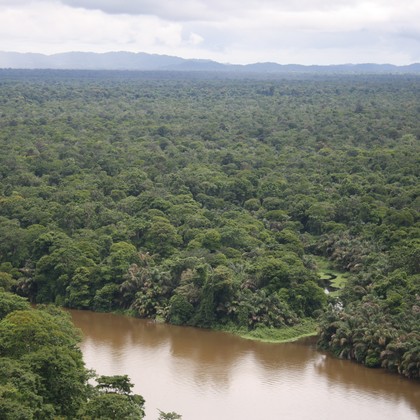
Forest edges, semi-open country with scattered tall trees, riverbanks, mangroves, swamp forest and savannas with groves, from sea level to about 1000 m, mostly lower. Also enters pasture with trees and lines of trees along fields, but avoids the interior of closed forest. Eats fruit, berries and seeds, both in the canopy and on the ground. The nest is a small platform of twigs in a tree, usually with one white egg.
Where the bird is most at home, classified by the vegetation units of Mexico and Central America.




Range and movements
The Caribbean lowlands from south-eastern Mexico (southern Veracruz, Tabasco, Chiapas, Campeche and Quintana Roo) through Belize, northern Guatemala, Honduras and Nicaragua to Costa Rica and Panama. In Costa Rica in the lowlands of both slopes, on the Pacific side mainly in the south; in Panama on both slopes. Absent from El Salvador. Outside the guide area over much of tropical South America to Bolivia and northern Argentina.
- Resident
- dark = core range, pale = thinly spread
How and when to look
Along rivers and lagoons in the lowlands, for example at Tortuguero and Caño Negro in Costa Rica, in the Petén in Guatemala and along the Chagres in Panama. Birds like to sit in dead treetops above the water; from below the pale vent is clearly visible.
Conservation status
Not threatened. Common to fairly common in suitable lowlands. As a bird of forest edges and semi-open country it holds up well in partly cleared land; it is hunted locally.
Scientific name
Patagioenas cayennensis | (Bonnaterre, 1792)
Bonnaterre described the species in 1792 as Columba cayennensis; because it was later moved to another genus, the author and year stand in brackets. The genus Patagioenas was introduced in 1853 by Reichenbach. Patagioenas is Greek, from patageō 'to clatter' and oinas 'pigeon', after the clattering wings on take-off. cayennensis refers to Cayenne in French Guiana. The specimen the first description was based on came from Cayenne, French Guiana (inferred from the name).