All species › Passerines › Ovenbirds and woodcreepers › Rufous-breasted Spinetail
Position in the tree Birds Aves › Birds with a flexible palate Neognathae › All other modern birds Neoaves › Landbirds Telluraves › Falcons, parrots and passerines Australaves › Falcons and passerines Eufalconimorphae › Parrots and passerines Psittacopasserae
Rufous-breasted Spinetail | Synallaxis erythrothorax
Roodborststekelstaart | Güitío pecho rufo
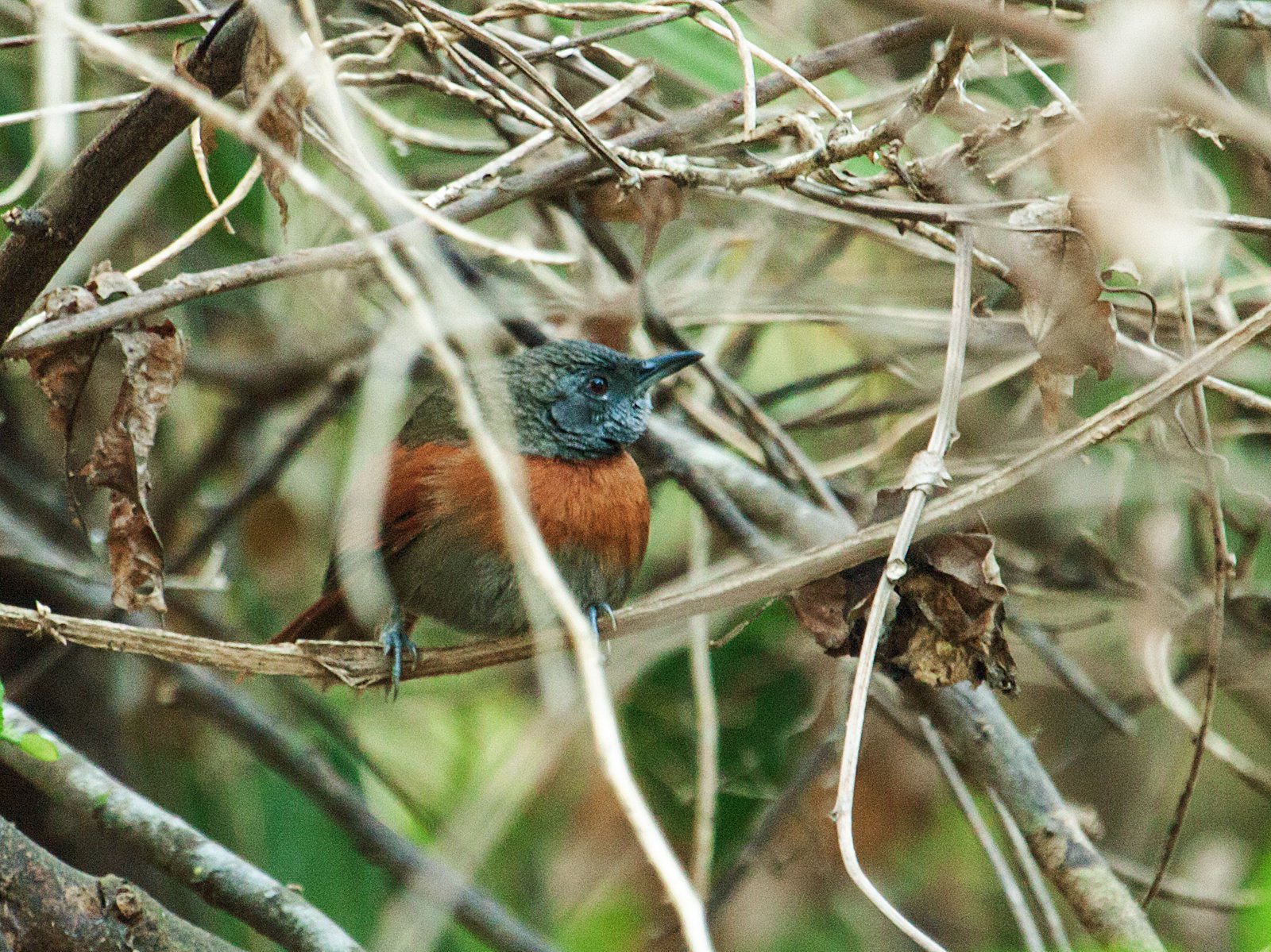
The Rufous-breasted Spinetail is a dark spinetail with a rufous breast and a black-and-white scaled throat that lives in dense scrub and rank growth of south-eastern Mexico and northern Central America. It stays hidden low in the vegetation and is identified mainly by voice. Its range lies entirely within the guide area.
Voice
A fast, repeated series of short, nasal notes, often from dense cover.
Recording: Paul Driver — CC BY-NC-SA 4.0 · shortened to the first 60 s, mono · xeno-canto
Identification
14–15 cm, about half of which is tail; tail long, graduated and dark greyish-brown, with pointed feather tips. Head greyish-brown, back brown, wings rufous. Throat black with white scaling. Breast rufous, belly grey with browner flanks. Bill short and pointed.
Confusion species
Slaty Spinetail Synallaxis brachyura is dark slate-grey without a rufous breast and has a rufous crown; in the guide area it lives mainly further south. Wrens in the same thickets have shorter tails and barring on the wings or tail.
Habitat
Dense scrub, rank growth, young secondary growth, forest edges, hedgerows and bushes along marshes, in humid and semi-arid lowlands and lower hills. Forages low in the vegetation for insects, usually in pairs. Builds a large stick nest with a tubular entrance.
Where the bird is most at home, classified by the vegetation units of Mexico and Central America.



Range and movements
South-eastern Mexico (southern Veracruz, Tabasco, Chiapas and the Yucatán Peninsula) through Belize and Guatemala to Honduras, and on the Pacific slope from Chiapas to El Salvador. Not known outside the guide area.
- Resident
- dark = core range, pale = thinly spread
How and when to look
Often heard in rank growth along roads and field margins on the Yucatán Peninsula and in Belize; waiting patiently at the edge of scrub gives the best chance.
Conservation status
Not threatened. Common in rank growth and scrub and benefits in part from secondary growth.
Scientific name
Synallaxis erythrothorax | Sclater, 1855
Sclater described the species in 1855 and placed it straight away in the genus where it still stands. The genus Synallaxis was introduced in 1818 by Vieillot. Synallaxis is Greek, from sunallaxis 'exchange'; why Vieillot chose the name is unclear. erythrothorax is Greek, from eruthros 'red' and thōrax 'breast', after the rufous breast. The specimen the first description was based on came from Cobán (Guatemala) and Honduras.