All species › Passerines › Ovenbirds and woodcreepers › Ruddy Treerunner
Position in the tree Birds Aves › Birds with a flexible palate Neognathae › All other modern birds Neoaves › Landbirds Telluraves › Falcons, parrots and passerines Australaves › Falcons and passerines Eufalconimorphae › Parrots and passerines Psittacopasserae
Ruddy Treerunner | Margarornis rubiginosus
Rode boomloper | Subepalo rojizo
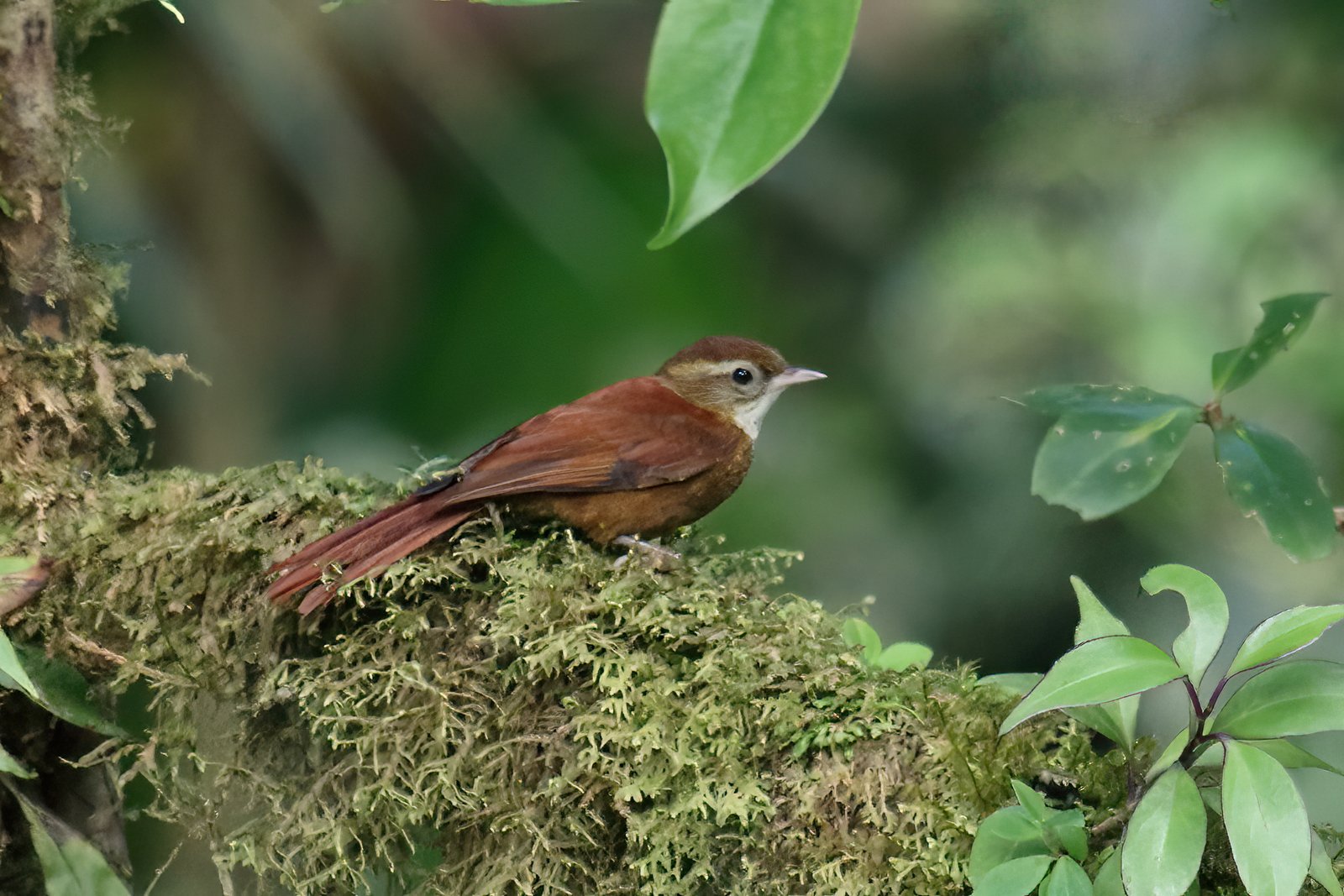
The Ruddy Treerunner is a bright rufous-brown ovenbird of high montane forest in Costa Rica and western Panama. It creeps along mossy branches like a treecreeper or nuthatch, often upside down, and is a regular member of mixed flocks. It occurs only in the guide area.
Voice
High, thin tsit calls, often in series, and a fast, dry, high trill.
Recording: Nick Talbot — CC BY-NC-SA 4.0 · converted to mono · xeno-canto
Identification
15–16 cm. Upperparts and tail bright rufous-brown. A whitish eyebrow. Throat white, sharply set off from the rufous-brown breast and belly. Tail feathers with projecting, spine-like shaft tips that serve as a prop when climbing. Bill short, straight and fairly pointed. Sexes alike.
Confusion species
Spotted Barbtail Premnoplex brunnescens is darker brown with an ochre-buff throat and pale spots on the breast, and forages lower in the forest. Spot-crowned Woodcreeper Lepidocolaptes affinis is larger, with a long, curved bill and pale streaks on the head and underparts.
Habitat
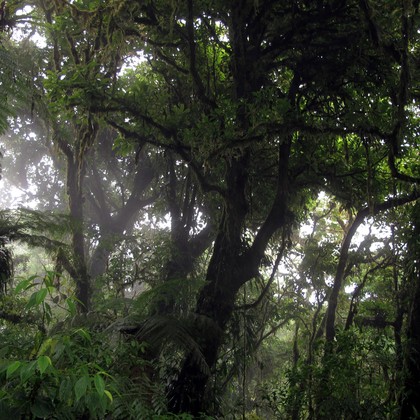
Humid, mossy montane forest with oaks, also forest edges and tall second growth, from about 1500 m up to the timberline, locally lower. It searches along branches and in moss, epiphytes and bamboo in the middle levels and canopy for insects and spiders, usually in mixed flocks.
Where the bird is most at home, classified by the vegetation units of Mexico and Central America.
Range and movements
Highlands of Costa Rica (Cordillera Central and Cordillera de Talamanca) and western Panama (mainly Chiriquí). Occurs only in the guide area.
- Resident
- dark = core range, pale = thinly spread
How and when to look
Common in the oak forests along Cerro de la Muerte and in the San Gerardo de Dota valley in Costa Rica, and at Volcán Barú in Panama, always in mixed flocks.
Conservation status
Not threatened. Common within its limited range, a large part of which lies in protected areas.
Scientific name
Margarornis rubiginosus | Lawrence, 1865
Lawrence described the species in 1865 and placed it straight away in the genus where it still stands. The genus Margarornis was introduced in 1853 by Reichenbach. Margarornis is Greek, from margaron 'pearl' and ornis 'bird', after the pearl-like spots on the underparts. rubiginosus is Latin for 'rusty', after the rufous plumage. The specimen the first description was based on came from San José, Costa Rica.