All species › Passerines › Ovenbirds and woodcreepers › Beautiful Treerunner
Position in the tree Birds Aves › Birds with a flexible palate Neognathae › All other modern birds Neoaves › Landbirds Telluraves › Falcons, parrots and passerines Australaves › Falcons and passerines Eufalconimorphae › Parrots and passerines Psittacopasserae
Beautiful Treerunner | Margarornis bellulus
Schone boomloper | Subepalo bonito
The Beautiful Treerunner is an ovenbird of cloud forest on the highest peaks of Darién, in eastern Panama and adjacent north-western Colombia. It creeps along mossy branches like a treecreeper and is marked by the white, black-edged drops on the underparts. It is one of the least known birds of the guide area.
No photograph of a living wild bird of this species with a suitable Creative Commons licence exists. Do you have one that meets the rules? Send it in.
Voice
Its voice is poorly documented.
No recording with a suitable Creative Commons licence is available for this species yet.
Identification
15–16 cm. Back, wings and tail rufous-brown; crown darker and browner. A narrow whitish eyebrow. Throat white. Breast and belly olive-brown with large white, black-edged drop-shaped spots. Tail feathers with projecting, spine-like shaft tips that serve as a prop when climbing. Bill short and straight. Sexes alike.
Confusion species
There is no other treerunner in its small range. Spotted Barbtail Premnoplex brunnescens is darker brown, with an ochre-buff throat and smaller ochre-buff spots, and forages lower in the forest. Woodcreepers are larger, with longer bills.
Habitat
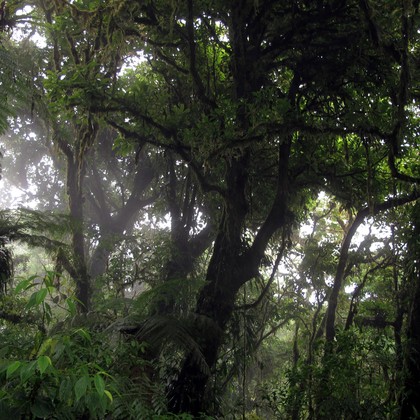
Humid, heavily mossy cloud forest and elfin forest on mountain tops, mainly above about 1300 m. It searches along branches and among moss and epiphytes in the middle levels and canopy for small invertebrates, usually in mixed flocks.
Where the bird is most at home, classified by the vegetation units of Mexico and Central America.
Range and movements
Known only from the highest mountains of Darién in eastern Panama, such as Cerro Pirre and the Tacarcuna massif, and from the adjacent border area in north-western Colombia.
- Resident
- dark = core range, pale = thinly spread
How and when to look
Its habitat can only be reached on a trek of several days to the peaks of Darién National Park, such as Cerro Pirre. There it forages with mixed flocks high in the mossy forest.
Conservation status
Near Threatened. Its very small range lies on a few isolated mountain tops; most of its habitat is remote and protected, but the species is vulnerable to deforestation and disturbance in the border area.
Scientific name
Margarornis bellulus | Nelson, 1912
Nelson described the species in 1912 and placed it straight away in the genus where it still stands. The genus Margarornis was introduced in 1853 by Reichenbach. Margarornis is Greek, from margaron 'pearl' and ornis 'bird', after the pearl-like spots on the underparts. bellulus is Latin for 'pretty, dainty' (diminutive of bellus 'beautiful'). The specimen the first description was based on came from Cerro Pirre, Darién, Panama.