All species › Waterfowl › Ducks, swans and geese › Ring-necked Duck
Position in the tree Birds Aves › Birds with a flexible palate Neognathae › Fowl Galloanserae
Ring-necked Duck | Aythya collaris
Ringsnaveleend | Porrón acollarado
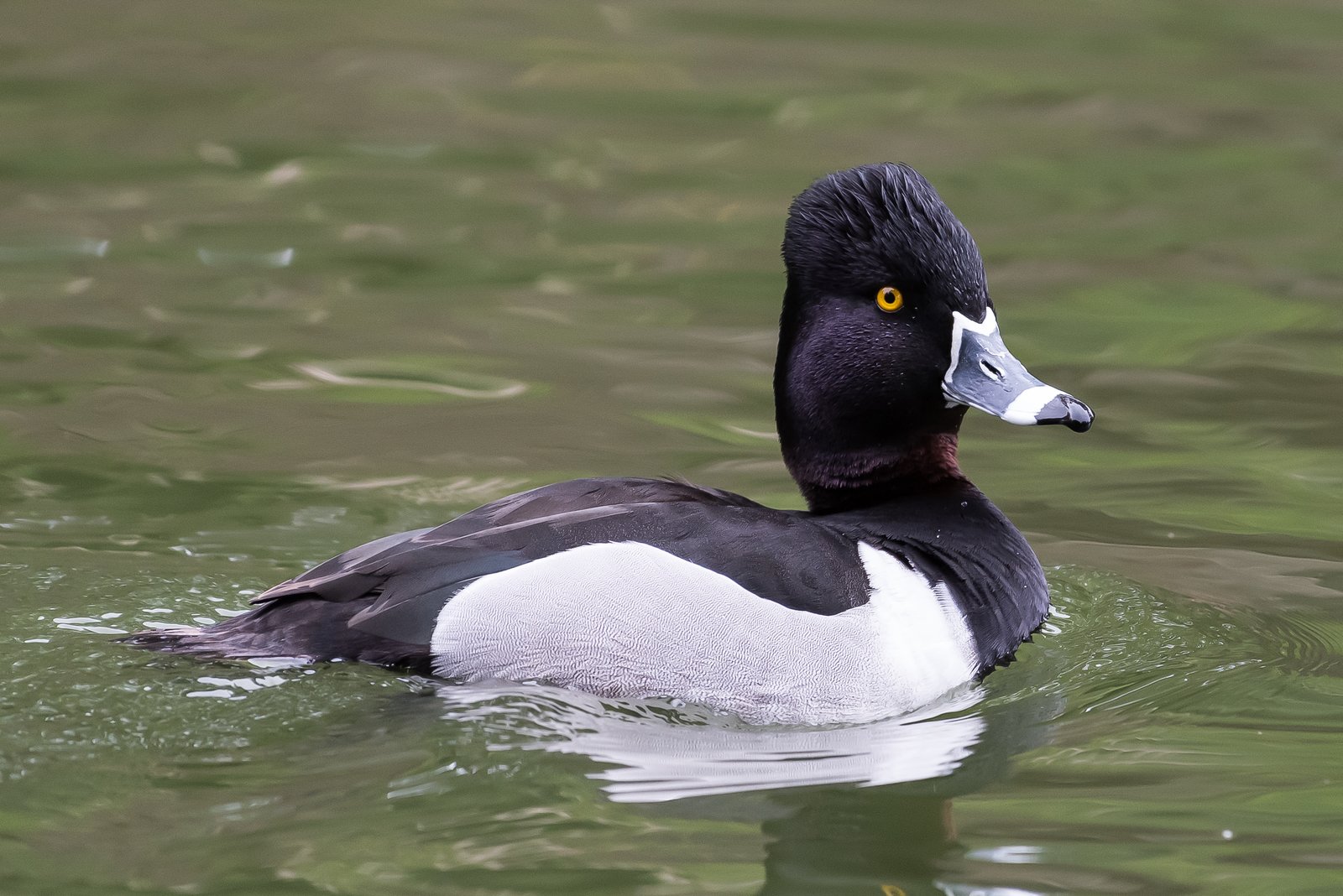
The Ring-necked Duck is a North American diving duck that winters throughout the guide area, most commonly in Mexico. More than the other diving ducks it uses small, shallow and sheltered waters, also in wooded country. The chestnut neck ring that gives the English name is rarely seen in the field; the white ring on the bill is all the more obvious.
Voice
Usually silent in winter. The female gives a rolling, growling krrr; the displaying male a soft, whistled note.
Recording: Stanislas Wroza — CC BY-NC-SA 4.0 · converted to mono · xeno-canto
Identification
39–46 cm, with a tall head peaked at the back of the crown and a fairly short tail. The male has a black head with a purple gloss, a black breast and back, grey flanks with a white, upward-pointing wedge in front of the wing, and a grey bill with a white edge at the base, a white ring behind the tip and a black tip. The eye is yellow. The female is brown with a greyer head, a dark eye, a white eye-ring often with a narrow white line behind it and a pale area around the base of the bill; her bill also has a pale ring. In flight a grey, not white, wing bar across the secondaries.
Confusion species
The male Lesser Scaup Aythya affinis has a pale grey, finely marked back, whitish flanks and no white bill ring; the female has a sharp white patch at the base of the bill, a yellow eye and a white wing bar in flight. Greater Scaup Aythya marila resembles Lesser Scaup, with a rounder head. The female Redhead Aythya americana is a more uniform brown, with a rounded head and no obvious eye-ring.
Habitat
Lakes, ponds, reservoirs, marshes with open water and sheltered parts of lagoons, often with floating and submerged vegetation; also small waters in forest and in the mountains. It dives for seeds, roots and water plants and for invertebrates. Often in small groups, sometimes among Lesser Scaup.
Where the bird is most at home, classified by the vegetation units of Mexico and Central America.



Range and movements
Winters throughout Mexico, most commonly in the north and on the plateau, from Baja California, Sonora and Chihuahua to Jalisco, Michoacán, Puebla and Veracruz, and further south to Oaxaca, Chiapas and the Yucatán Peninsula. In Central America scarcer and local, in Guatemala, Belize, Honduras, El Salvador, Nicaragua and Costa Rica; rare in Panama. Breeds in Canada, Alaska and the northern United States.
- Winter visitor (c. Oct–Mar)
- dark = core range, pale = thinly spread
How and when to look
On smaller lakes and ponds with water plants, where larger flocks of diving ducks are absent. The peaked head and the white ring on the bill can be seen even at a distance; females stand out by the eye-ring with a line behind it.
Conservation status
Not threatened globally. The North American population has increased since the 1960s. In the guide area a fairly common winter visitor in northern Mexico, scarcer towards the south.
Scientific name
Aythya collaris | (Donovan, 1809)
Donovan described the species in 1809 as Anas collaris; because it was later moved to another genus, the author and year stand in brackets. The genus Aythya was introduced in 1822 by Boie. Aythya is from Greek aithuia, an unidentified diving seabird mentioned by Aristotle and Hesychius. collaris is Latin for 'of the neck', from collum 'neck', after the chestnut ring around the throat. The specimen the first description was based on came from Lincolnshire, England.