All species › Passerines › Wagtails and pipits › Red-throated Pipit
Position in the tree Birds Aves › Birds with a flexible palate Neognathae › All other modern birds Neoaves › Landbirds Telluraves › Falcons, parrots and passerines Australaves › Falcons and passerines Eufalconimorphae › Parrots and passerines Psittacopasserae
Red-throated Pipit | Anthus cervinus
Roodkeelpieper | Bisbita gorgirrojo
The Red-throated Pipit is a pipit of the Arctic tundra of Eurasia and western Alaska that normally winters in Africa and South and South-East Asia. A small number migrate south in autumn along the Pacific coast of North America. In the guide area it is a vagrant, almost only in Baja California.
Voice
The call is a long, thin, drawn-out pseeee, often given in flight, and usually gives the bird away before its plumage does. The song, a varied, tinkling series in a song flight, is not heard away from the breeding grounds.
Recording: Stanislas Wroza — CC BY-NC-SA 4.0 · shortened to the first 60 s, mono · xeno-canto
Identification
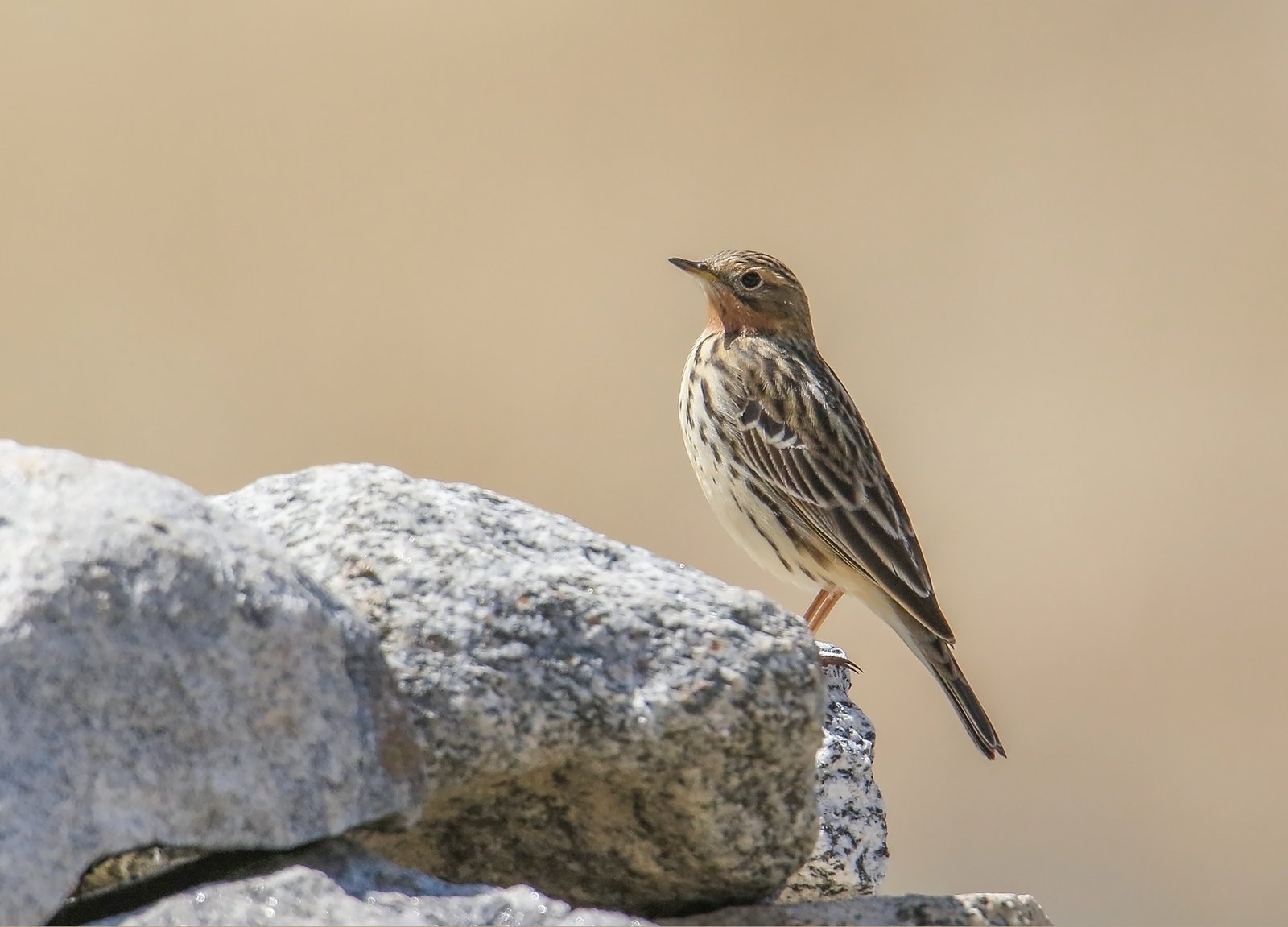
14–15 cm. A sturdy, heavily streaked pipit with a thin bill and pale pink legs. In autumn the upperparts are brown with heavy black streaks and two pale lines on the back; the rump is also clearly streaked. Underparts whitish to buff with heavy black streaks on breast and flanks. Adults often still show a brick-red to pinkish throat, supercilium and upper breast in autumn; young birds lack this colour. The sexes are similar; the female averages less red.
Confusion species
American Pipit Anthus rubescens, with which it is often seen, has a plainer greyish-brown, barely streaked back and rump, dark legs and finer streaks below. Sprague's Pipit Anthus spragueii has a pale, plain face, a scaly back and an unstreaked rump. The call is the best feature: long and thin, quite unlike the short pi-pit of American Pipit.
Habitat
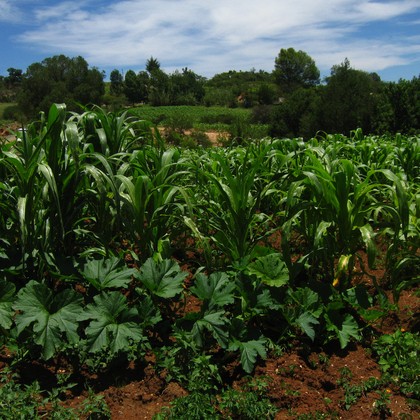
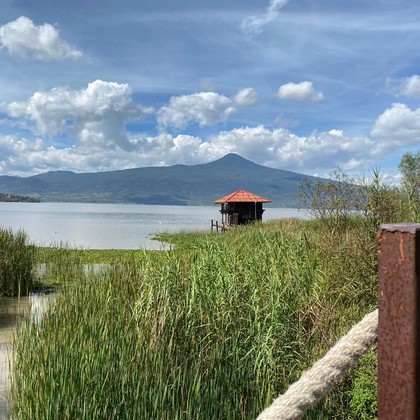
On migration irrigated fields, lawns, sports fields, wet pastures and the edges of shallow water, often in the company of American Pipits. It walks while searching for insects on short grass and wet ground.
Where the bird is most at home, classified by the vegetation units of Mexico and Central America.

Range and movements
Breeds on the tundra from northern Scandinavia to north-eastern Siberia and in western Alaska. Winters in sub-Saharan Africa and South and South-East Asia. A small number migrate along the west coast of North America in autumn. In the guide area a vagrant, almost only in Baja California and Baja California Sur; very rare elsewhere (including Oaxaca, Sonora and Guatemala).
- Winter visitor (c. Oct–Mar)
- Passage (Mar–Apr, Oct–Nov)
- dark = core range, pale = thinly spread
How and when to look
In autumn the best chance is at irrigated fields and lawns in northern Baja California and in the Cape region of Baja California Sur, by checking flocks of American Pipits and listening for the long, thin call.
Conservation status
Not threatened (LC). Widespread and numerous on the breeding grounds; in the guide area a rare vagrant.
Scientific name
Anthus cervinus | (Pallas, 1811)
Pallas described the species in 1811 as Motacilla cervina; because it was later moved to another genus, the author and year stand in brackets. The genus Anthus was introduced in 1805 by Bechstein. Anthus is the Latin word for a small bird of grasslands mentioned by Pliny the Elder. cervinus is Latin for 'stag-coloured', from cervus 'stag', after the rusty red throat of the breeding bird. The specimen the first description was based on came from the Kolyma River, Siberia.