All species › Pigeons and doves › Doves and pigeons › Plumbeous Pigeon
Position in the tree Birds Aves › Birds with a flexible palate Neognathae › All other modern birds Neoaves › Doves, turacos and allies Columbaves › Doves and sandgrouse Columbimorphae
Plumbeous Pigeon | Patagioenas plumbea
Loodgrijze duif | Paloma plomiza
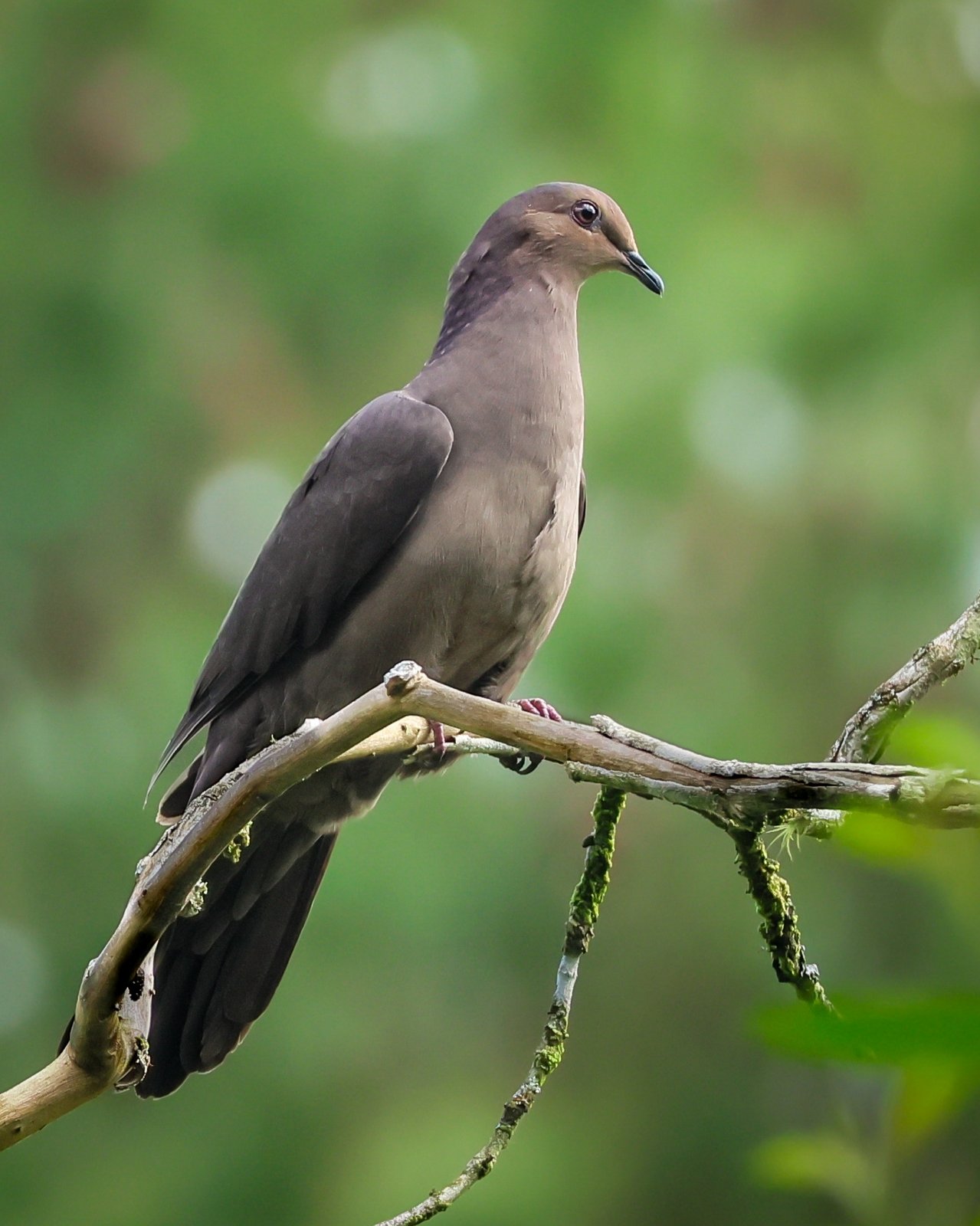
The Plumbeous Pigeon is a dark, plain arboreal pigeon of South American rainforest. Within the guide area it occurs only in the far east of Panama, in the montane forests of the Serranía de Pirre in Darién. It lives high in the canopy and is heard more often than seen.
Voice
A rhythmic, hollow coo of three or four notes, hoo, hoo-hoo-hoo, given from a treetop and often repeated. It resembles the songs of Ruddy and Short-billed Pigeons but sounds lower and fuller.
Recording: JAYRSON ARAUJO DE OLIVEIRA — CC BY-NC-SA 4.0 · converted to mono · xeno-canto
Identification
32–34 cm. A fairly large, slim pigeon with a medium-length, rounded tail and a short black bill. The plumage is dark leaden grey almost throughout; the head, neck and breast have a dull wine-red to purplish wash. The back, wings and tail are darker and browner grey, without spots or bars. The underwing is grey. The legs are red. The sexes are alike; young birds are duller and browner.
Confusion species
Ruddy Pigeon Patagioenas subvinacea is smaller and warmer reddish-brown, with a cinnamon underwing. Short-billed Pigeon Patagioenas nigrirostris is smaller and browner, with olive-brown upperparts, and in Darién lives mainly lower down in the lowlands. Pale-vented Pigeon Patagioenas cayennensis has a pale lower belly and lives in open country and along rivers.
Habitat
The canopy and edge of humid foothill and lower montane forest, in the guide area mainly between about 500 and 1500 m. Lives alone or in pairs and feeds on fruit and berries in the treetops; seldom comes to the ground.
Where the bird is most at home, classified by the vegetation units of Mexico and Central America.



Range and movements
In the guide area only in eastern Darién in Panama, mainly on the Serranía de Pirre and around Cana. Outside the guide area in Colombia and much of the Amazon basin, and in the Atlantic Forest of eastern Brazil and Paraguay.
- Resident
- dark = core range, pale = thinly spread
How and when to look
Look at Cana and on the slopes of Cerro Pirre in Darién National Park, where the song from the treetops is the best clue. A bird sitting silently in the canopy can scarcely be separated from the other large pigeons when seen from below.
Conservation status
Not globally threatened, but declining through deforestation. In the guide area confined to one remote mountain range, most of which lies within a national park.
Scientific name
Patagioenas plumbea | (Vieillot, 1818)
Vieillot described the species in 1818 as Columba plumbea; because it was later moved to another genus, the author and year stand in brackets. The genus Patagioenas was introduced in 1853 by Reichenbach. Patagioenas is Greek, from patageō 'to clatter' and oinas 'pigeon', after the clattering wings on take-off. plumbea is Latin for 'leaden', after the grey plumage. The specimen the first description was based on came from Brazil.