All species › Passerines › Ovenbirds and woodcreepers › Plain-brown Woodcreeper
Position in the tree Birds Aves › Birds with a flexible palate Neognathae › All other modern birds Neoaves › Landbirds Telluraves › Falcons, parrots and passerines Australaves › Falcons and passerines Eufalconimorphae › Parrots and passerines Psittacopasserae
Plain-brown Woodcreeper | Dendrocincla fuliginosa
Grijswangmuisspecht | Trepatroncos pardo
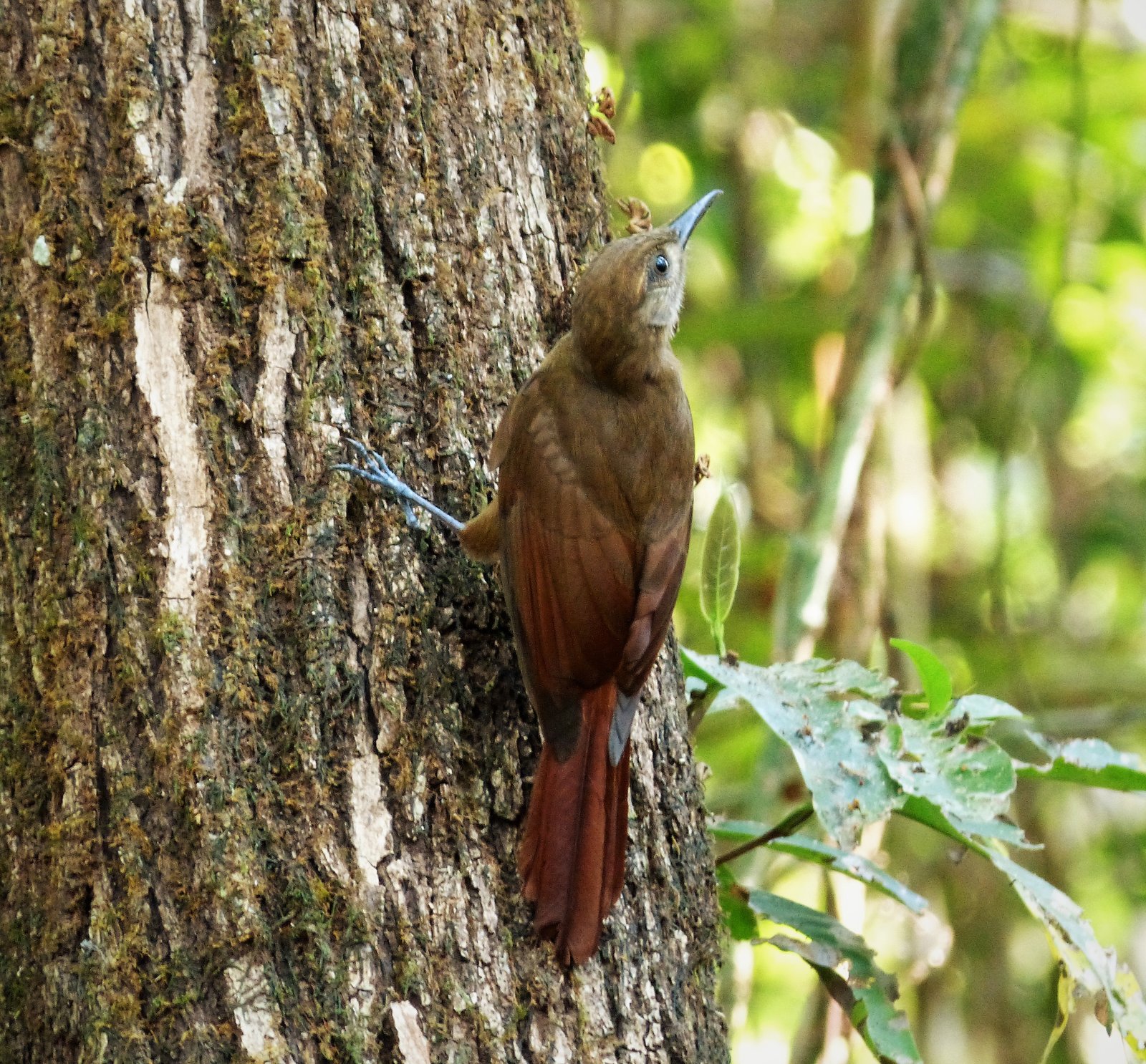
The Plain-brown Woodcreeper is a uniformly brown woodcreeper of humid lowland forest in southern Central America. It regularly follows army-ant swarms, catching the insects and other invertebrates flushed by the ants. In the guide area it lives from Honduras to Panama.
Voice
A long, rapid series of nasal notes that first swells and then fades, mainly at dawn and dusk. Also a nasal, squeaky chee-uh.
Recording: Jaime Suárez — CC BY-NC-SA 4.0 · shortened to the first 60 s, mono · xeno-canto
Identification
20–22 cm. Almost unmarked olive-brown, with rufous wings and tail. Cheek greyish, with a dark stripe behind the eye and an indistinct dark malar stripe; throat slightly paler. No streaks or spots on head, back or breast. Bill straight, medium-length and dark. Male and female are alike.
Confusion species
Tawny-winged Woodcreeper Dendrocincla anabatina has a pale eyebrow, a paler throat and distinctly rufous primaries contrasting with the rest of the wing. Ruddy Woodcreeper Dendrocincla homochroa is warmer rufous-brown all over, with greyish lores. Other woodcreepers in the same forest show streaks, spots or bars.
Habitat
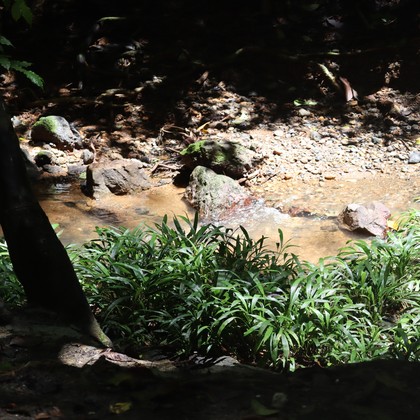
Interior of humid evergreen lowland and foothill forest, also mature secondary forest; mostly in the lower and middle levels. It climbs trunks and at army-ant swarms waits on a vertical trunk for prey to be flushed. It nests in a tree cavity.
Where the bird is most at home, classified by the vegetation units of Mexico and Central America.



Range and movements
Caribbean slope of eastern Honduras and Nicaragua, Costa Rica (mainly the Caribbean slope and the south-west) and Panama on both slopes. Outside the guide area across much of northern South America.
- Resident
- dark = core range, pale = thinly spread
How and when to look
Most often seen at an army-ant swarm, for example at La Selva in Costa Rica or along Pipeline Road (Camino del Oleoducto) in Panama, where several woodcreepers often gather together.
Conservation status
Not threatened. Fairly common in continuous forest, but dependent on forest with enough army ants and therefore sensitive to fragmentation. The species limits of this woodcreeper are under review.
Scientific name
Dendrocincla fuliginosa | (Vieillot, 1818)
Vieillot described the species in 1818 as Dendrocopus fuliginosus; because it was later moved to another genus, the author and year stand in brackets. The genus Dendrocincla was introduced in 1840 by Gray. Dendrocincla is Greek, from dendron 'tree' and kinklos, an unidentified bird mentioned by Aristotle and later linked with wagtails. fuliginosa is Latin for 'sooty', after the plain dark brown plumage. The specimen the first description was based on came from Cayenne, French Guiana.