All species › Passerines › Ovenbirds and woodcreepers › Northern Barred Woodcreeper
Position in the tree Birds Aves › Birds with a flexible palate Neognathae › All other modern birds Neoaves › Landbirds Telluraves › Falcons, parrots and passerines Australaves › Falcons and passerines Eufalconimorphae › Parrots and passerines Psittacopasserae
Northern Barred Woodcreeper | Dendrocolaptes sanctithomae
Noordelijke gebandeerde muisspecht | Trepatroncos barrado norteño
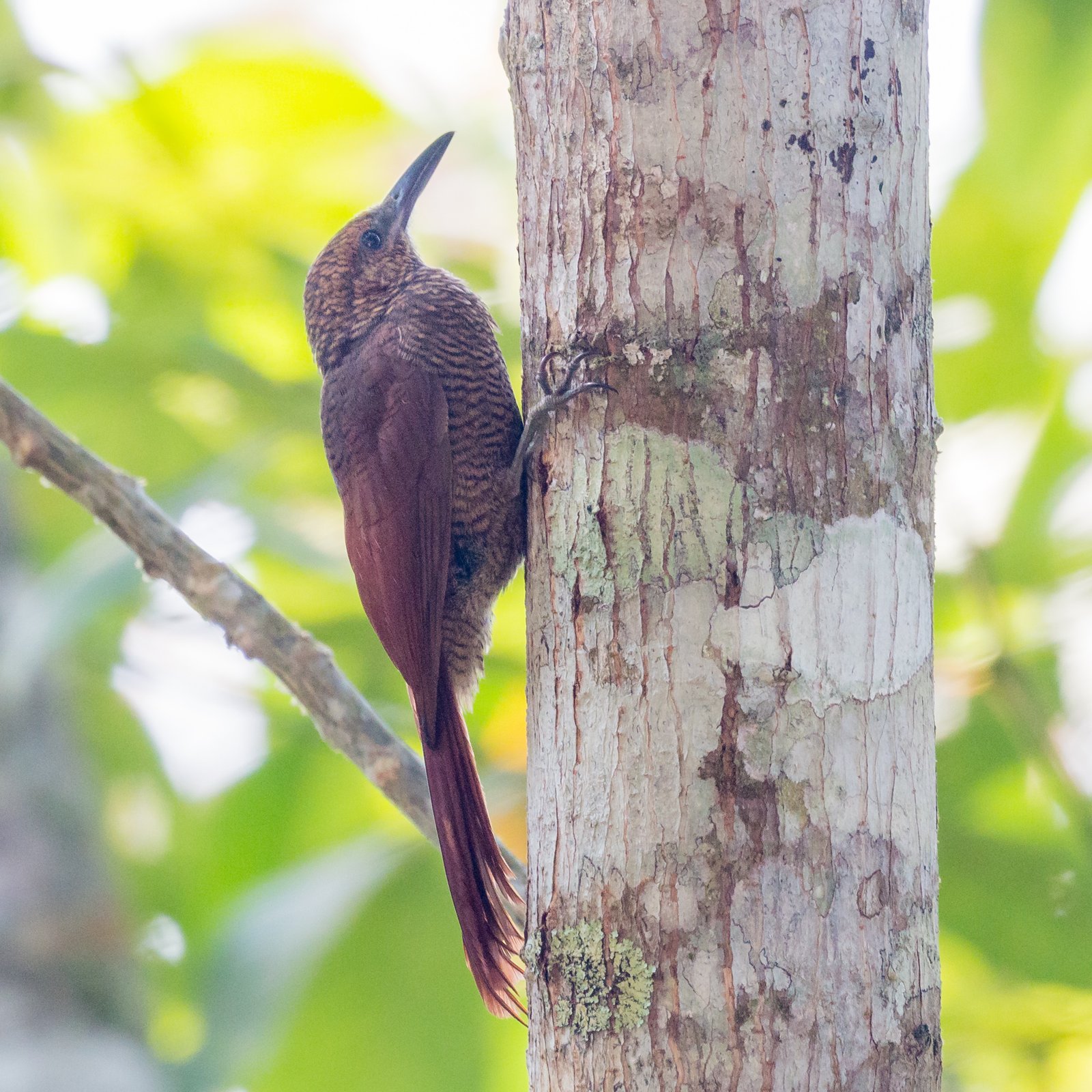
The Northern Barred Woodcreeper is a large, powerful woodcreeper finely barred black all over. It is a regular attendant at army-ant swarms in humid lowland forest. In the guide area it lives from southern Mexico to Panama; for a long time it was treated as one species with the South American Amazonian Barred Woodcreeper.
Voice
A series of loud, slightly rising, piercing whistles, too-wee too-wee too-wee, mainly at dawn and dusk. Also short, nasal calls.
Recording: Paul Driver — CC BY-NC-SA 4.0 · converted to mono · xeno-canto
Identification
26–29 cm. Large and sturdy, with a straight, heavy, dark reddish-brown bill. Head, back and underparts warm brown with dense, fine black bars; wings and tail plain rufous. At close range the barring is obvious; at a distance the bird looks plain brown. Male and female are alike.
Confusion species
Black-banded Woodcreeper Dendrocolaptes picumnus has a streaked head and breast and bars only on the belly; it lives mainly in the mountains. Strong-billed Woodcreeper Xiphocolaptes promeropirhynchus has a slightly curved bill, a pale throat and streaks instead of bars. Other lowland woodcreepers are smaller and streaked or spotted.
Habitat
Humid evergreen and semi-evergreen forest in the lowlands and foothills, also mature secondary forest and forest edges; on the Yucatán Peninsula also in drier seasonal forest. It follows army-ant swarms, taking mainly large insects; it also forages independently on trunks and branches. It nests in a tree cavity.
Where the bird is most at home, classified by the vegetation units of Mexico and Central America.





Range and movements
From southern Mexico (from Veracruz and Oaxaca, the Yucatán Peninsula and Chiapas) through Belize, Guatemala, Honduras, Nicaragua and Costa Rica to Panama. Outside the guide area in northern and western Colombia, north-western Venezuela and western Ecuador.
- Resident
- dark = core range, pale = thinly spread
How and when to look
Most visible at army-ant swarms, for example at Tikal in Guatemala or at La Selva in Costa Rica. At dawn and dusk the whistled song often gives away where it is.
Conservation status
Not threatened. Fairly common in larger forest tracts, but sensitive to deforestation and fragmentation.
Scientific name
Dendrocolaptes sanctithomae | (de Lafresnaye, 1852)
De Lafresnaye described the species in 1852 as Dendrocops Sancti-Thomoe; because it was later moved to another genus, the author and year stand in brackets. The genus Dendrocolaptes was introduced in 1804 by Hermann. Dendrocolaptes is Greek, from dendron 'tree' and kolaptēs 'chiseller, pecker': 'tree-pecker', after its foraging on trunks. sanctithomae is Latin for 'of Saint Thomas', after Santo Tomás near Omoa (Honduras), mistakenly given as an island by the describer. The specimen the first description was based on came from Santo Tomás near Omoa, Honduras.