All species › Passerines › Tanagers and allies › Peg-billed Finch
Position in the tree Birds Aves › Birds with a flexible palate Neognathae › All other modern birds Neoaves › Landbirds Telluraves › Falcons, parrots and passerines Australaves › Falcons and passerines Eufalconimorphae › Parrots and passerines Psittacopasserae
Peg-billed Finch | Acanthidops bairdi
Wigsnavelgors | Yal costarricense
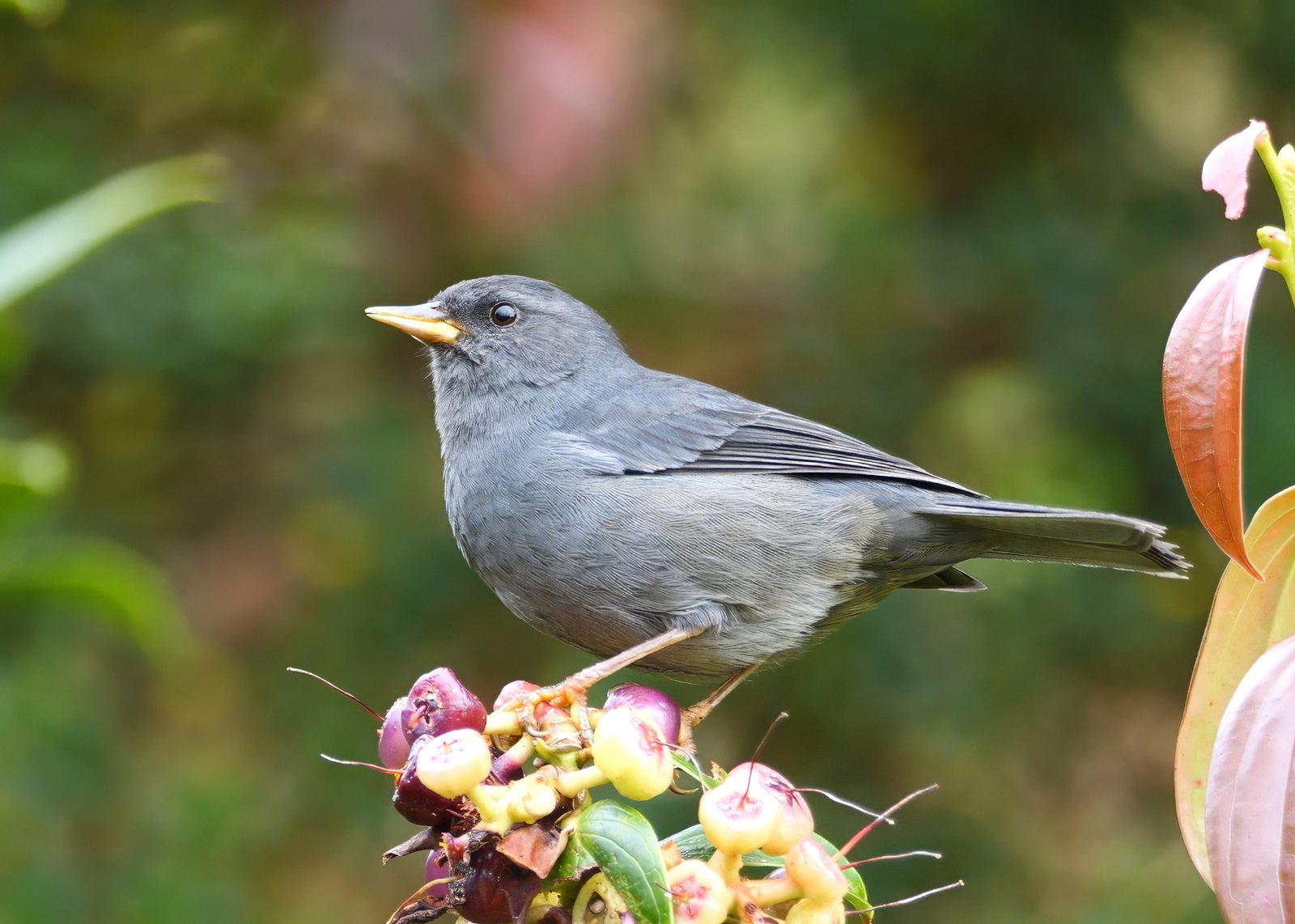
The Peg-billed Finch is a grey finch-like tanager of the high mountains of Costa Rica and western Panama, with a long, sharply pointed, wedge-shaped bill. Like the Slaty Finch it wanders in the wake of seeding bamboo. It occurs only in the guide area.
Voice
Song a short, dry series of high, buzzy and chipping notes. Call a sharp, high tsip.
Recording: William Adsett — CC BY-NC-SA 4.0 · converted to mono · xeno-canto
Identification
13–14 cm. Male uniformly slate-grey, slightly paler on the belly; wings and tail darker. Bill long, straight and very sharply pointed, with a dark upper mandible and a yellow to orange-yellow lower mandible. The female is olive-brown above, greyish-brown below, with two buff wing bars; the bill is as in the male.
Confusion species
Slaty Finch Haplospiza rustica is darker slate-grey, has a shorter, all-dark bill, and the female lacks distinct wing bars. Slaty Flowerpiercer Diglossa plumbea is smaller and has an upturned bill hooked at the tip. Volcano Junco Junco vulcani is browner, has a pale bill and a bright yellow eye.
Habitat
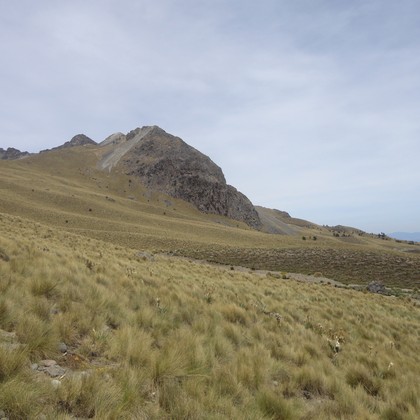
Edges and clearings of montane forest and oak-bamboo forest, scrub above the timberline and páramo, mostly above 2000 m and up to about 3300 m, especially where Chusquea bamboo grows. It eats bamboo seed and other seeds, insects and also nectar from flowers. It wanders and is numerous at one time, scarce at another.
Where the bird is most at home, classified by the vegetation units of Mexico and Central America.


Range and movements
Mountains of Costa Rica, mainly the Cordillera Central and the Cordillera de Talamanca, and western Panama in Chiriquí. It does not occur outside the guide area.
- Resident
- dark = core range, pale = thinly spread
How and when to look
Best looked for along the Inter-American Highway at Cerro de la Muerte and in the Savegre valley in Costa Rica, especially when the bamboo is seeding.
Conservation status
Not threatened (LC). It lives in a small area, but largely in protected montane forest; numbers fluctuate with bamboo flowering.
Scientific name
Acanthidops bairdi | Ridgway, 1882
Ridgway described the species in 1882 and placed it straight away in the genus where it still stands. He introduced the genus Acanthidops in that same work. Acanthidops is Greek, from akanthis 'small finch' (cf. Acanthis) and ōps 'appearance': 'looking like a siskin'. bairdi honours the American ornithologist Spencer Fullerton Baird (1823–1887) of the Smithsonian Institution. The specimen the first description was based on came from Irazú Volcano, Costa Rica.