All species › Birds of prey › Kites, Old World vultures, eagles and hawks › Pearl Kite
Position in the tree Birds Aves › Birds with a flexible palate Neognathae › All other modern birds Neoaves › Landbirds Telluraves › Raptors, owls, kingfishers and woodpeckers Afroaves › Hawks and owls Hieraves
Pearl Kite | Gampsonyx swainsonii
Parelwouw | Elanio perla
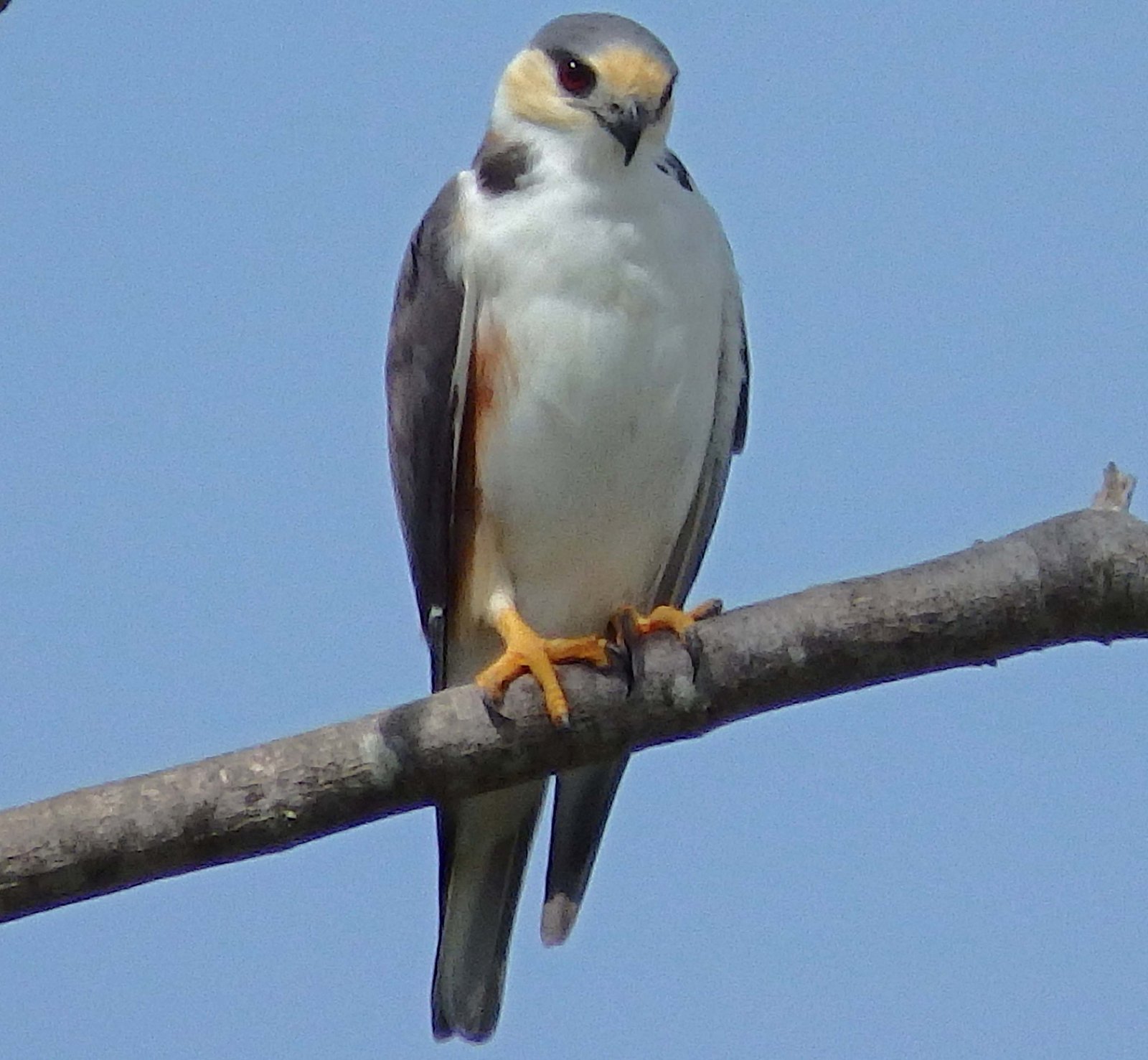
The Pearl Kite is the smallest kite in the Americas, weighing about ninety grams, and in build and behaviour resembles a small falcon more than a kite. It lives in open, dry country with scattered trees and hunts lizards, large insects and small birds from a perch. In the guide area it is resident from Panama to Honduras and El Salvador; with deforestation it has spread far to the north in recent decades.
Voice
Inconspicuous. A series of thin, high whistles, kewee-kewee-kewee, mainly around the nest, and a short, sharp tseep.
Recording: Francisco contreras — CC BY-NC-SA 4.0 · converted to mono · xeno-canto
Identification
20–23 cm, compact, with pointed wings and a fairly short, square tail. The upperparts are slate grey to blackish, the underparts white. Forehead and cheeks are pale buff, a white collar crosses the hindneck and there is a black patch on the side of the breast. The thighs are rufous. Young birds have pale fringes to the feathers of the upperparts, giving a scaly back, and a warmer buff wash on the head and breast. Male and female are alike.
Confusion species
The American Kestrel Falco sparverius has a rufous back and tail and two dark stripes on the face. The Bat Falcon Falco rufigularis is larger and stockier, with a black head, a dark, finely barred breast band and a rufous belly. The Aplomado Falcon Falco femoralis is much larger, with a long tail and a dark band across the belly. The White-tailed Kite Elanus leucurus is much larger and pale grey, with a white tail.
Habitat
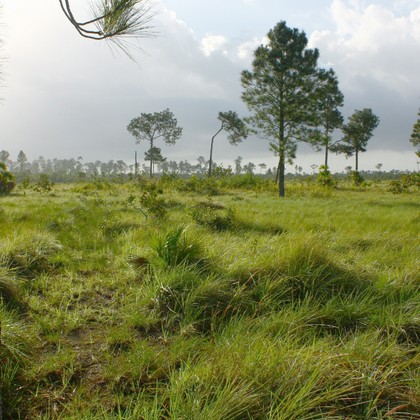
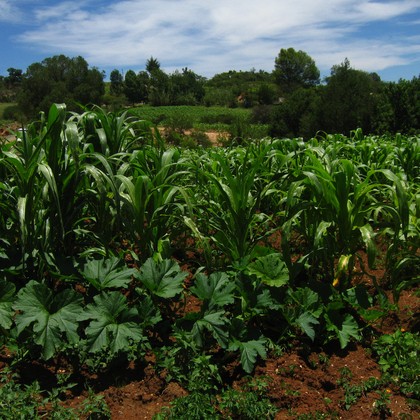
Open savanna and pasture with scattered trees, hedgerows and palms, farmland, forest edges and roadsides, mainly in dry lowland regions. It often uses dead branches, posts and power lines as lookouts. It hunts lizards, grasshoppers, beetles and small birds from a perch or after a short flight, sometimes catching them in the air. The nest is a small stick platform high in a tree.
Where the bird is most at home, classified by the vegetation units of Mexico and Central America.



Range and movements
Resident on the Pacific side of Panama, Costa Rica and Nicaragua, and in southern Honduras and El Salvador; in Costa Rica and Panama now also locally on the Caribbean side and in the interior. Rare in Guatemala and recorded only exceptionally in Mexico. Over recent decades it has spread northwards with the clearing of forest and the creation of pasture. Outside the guide area in northern and central South America, south to northern Argentina.
- Resident
- dark = core range, pale = thinly spread
How and when to look
In the dry season, from December to April, it often perches on dead branches and wires above pasture and savanna in the Pacific lowlands of Panama and Costa Rica, for example around Guanacaste and on the Azuero Peninsula. Its size makes it inconspicuous among doves and falcons on a wire; look for the white collar and pale cheeks.
Conservation status
Not threatened. The species benefits from deforestation and the spread of pasture and is still expanding in Central America.
Scientific name
Gampsonyx swainsonii | Vigors, 1825
Vigors described the species in 1825 and placed it straight away in the genus where it still stands. He introduced the genus Gampsonyx in that same work. Gampsonyx is Greek, from gampsos 'curved' and onux 'claw': 'curved claw'. swainsonii honours the English naturalist William Swainson (1789–1855). The specimen the first description was based on came from tableland of Bahia, Brazil.