All species › Passerines › Tyrant flycatchers and allies › Olive-striped Flycatcher
Position in the tree Birds Aves › Birds with a flexible palate Neognathae › All other modern birds Neoaves › Landbirds Telluraves › Falcons, parrots and passerines Australaves › Falcons and passerines Eufalconimorphae › Parrots and passerines Psittacopasserae
Olive-striped Flycatcher | Mionectes olivaceus
Olijfstreeppipratiran | Mosquerito olivirrayado
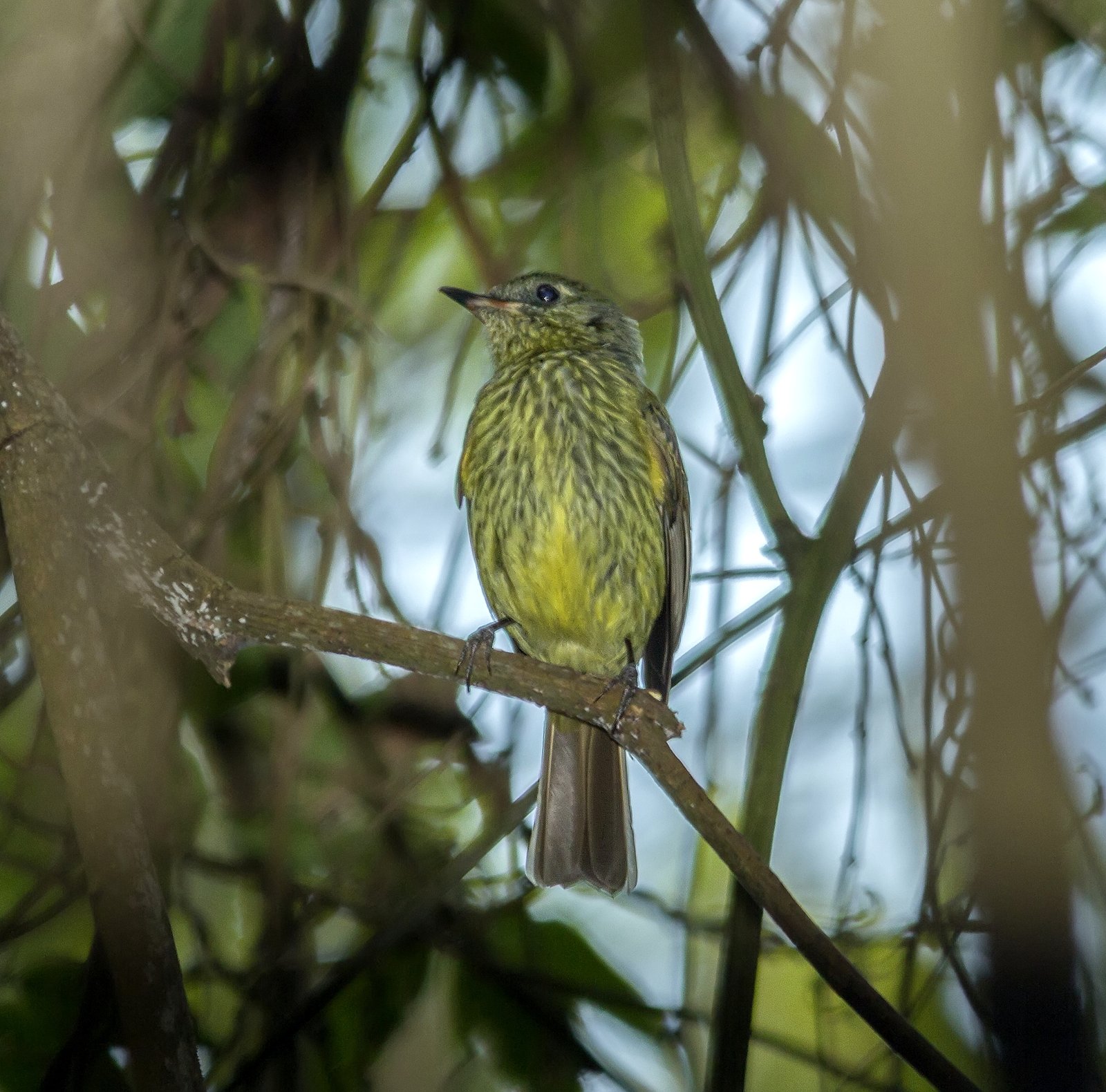
The Olive-striped Flycatcher is an olive-green Mionectes flycatcher with a finely streaked breast and a small white spot behind the eye. It eats much fruit and, like its relatives, often lifts one wing above the back. In the guide area it lives in foothill and montane forest of Costa Rica and Panama.
Voice
Rather quiet. Mainly very high, thin tsip calls; the song is a series of high, thin notes.
Recording: Carlos Delgado JUMABITA — CC BY-NC-SA 4.0 · shortened to the first 60 s, mono · xeno-canto
Identification
13 cm. Slender, with a thin bill and a fairly long tail. Upperparts olive-green, head slightly greyer. Small white spot just behind the eye. Throat and breast olive with fine yellowish streaks, belly yellow with olive streaks on the flanks. Wings without distinct wing bars. Bill dark, base of the lower mandible pale. Sexes alike.
Confusion species
Ochre-bellied Flycatcher Mionectes oleagineus has unstreaked ochre breast and belly and no white spot behind the eye; it lives mainly lower down. Sepia-capped Flycatcher Leptopogon amaurocephalus and Slaty-capped Flycatcher Leptopogon superciliaris have clear wing bars, a dark ear patch and an unstreaked breast.
Habitat
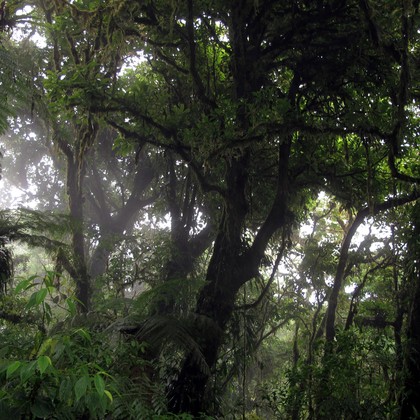
Middle levels and understorey of humid foothill and montane forest, forest edges and mature secondary forest. It breeds mainly between about 600 and 2000 m; after breeding some descend to the lowlands. It eats many small berries and fruits, including mistletoe, as well as insects. Usually alone.
Where the bird is most at home, classified by the vegetation units of Mexico and Central America.



Range and movements
Costa Rica and Panama, in foothill and montane forest on both slopes of the mountain ranges and in the mountains of eastern Panama (Darién); lower outside the breeding season. Outside the guide area in the Andes and coastal mountains of northern South America, south to Peru.
- Resident
- dark = core range, pale = thinly spread
How and when to look
Look at fruiting shrubs and trees along forest edges in foothill forest; watch for an olive bird lifting one wing and for the white spot behind the eye.
Conservation status
Not threatened. Fairly common in suitable forest. Its taxonomy is in flux, and the treatment of the various populations may change.
Scientific name
Mionectes olivaceus | Lawrence, 1868
Lawrence described the species in 1868 and placed it straight away in the genus where it still stands. The genus Mionectes was introduced in 1844 by Cabanis. Mionectes is Greek meionektēs 'small, having suffered loss', from meionekteō 'to have too little'. olivaceus is Modern Latin for 'olive-coloured', after the olive-green plumage. The specimen the first description was based on came from Barranca, Costa Rica.