All species › Passerines › Tyrant flycatchers and allies › Ochre-bellied Flycatcher
Position in the tree Birds Aves › Birds with a flexible palate Neognathae › All other modern birds Neoaves › Landbirds Telluraves › Falcons, parrots and passerines Australaves › Falcons and passerines Eufalconimorphae › Parrots and passerines Psittacopasserae
Ochre-bellied Flycatcher | Mionectes oleagineus
Okerbuikpipratiran | Mosquero ocrillo
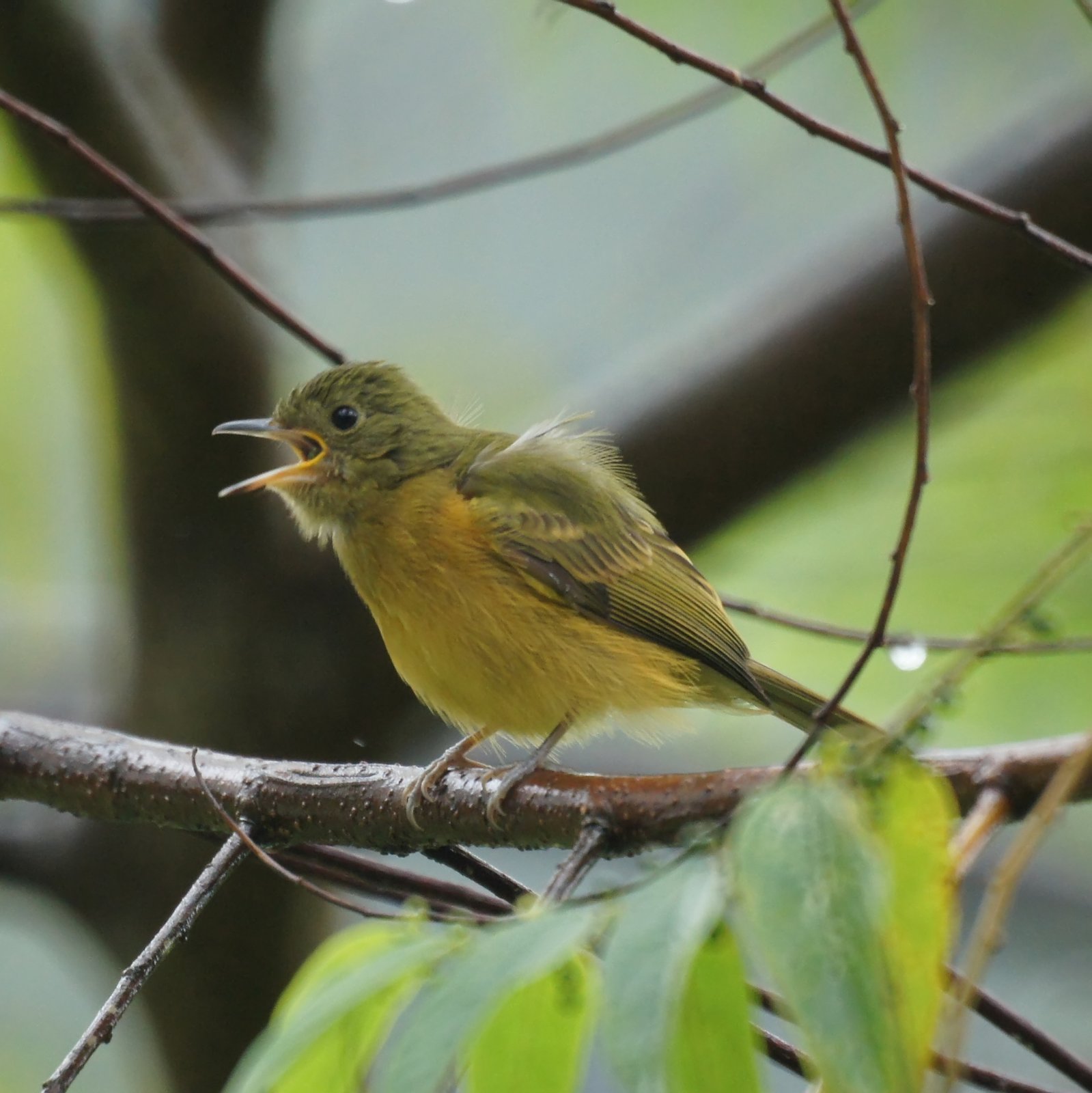
The Ochre-bellied Flycatcher is a slim, inconspicuous tyrant flycatcher of the lower and middle levels of humid forest, olive-green above and ochre below. It feeds mainly on small fruits and arils and has the habit of briefly lifting one wing at a time. In the guide area it lives from southern Mexico to Panama.
Voice
In the breeding season males sing for long periods from a fixed song perch in the lower forest: a series of sharp chip notes alternating with a nasal, repeated chee-a. Also short, dry calls.
Recording: Mateus Gonçalves Santos — CC BY-NC-SA 4.0 · shortened to the first 60 s, mono · xeno-canto
Identification
13 cm, with a small, rounded head and a slender dark bill with a paler base to the lower mandible. Head, back and tail olive-green; wings darker with faint ochre-buff edges to the coverts and tertials. Throat greyish-olive, breast olive washed ochre, belly bright ochre to cinnamon-buff. Male and female are alike.
Confusion species
Olive-striped Flycatcher Mionectes olivaceus of montane forest in Costa Rica and Panama has finely streaked, yellowish underparts and a pale spot behind the eye. Sepia-capped Flycatcher Leptopogon amaurocephalus and Slaty-capped Flycatcher Leptopogon superciliaris have a dark patch on the ear-coverts and distinct wing-bars. Ruddy-tailed Flycatcher Terenotriccus erythrurus is smaller, with a rufous tail and wings. Female manakins are stockier and lack the ochre belly.
Habitat
Lower and middle levels of humid evergreen forest, forest edges, mature secondary forest and gallery forest, from the lowlands to about 1200 m, locally higher. It eats mainly small berries and arils, picked in flight or from a perch, as well as insects. Males display at individual song perches; the female builds a pear-shaped hanging nest of moss, often attached to a root or vine over a stream or by a bank, and cares for the young alone.
Where the bird is most at home, classified by the vegetation units of Mexico and Central America.





Range and movements
From southern Mexico through Belize, Guatemala, El Salvador, Honduras, Nicaragua and Costa Rica to Panama; in the north of the guide area mainly on the Caribbean slope. Outside the guide area over much of tropical South America, to Amazonia, eastern Brazil and Trinidad and Tobago.
- Resident
- dark = core range, pale = thinly spread
How and when to look
Common in forest areas such as La Selva in Costa Rica and along Pipeline Road (Camino del Oleoducto) in Panama. The alternate lifting of one wing and feeding at fruiting shrubs in the lower forest give it away.
Conservation status
Not threatened. Widespread and common in suitable forest; disappears where forest is cleared completely, but persists in secondary forest and at forest edges.
Scientific name
Mionectes oleagineus | (Lichtenstein, 1823)
Lichtenstein described the species in 1823 as M[uscicapa] oleaginea; because it was later moved to another genus, the author and year stand in brackets. The genus Mionectes was introduced in 1844 by Cabanis. Mionectes is Greek meionektēs 'small, having suffered loss', from meionekteō 'to have too little'. oleagineus is Latin for 'olive-coloured, of the olive tree', from olea 'olive tree', after the olive-green upperparts. The specimen the first description was based on came from Bahia, Brazil.