All species › Passerines › New World sparrows › Olive Sparrow
Position in the tree Birds Aves › Birds with a flexible palate Neognathae › All other modern birds Neoaves › Landbirds Telluraves › Falcons, parrots and passerines Australaves › Falcons and passerines Eufalconimorphae › Parrots and passerines Psittacopasserae
Olive Sparrow | Arremonops rufivirgatus
Olijfgors | Rascador oliváceo
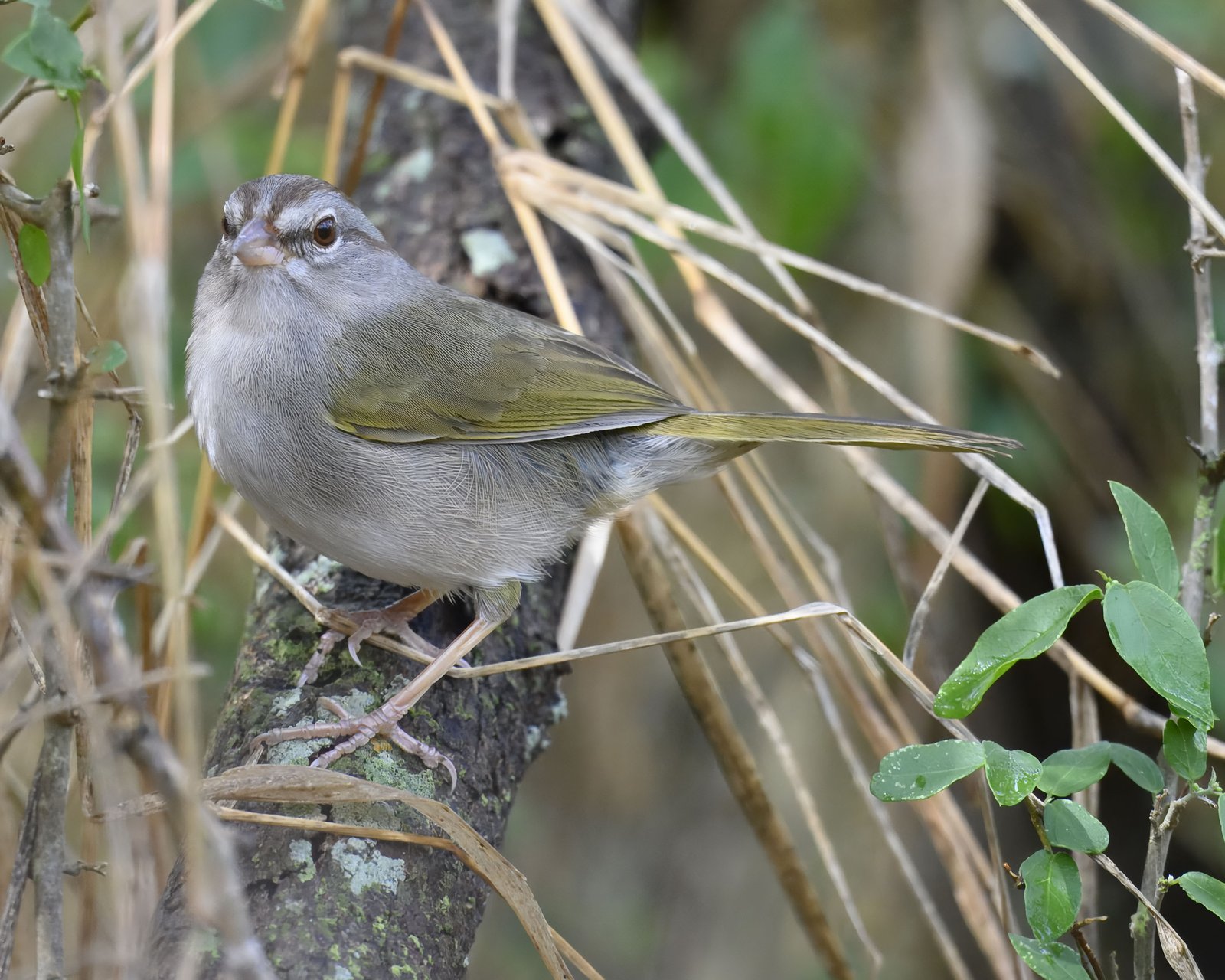
The Olive Sparrow is a fairly large, olive-green sparrow with two brown crown stripes that lives mainly on the ground in dense scrub. It is heard more often than seen. In the guide area it occurs in dry and semi-arid lowlands, from north-eastern Mexico to the Yucatán Peninsula, on the Pacific slope of Mexico and in north-western Costa Rica.
Voice
The song is a series of dry, sharp chips that speeds up and ends in a trill, like a bouncing ping-pong ball. The call is a dry chip and a high, hissing tseee.
Recording: Richard E. Webster — CC BY-NC-SA 4.0 · converted to mono · xeno-canto
Identification
14–16 cm. Upperparts plain olive-green, tail and wings slightly greener. Head grey with two broad rufous-brown to brown crown stripes separated by a grey central stripe, and a narrow brown eye-stripe. Throat and belly dull white, breast and flanks greyish beige to buff. Bill fairly long, upper mandible dark, lower mandible paler. The sexes are alike; juveniles are browner and faintly streaked.
Confusion species
Green-backed Sparrow Arremonops chloronotus (southern Yucatán Peninsula and Belize to Honduras) has black rather than brown crown and eye stripes, a brighter green back and lives in more humid country. Black-striped Sparrow Arremonops conirostris is larger, with broad black head stripes, and lives further south. Green-tailed Towhee Pipilo chlorurus, a winter visitor to northern Mexico, has a rufous crown, a white throat and a grey breast.
Habitat
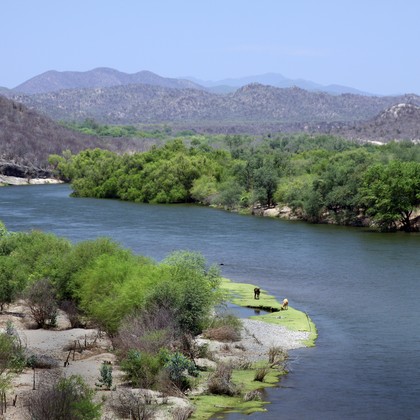
Dense, dry to semi-arid scrub, thornscrub, edges and understorey of dry and semi-humid forest, riparian woodland and overgrown field edges in the lowlands and foothills. It forages on the ground, scratching among leaf litter for insects and seeds. It builds a domed nest with a side entrance low in a bush.
Where the bird is most at home, classified by the vegetation units of Mexico and Central America.




Range and movements
Extreme southern Texas. In the guide area in north-eastern Mexico (Coahuila, Nuevo León, Tamaulipas) and south along the Gulf Coast to Veracruz, on the Yucatán Peninsula, on the Pacific slope of Mexico from Sinaloa to Oaxaca and Chiapas, and in north-western Costa Rica.
- Resident
- dark = core range, pale = thinly spread
How and when to look
Best found by listening for the bouncing song or for rustling leaves on the ground at the edge of dense scrub; the bird often emerges briefly into a clearing or onto a track.
Conservation status
Not threatened (LC). Common in suitable scrub; declining locally where thornscrub and dry forest are converted to farmland.
Scientific name
Arremonops rufivirgatus | (Lawrence, 1851)
Lawrence described the species in 1851 as Embernagra rufivirgata; because it was later moved to another genus, the author and year stand in brackets. The genus Arremonops was introduced in 1896 by Ridgway. Arremonops is formed from the genus Arremon and Greek ōps 'appearance': 'resembling Arremon', as Ridgway considered it closely related. rufivirgatus is Latin, from rufus 'rufous' and virgatus 'striped', after the rufous crown stripes. The specimen the first description was based on came from Brownsville, Texas (Rio Grande), USA.