All species › Passerines › Mockingbirds and thrashers › Ocellated Thrasher
Position in the tree Birds Aves › Birds with a flexible palate Neognathae › All other modern birds Neoaves › Landbirds Telluraves › Falcons, parrots and passerines Australaves › Falcons and passerines Eufalconimorphae › Parrots and passerines Psittacopasserae
Ocellated Thrasher | Toxostoma ocellatum
Gevlekte spotlijster | Cuitlacoche manchado
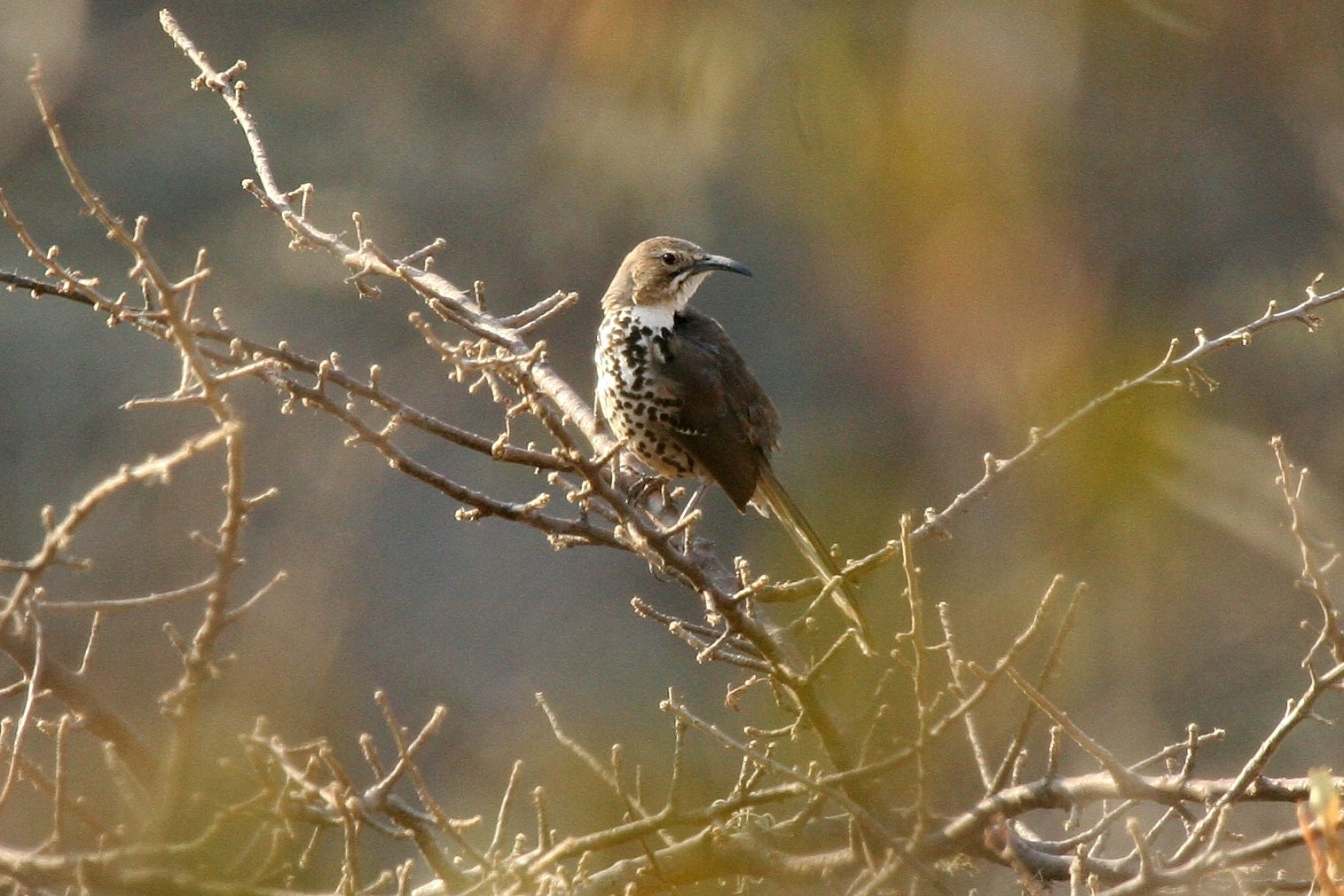
The Ocellated Thrasher is a large thrasher of dry scrub in the highlands of central Mexico, recognised by the large, round black spots on its pale underparts. It lives hidden and is easiest to find in spring, when it sings from the top of a bush. The species occurs only in Mexico.
Voice
A rich, varied song of whistled and hoarse phrases, often repeated twice, resembling that of other thrashers. Call a dry chak.
Recording: Manuel Grosselet — CC BY-NC-SA 4.0 · converted to mono · xeno-canto
Identification
27–30 cm. Upperparts grey-brown. Underparts white to pale buff, densely covered on breast and flanks with large, round blackish spots. Head with a short pale supercilium, dark cheeks and a dark malar stripe. Two narrow white wing bars. Bill long, black and decurved; tail long. The sexes are alike.
Confusion species
Curve-billed Thrasher Toxostoma curvirostre has much fainter, grey breast spots, an orange eye and a plainer face. Long-billed Thrasher Toxostoma longirostre is rufous-brown above, has black streaks instead of round spots and lives in the lowlands of the north-east.
Habitat
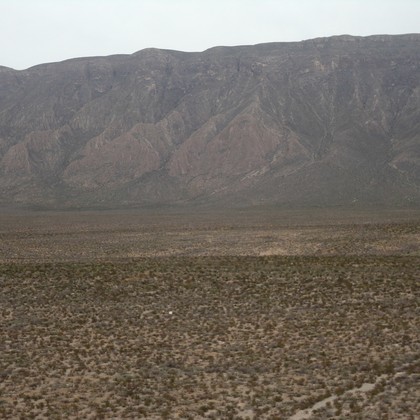
Dry to semi-arid highland scrub with acacia, agave and cacti, also open oak and juniper scrub and the edges of pine-oak forest, mostly between 1400 and 3000 m. It forages on the ground beneath shrubs for insects.
Where the bird is most at home, classified by the vegetation units of Mexico and Central America.


Range and movements
Endemic to the highlands of central Mexico, from Guanajuato and Hidalgo south through the State of Mexico, Puebla and Tlaxcala to Oaxaca. It does not occur outside the guide area.
- Resident
- dark = core range, pale = thinly spread
How and when to look
In spring, mainly March to June, males sing early in the morning from the top of a shrub or agave; at other times the species is seldom seen.
Conservation status
Not threatened (LC). Rather scarce and local; dry highland scrub is under pressure from grazing, cultivation and expanding cities.
Scientific name
Toxostoma ocellatum | (Sclater, 1862)
Sclater described the species in 1862 as Harporhynchus ocellatus; because it was later moved to another genus, the author and year stand in brackets. The genus Toxostoma was introduced in 1831 by Wagler. Toxostoma is Greek, from toxon 'bow' and stoma 'mouth', after the long, curved bill. ocellatum is Latin for 'with eye-spots' (from ocellus 'little eye'), after the round dark spots on breast and belly. The specimen the first description was based on came from Oaxaca, Mexico.