All species › Passerines › New World sparrows › Oaxaca Sparrow
Position in the tree Birds Aves › Birds with a flexible palate Neognathae › All other modern birds Neoaves › Landbirds Telluraves › Falcons, parrots and passerines Australaves › Falcons and passerines Eufalconimorphae › Parrots and passerines Psittacopasserae
Oaxaca Sparrow | Aimophila notosticta
Oaxacagors | Zacatonero oaxaqueño
The Oaxaca Sparrow is a medium-sized, dark sparrow of dry scrub on the slopes of the interior valleys of Oaxaca. It is closely related to the Rusty Sparrow and occurs only in a small part of southern Mexico. Outside the song period it is inconspicuous and often stays low in the shrubs.
Voice
The song is a short, clear phrase of whistled notes, often ending in a fast trill, similar to that of Rusty Sparrow. The call is a sharp tsip and a fast, dry chatter.
Recording: Manuel Grosselet — CC BY-NC-SA 4.0 · converted to mono · xeno-canto
Identification
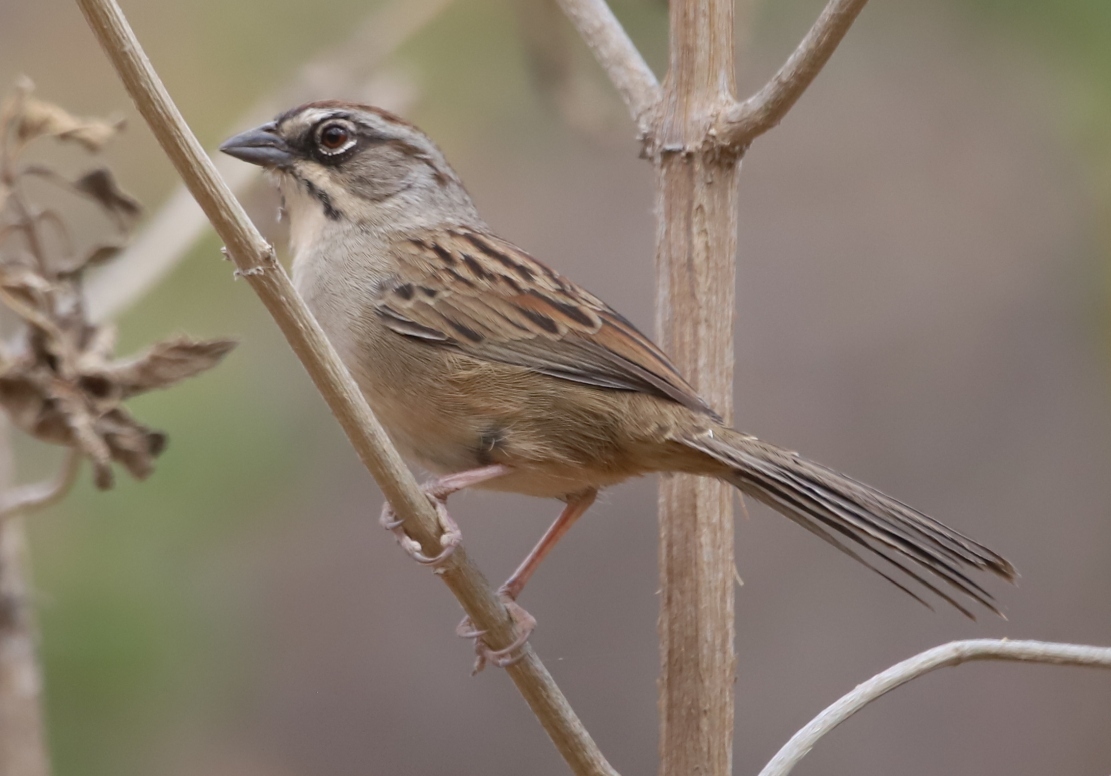
16–17 cm. Crown dark rufous-brown with a narrow grey central stripe; supercilium grey, white in front of the eye, with a narrow dark eye-stripe, a narrow white eye-ring and a sharp black malar stripe beside a white throat. Back brown with distinct black streaks; wings and long tail warm brown. Underparts grey, flanks greyish-brown. Bill entirely blackish. The sexes are alike.
Confusion species
Rusty Sparrow Aimophila rufescens is larger and warmer rufous, with a heavy two-toned bill with a bluish-grey lower mandible and a less heavily streaked back. Rufous-crowned Sparrow Aimophila ruficeps is smaller and paler grey, with a plain rufous crown and a paler lower mandible. Bridled Sparrow Peucaea mystacalis, which lives in the same valleys, has a black throat, a white moustachial stripe and white wing bars.
Habitat
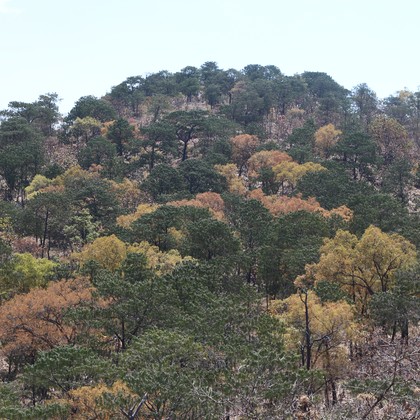
Dry thorn scrub and brush with scattered oaks and grasses on rocky slopes, also edges of dry forest and low oak groves, at about 1500 to 2100 m. It feeds on the ground under shrubs on seeds and insects.
Where the bird is most at home, classified by the vegetation units of Mexico and Central America.


Range and movements
Endemic to Mexico. Mainly in the interior valleys and surrounding slopes of central Oaxaca, such as the Valles Centrales and the Tehuacán-Cuicatlán valley, with a few sites in adjacent southern Puebla.
- Resident
- dark = core range, pale = thinly spread
How and when to look
Well-known sites are the slopes at Yagul and Teotitlán del Valle east of the city of Oaxaca. The chance is greatest early in the morning, when the birds are singing.
Conservation status
Not threatened (LC). The range is small and the species is locally scarce; overgrazing by goats, fires, woodcutting and the expansion of fields and settlements degrade the scrub.
Scientific name
Aimophila notosticta | (Sclater & Salvin, 1868)
Sclater & Salvin described the species in 1868 as Peucaea notosticta; because it was later moved to another genus, the author and year stand in brackets. The genus Aimophila was introduced in 1837 by Swainson. Aimophila is Greek, from haimos 'thicket' and philos 'loving': 'thicket-lover'. notosticta is Greek, from nōton 'back' and stiktos 'spotted', after the streaked back. The specimen the first description was based on came from central Mexico (probably Puebla).