All species › Passerines › Tyrant flycatchers and allies › Northern Tufted Flycatcher
Position in the tree Birds Aves › Birds with a flexible palate Neognathae › All other modern birds Neoaves › Landbirds Telluraves › Falcons, parrots and passerines Australaves › Falcons and passerines Eufalconimorphae › Parrots and passerines Psittacopasserae
Northern Tufted Flycatcher | Mitrephanes phaeocercus
Noordelijke kuiftiran | Mosquero copetón
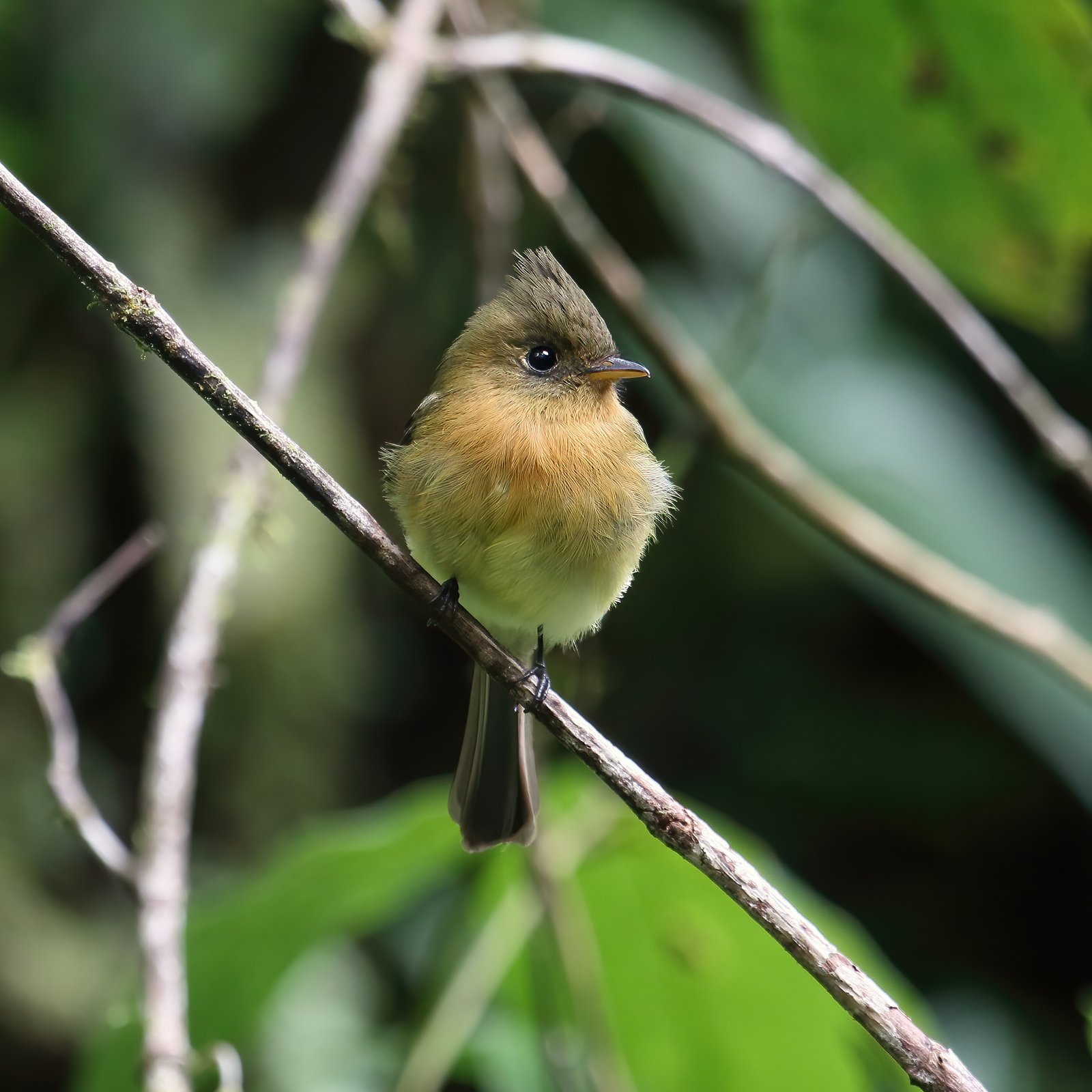
The Northern Tufted Flycatcher is a small tyrant flycatcher with a pointed crest and a cinnamon breast that lives in montane forests from Mexico to Panama. Like a pewee it sallies after insects from an open perch and often returns to the same branch, quivering its tail on landing.
Voice
A rapid series of clear, whistled pee-pee-pee notes, often given on returning to the perch.
Recording: Manuel Grosselet - Rebeca Martinez — CC BY-NC-SA 4.0 · shortened to the first 60 s, mono · xeno-canto
Identification
12–13 cm, with a pointed crest. Head and back olive-brown to olive. Throat and breast cinnamon to ochre-brown, belly yellowish. Wings and tail dark, with two pale, buffy wing-bars. Bill short and broad, the lower mandible pale. Male and female are alike.
Confusion species
Buff-breasted Flycatcher Empidonax fulvifrons has no crest, is smaller and greyer brown, with a white eye-ring, and lives in open pine woodland. Ochraceous Pewee Contopus ochraceus (Costa Rica and western Panama) is much larger, with an olive breast and a yellow belly. Greater Pewee Contopus pertinax also has a pointed crest but is much larger and grey, without cinnamon.
Habitat
Edges and clearings of cloud forest, montane rainforest, pine-oak forest and foothill forest, also along streams and roads through forest and in shade coffee, mainly above about 600 m and up to over 3000 m. It perches on an open branch or at the forest edge and catches insects in the air.
Where the bird is most at home, classified by the vegetation units of Mexico and Central America.






Range and movements
From north-western Mexico (Sonora and Chihuahua) through the mountains of Mexico and Central America to Panama. North of the guide area a rare visitor to Arizona and Texas.
- Resident
- dark = core range, pale = thinly spread
How and when to look
Common in the mountains of Costa Rica, for example around Monteverde and San Gerardo de Dota; the crest, cinnamon breast and tail-quivering after each sally make it distinctive.
Conservation status
Not threatened. Common in montane forest and at forest edges.
Scientific name
Mitrephanes phaeocercus | (Sclater, 1859)
Sclater described the species in 1859 as Mitrephorus phaeocercus; because it was later moved to another genus, the author and year stand in brackets. The genus Mitrephanes was introduced in 1882 by Coues. Mitrephanes is Greek, from mitra 'headband, turban' and -phanēs 'showing', after the crest. phaeocercus is Greek, from phaios 'dusky' and kerkos 'tail', after the dark tail. The specimen the first description was based on came from Córdoba, Veracruz, Mexico.