All species › Owls › Owls › Northern Pygmy Owl
Position in the tree Birds Aves › Birds with a flexible palate Neognathae › All other modern birds Neoaves › Landbirds Telluraves › Raptors, owls, kingfishers and woodpeckers Afroaves › Hawks and owls Hieraves
Northern Pygmy Owl | Glaucidium gnoma
Bergdwerguil | Tecolote serrano
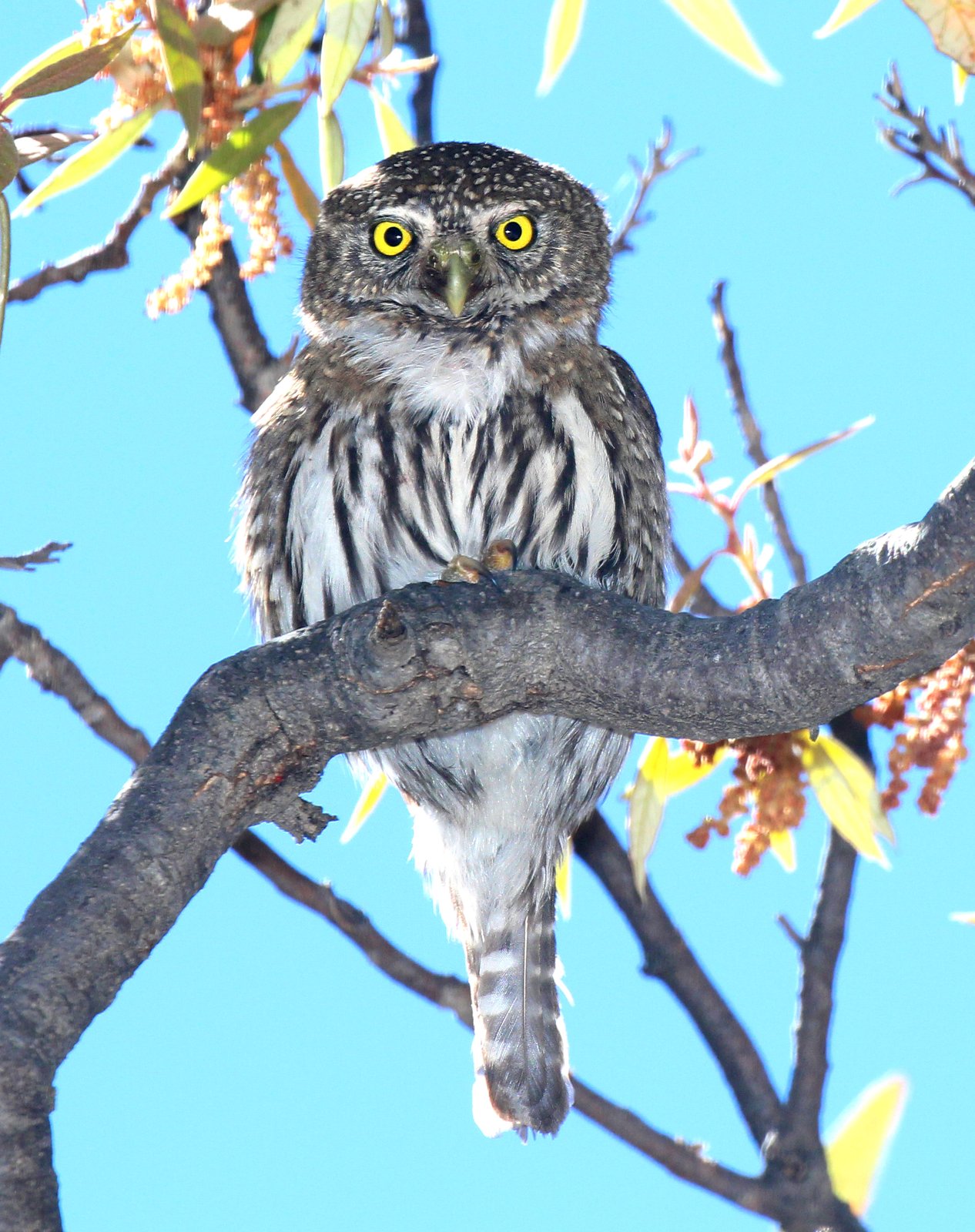
The Northern Pygmy Owl is a small pygmy owl of montane conifer and oak forest, from western North America to Honduras. It hunts both by day and at dusk and carries two dark spots on the nape that act as a second pair of eyes. This guide treats the species in the broad sense: the form of Baja California Sur, the form of Guatemala and Honduras and the northern forms are regarded by some authors as separate species. The song differs between forms and is the key feature.
Voice
The song consists of hollow, whistled toots with pauses between them. On the Mexican mainland and in Guatemala and Honduras the toots are often paired, toot-toot … toot-toot, or given in short groups. Birds from the northwest and from Baja California more often give single toots at regular intervals. Also a rapid trill. Sings by day as well; small birds often respond with alarm calls.
Recording: GABRIEL LEITE — CC BY-NC-SA 4.0 · shortened to the first 60 s, mono · xeno-canto
Identification
15–17 cm, with a round head without ear tufts, yellow eyes and a fairly long tail. The upperparts are grey-brown to rufous-brown, with small white or buff dots on the crown and forehead. On the nape are two black spots bordered white: the false eyes. The tail is dark with narrow white or pale bars. The underparts are white, with dark brown streaks on the flanks and belly and brown breast sides. There are grey-brown and rufous birds.
Confusion species
The Ferruginous Pygmy Owl Glaucidium brasilianum lives lower, in dry and humid lowlands, has fine pale streaks instead of dots on the crown and a rufous or dark tail with pale bars; its song is a long, rapid series of dozens of toots. The Colima Pygmy Owl Glaucidium palmarum of the Pacific lowlands and the Tamaulipas Pygmy Owl Glaucidium sanchezi of the humid montane forest of the Sierra Madre Oriental are smaller and have different call series. The Elf Owl Micrathene whitneyi has a short tail and is active only at night.
Habitat
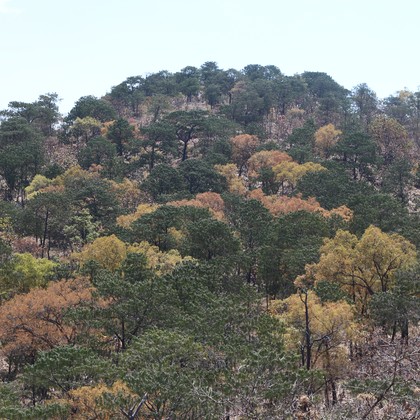
Montane pine-oak, oak and conifer forest and cloud forest, also forest edges and open woodland with scattered large trees; in the guide area mainly above about 1500 m. It nests in old woodpecker holes. By day and at dusk it hunts from a perch for small birds, lizards, mice and large insects, sometimes taking prey heavier than itself.
Where the bird is most at home, classified by the vegetation units of Mexico and Central America.



Range and movements
Resident in the mountains of the guide area: in the Sierra de la Laguna in southern Baja California Sur, in the Sierra Madre Occidental from Sonora and Chihuahua to Jalisco, in the Sierra Madre Oriental from Coahuila and Nuevo León southward, in the volcanic belt and the Sierra Madre del Sur, in Oaxaca and Chiapas, and further in the highlands of Guatemala, El Salvador and Honduras. Outside the guide area in the mountains of the western United States and Canada and in southeastern Alaska.
- Resident
- dark = core range, pale = thinly spread
How and when to look
Singing birds can be heard year-round, also by day; a flock of small birds giving alarm calls often points to a pygmy owl. Suitable places are the pine-oak forest of the Sierra de la Laguna in Baja California Sur, the mountains around San Cristóbal de las Casas in Chiapas and the highlands of Guatemala.
Conservation status
Not threatened. Little is known about the numbers of the individual forms in Mexico and Central America; the Baja California Sur form has a small range.
Scientific name
Glaucidium gnoma | Wagler, 1832
Wagler described the species in 1832 and placed it straight away in the genus where it still stands. The genus Glaucidium was introduced in 1826 by Boie. Glaucidium is Greek glaukidion 'little owl' or 'owlet', a diminutive of glaux 'owl'. gnoma is New Latin, from gnomus 'gnome, goblin', after the tiny owl. The specimen the first description was based on came from Mexico (not specified).