All species › Waders, gulls and terns › Plovers and lapwings › Mountain Plover
Position in the tree Birds Aves › Birds with a flexible palate Neognathae › All other modern birds Neoaves › Birds of the elements Elementaves › Cranes and waders Gruimorphae
Mountain Plover | Anarhynchus montanus
Bergplevier | Chorlo llanero
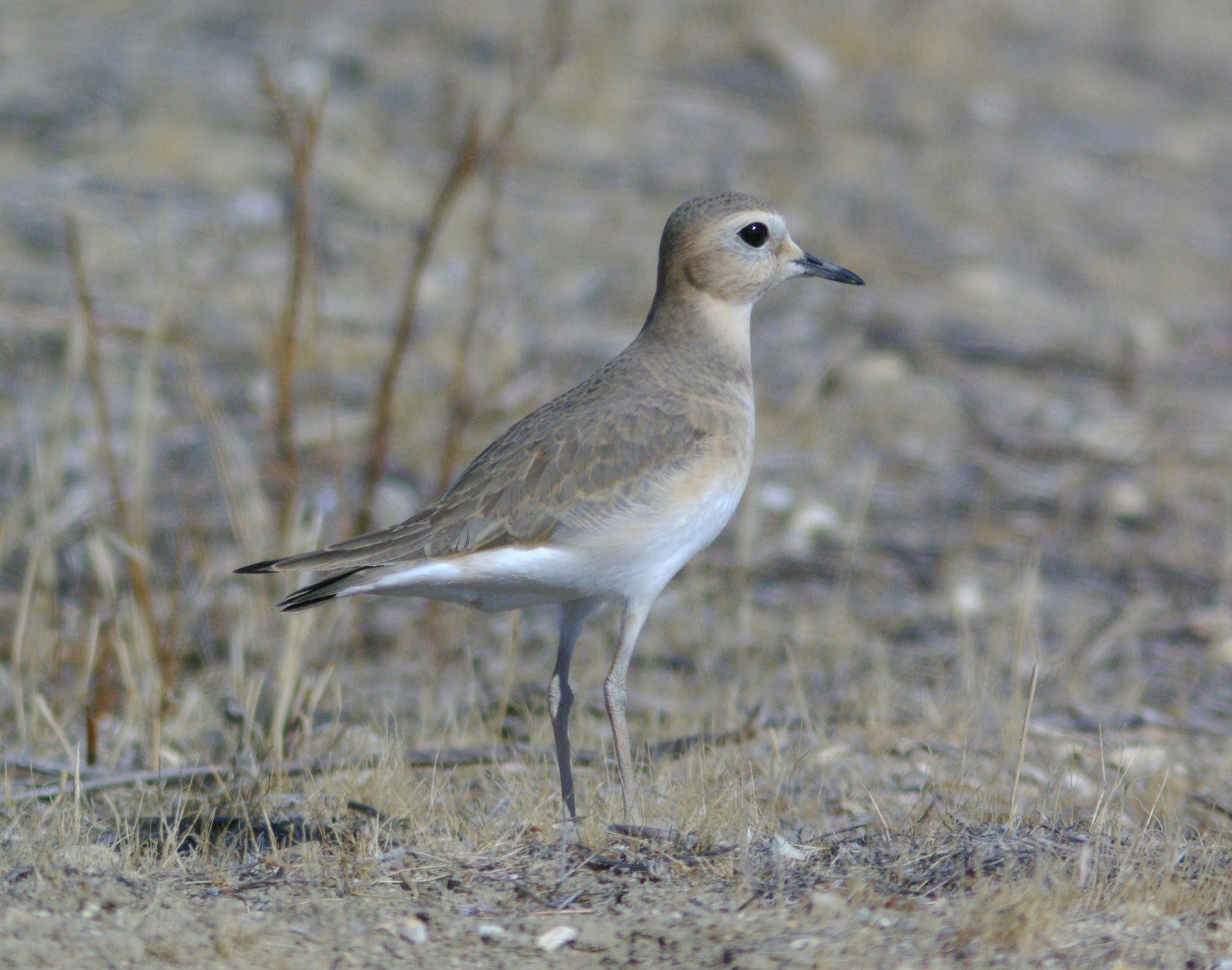
Despite its name, the Mountain Plover is a bird of dry, short-grass plains. It breeds on the prairies and high plains of the western United States and part of the population winters in northern Mexico. It is a plain sandy-brown plover without a breast band, rarely found near water.
Voice
Usually silent in winter. Sometimes a low, rattling krrr or a short, dry kip, especially when flushed.
Recording: Dan Lane — CC BY-NC-SA 3.0 · converted to mono · xeno-canto
Identification
21–24 cm. A fairly large, upright plover with a round head, a thin black bill and long, dull yellowish-brown to flesh-coloured legs. No breast band: the upperparts are plain sandy brown, the breast is washed pale brownish and the belly is white. In non-breeding plumage the head is almost unmarked, with a pale supercilium; in breeding plumage, which may already show in spring, a black band on the forecrown and a narrow black loral stripe. In flight a narrow white wing bar, white underwings and a tail with a dark subterminal band and white edges.
Confusion species
American Golden-Plover Pluvialis dominica in non-breeding plumage is larger and greyer, with speckled upperparts, grey underwings and a dark crown. Killdeer Charadrius vociferus has two black breast bands and an orange rump. Buff-breasted Sandpiper Calidris subruficollis is smaller, with scaly upperparts and entirely buff underparts, and Upland Sandpiper Bartramia longicauda has a long neck, a small head and a streaked breast.
Habitat
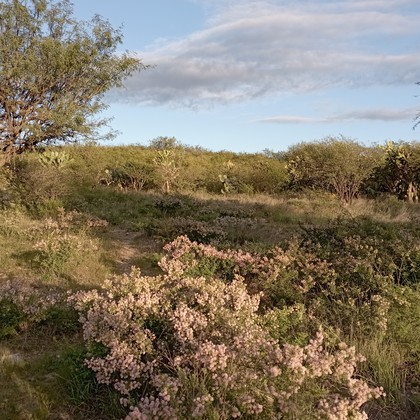
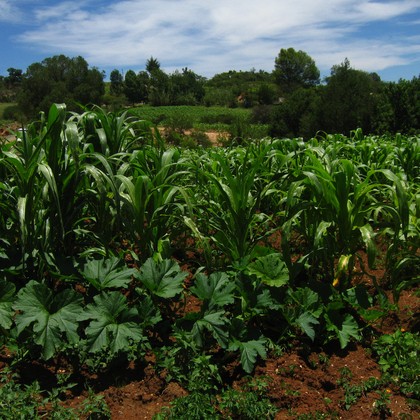
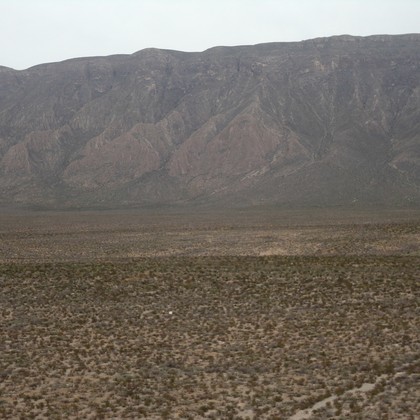
Short-grazed and overgrazed grassland, bare or freshly ploughed fields, fallow land and dry plains with scattered low scrub, on the plateau and in dry lowlands. Avoids tall grass and water. Forages with short runs, pauses and pecks at beetles, grasshoppers and other insects. Often in flocks in winter.
Where the bird is most at home, classified by the vegetation units of Mexico and Central America.

Range and movements
Winter visitor to northern Mexico: on the plains of Baja California and Sonora, on the plateau of Chihuahua, Coahuila, Durango, Zacatecas and San Luis Potosí, and in the farmland of Tamaulipas. A large part of the population winters outside the guide area in California, Arizona and Texas. Breeds on the prairies and high plains of the western United States, from Montana to New Mexico.
- Winter visitor (c. Oct–Mar)
- dark = core range, pale = thinly spread
How and when to look
Scan bare fields and short-grass plains with a telescope; the birds crouch motionless against the ground and only catch the eye when they move or take flight. Flocks often return to the same fields.
Conservation status
Near Threatened. The population is small and declining through the loss of short-grass prairie, the control of prairie dogs, whose colonies provide suitable breeding habitat, and the conversion of grassland to cropland. In the Mexican wintering areas, too, grassland is disappearing through the expansion and intensification of agriculture.
Scientific name
Anarhynchus montanus | (Townsend, 1837)
Townsend described the species in 1837 as Charadrius montanus; because it was later moved to another genus, the author and year stand in brackets. The genus Anarhynchus was introduced in 1832 by Quoy & Gaimard. Anarhynchus is Greek, from ana- 'backward' and rhunkhos 'bill', after the sideways-bent bill of the wrybill, the type species of the genus. montanus is Latin for 'of the mountains', after the type locality in the Rocky Mountains; the species breeds mainly on dry high plains. The specimen the first description was based on came from the Sweetwater River, Wyoming.