All species › Passerines › Tanagers and allies › Morelet's Seedeater
Position in the tree Birds Aves › Birds with a flexible palate Neognathae › All other modern birds Neoaves › Landbirds Telluraves › Falcons, parrots and passerines Australaves › Falcons and passerines Eufalconimorphae › Parrots and passerines Psittacopasserae
Morelet's Seedeater | Sporophila morelleti
Morelets dikbekje | Semillero cuelliblanco
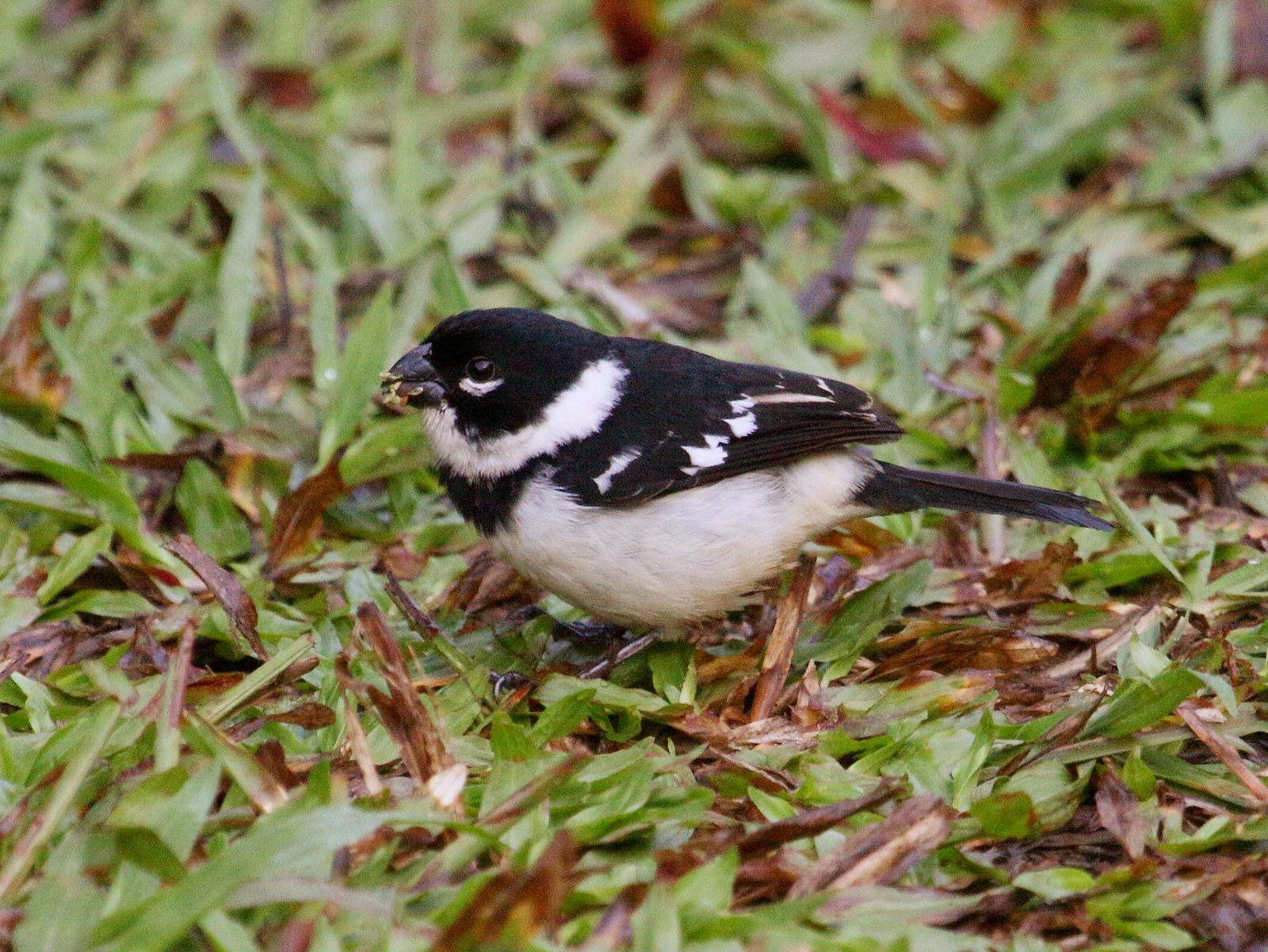
Morelet's Seedeater is the most widespread seedeater in the guide area, a small seed-eater of rank grassland, roadsides and pasture. The male is black and white with white wing bars, the female buffy brown. It often lives in flocks and is common in human-modified landscapes.
Voice
The song is a clear, varied series of whistled notes, often ending in a few descending or repeated notes, like sweet sweet sweet chew chew. The call is a soft, nasal cheh.
Recording: Bobby Wilcox — CC BY-NC-SA 4.0 · converted to mono · xeno-canto
Identification
10–11 cm. Short, thick, rounded bill, blackish in the male, horn-coloured in the female. The male has a black crown and black cheeks, a white throat and a white or pale buff collar; the back is black to grey-mottled, the rump pale grey or buff. The black wings show two white wing bars and a white wing speculum. The underparts are white to pale buffy yellow, with a black breast band that can be complete, broken or absent. The female is olive brown above, pale buff below, with two buffy wing bars.
Confusion species
Cinnamon-rumped Seedeater Sporophila torqueola of western Mexico has a cinnamon rump and cinnamon underparts. The male Variable Seedeater Sporophila corvina lacks wing bars; the female is more uniformly olive brown without wing bars. The female Blue-black Grassquit Volatinia jacarina is streaked on the breast and has a more pointed bill. The male Ruddy-breasted Seedeater Sporophila minuta is rufous below.
Habitat
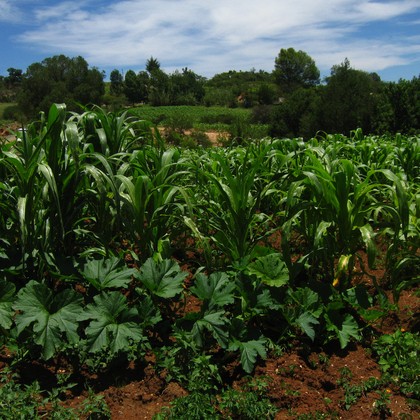
Rank grassland, roadsides, overgrown fields, pasture with bushes, marsh edges, forest edges and villages, from sea level to about 1500 m. Lives in flocks, outside the breeding season sometimes of dozens of birds, often with other seed-eaters; feeds mainly on grass seed.
Where the bird is most at home, classified by the vegetation units of Mexico and Central America.





Range and movements
From the extreme south of Texas and northeastern Mexico south along the Caribbean side, including the Yucatán Peninsula, and through all of northern Central America to western Panama, on both sides of the mountains. Until 2018 treated as one species together with Cinnamon-rumped Seedeater.
- Resident
- dark = core range, pale = thinly spread
How and when to look
Flocks of seed-eaters in tall grass along roads and pastures are worth checking; singing males often perch on wires or bushes. The wing bars are the best feature to separate this species from other seedeaters.
Conservation status
Not threatened (LC). Common and has increased through deforestation; rare and local in Texas. Trapped as a cage bird.
Scientific name
Sporophila morelleti | (Bonaparte, 1850)
Bonaparte described the species in 1850 as Spermophila morelleti; because it was later moved to another genus, the author and year stand in brackets. The genus Sporophila was introduced in 1844 by Cabanis. Sporophila is Greek, from sporos 'seed' and philos 'lover': 'seed-lover'. morelleti honours the French naturalist Pierre Marie Arthur Morelet (1809–1892), who travelled through Yucatán and Guatemala. The specimen the first description was based on came from Petén, Guatemala.