All species › Swifts › Hummingbirds › Mexican Woodnymph
Position in the tree Birds Aves › Birds with a flexible palate Neognathae › All other modern birds Neoaves › Birds of the elements Elementaves › Nightjars and swifts Strisores
Mexican Woodnymph | Eupherusa ridgwayi
Mexicaanse bosnimf | Ninfa mexicana
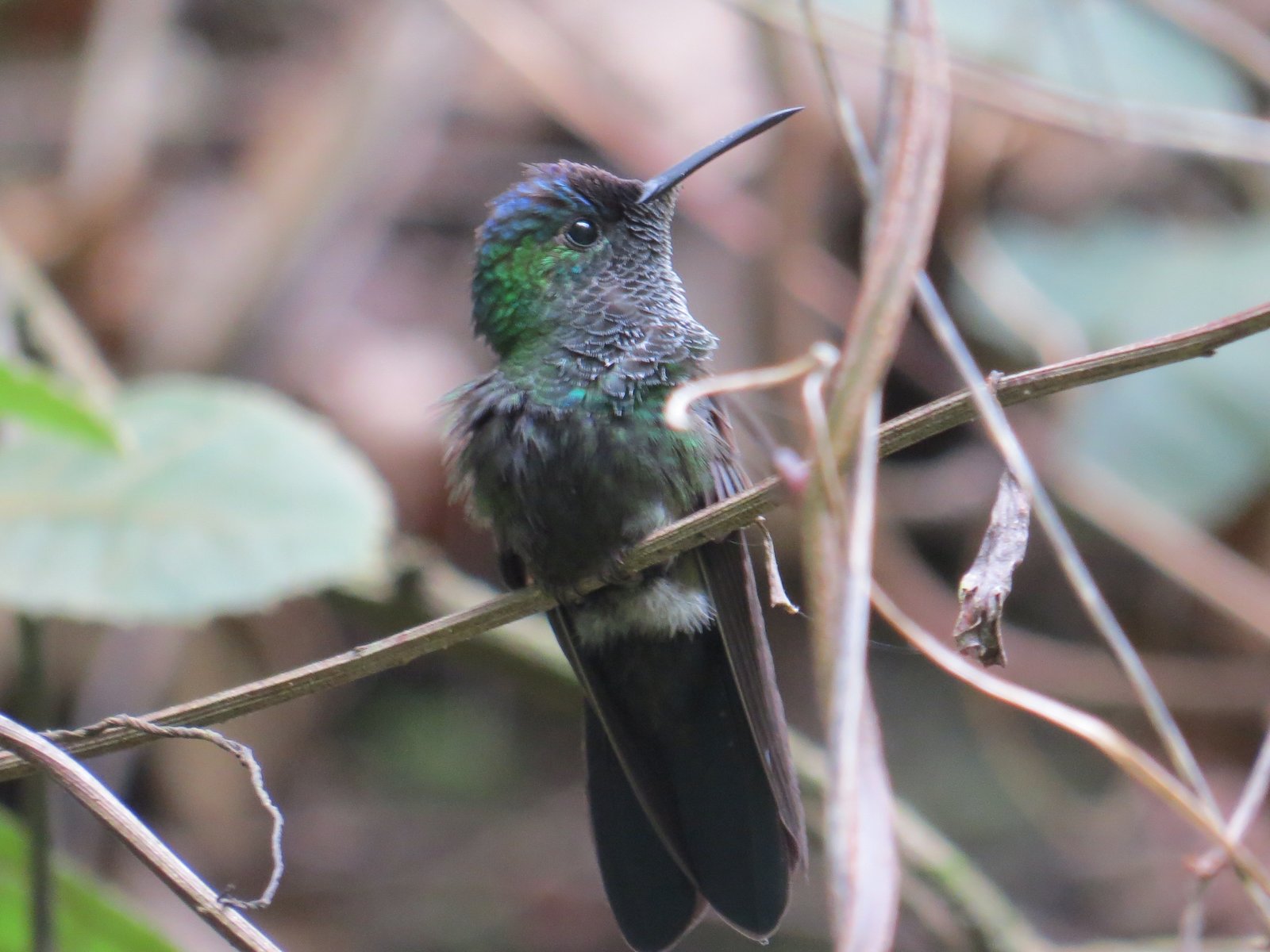
The Mexican Woodnymph is a hummingbird found only in western Mexico, in Nayarit, Jalisco and Colima. The male is green, with an indigo crown and a forked, blue-black tail. The species was formerly placed in the genus Thalurania, with the Crowned Woodnymph, but is more closely related to the other species of Eupherusa.
Voice
An irregular series of two to four quick notes, and as a call a liquid rattle.
Recording: Richard E. Webster — CC BY-NC-SA 4.0 · converted to mono · xeno-canto
Identification
9–10 cm, with a straight black bill. The male is mostly green, with a dull green breast, an indigo crown and a forked, blue-black tail. The female is green above, with darker wings and tail, a white spot behind the eye and pale grey underparts with green patches on the sides of the breast; the crown is green.
Confusion species
Berylline Hummingbird Saucerottia beryllina has rufous in the wings, a purplish-brown tail and a red base to the lower mandible. Males of Golden-crowned Emerald Cynanthus auriceps and Broad-billed Hummingbird Cynanthus latirostris have a red bill with a dark tip; Broad-billed also has a blue throat. Violet-crowned Hummingbird Ramosomyia violiceps has white underparts and a red bill.
Habitat
Humid forest in canyons and foothills, forest edges, open woodland and locally coffee plantations, at about 250 to 1200 m. It feeds in the understorey and middle strata at flowers of shrubs and epiphytes.
Where the bird is most at home, classified by the vegetation units of Mexico and Central America.





Range and movements
Endemic to the guide area and to Mexico. Only on the Pacific slope in the west, in Nayarit, Jalisco and Colima, mainly in the mountains around Tepic and San Blas and south of Puerto Vallarta.
- Resident
- dark = core range, pale = thinly spread
How and when to look
In the Sierra de San Juan near Tepic, for example around La Noria and El Cuarenteño, and along the road from La Palma to Tecuitata near San Blas; also in the Vallarta botanical garden south of Puerto Vallarta.
Conservation status
Vulnerable. The range is small and forest in western Mexico is being lost to logging and clearing. The species depends on humid forest in canyons and on slopes.
Scientific name
Eupherusa ridgwayi | (Nelson, 1900)
Nelson described the species in 1900 as Thalurania ridgwayi; because it was later moved to another genus, the author and year stand in brackets. The genus Eupherusa was introduced in 1857 by Gould. Eupherusa is Greek, from eu 'well, finely' and pherousa 'bearing' (from pherō 'to carry'): 'finely bearing', probably after the boldly patterned tail. ridgwayi honours the American ornithologist Robert Ridgway (1850–1929), curator of birds at the Smithsonian. The specimen the first description was based on came from San Sebastián, Jalisco, Mexico.