All species › Swifts › Hummingbirds › Mexican Hermit
Position in the tree Birds Aves › Birds with a flexible palate Neognathae › All other modern birds Neoaves › Birds of the elements Elementaves › Nightjars and swifts Strisores
Mexican Hermit | Phaethornis mexicanus
Mexicaanse heremietkolibrie | Ermitaño mexicano
The Mexican Hermit occurs only in western Mexico, on the Pacific slope, far from all other hermits. For a long time it was regarded as a form of Long-billed Hermit, but since 2015 it has been recognised as a separate species. It lives in two separate areas: in Nayarit, Jalisco and Colima, and in Guerrero and Oaxaca.
Voice
The call is a shrill, drawn-out, slightly slurred sweeek. At the lek, with four to six males, a continuous series of single, metallic notes is given.
Recording: Aziza Cooper — CC BY-NC-SA 4.0 · converted to mono · xeno-canto
Identification
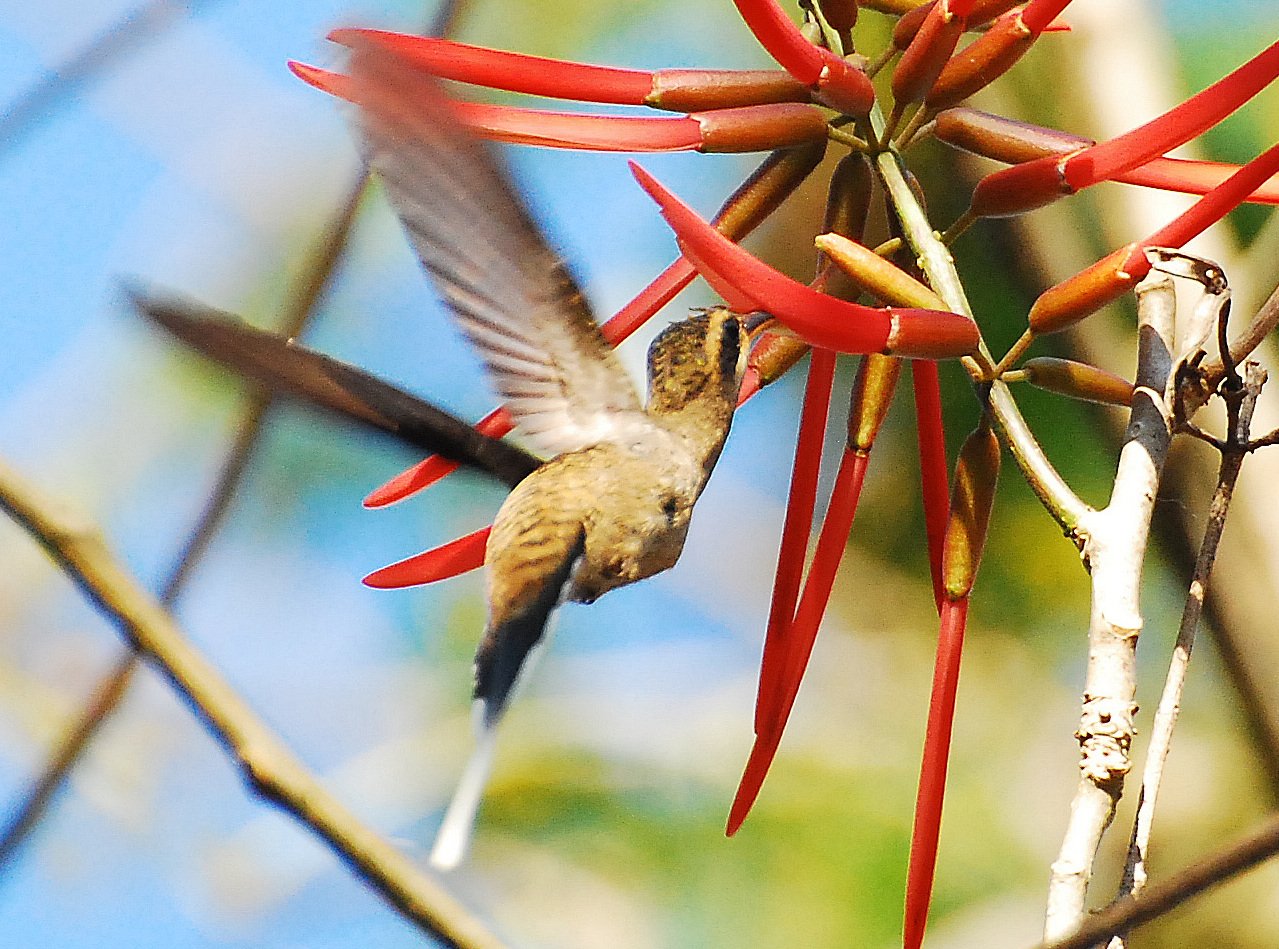
13–14 cm excluding the elongated, white-tipped central tail feathers, which project a further 3 cm or so beyond the tail. The bill is long, about 4 cm, and curved, with a yellow lower mandible. The crown is dusky, the nape and upperparts bronze-green. A black mask runs through the eye, bordered by a pale cinnamon stripe above and a pale moustachial stripe; the throat is pale buff. The tail is blackish with white tips. Birds from Nayarit, Jalisco and Colima are paler and greyer below, with more white in the central tail feathers than those from Guerrero and Oaxaca.
Confusion species
Within its range it is the only hermit and therefore hardly confusable. Long-billed Hermit Phaethornis longirostris lives on the Gulf side and in Chiapas, and is buffier below with shorter central tail feathers. Other hummingbirds of western Mexico, such as Turquoise-crowned Hummingbird Cynanthus doubledayi and Broad-billed Hummingbird Cynanthus latirostris, have a straight, shorter bill and no elongated central tail feathers.
Habitat
Interior and edges of humid evergreen forest, heliconia thickets and humid ravines and gallery forest in semi-deciduous forest, and shady coffee plantations, from sea level to about 2000 m, mostly lower. It forages along a fixed route at heliconias and other flowers with a long corolla.
Where the bird is most at home, classified by the vegetation units of Mexico and Central America.




Range and movements
Endemic to western Mexico, on the Pacific slope. A northern form lives in Nayarit, Jalisco and Colima, the nominate form from south-western Guerrero to south-eastern Oaxaca; in Michoacán the species has hardly been recorded. Locally fairly common, but tied to humid ravines and forest remnants.
- Resident
- Summer visitor (c. Apr–Sep)
- Winter visitor (c. Oct–Mar)
- Passage (Mar–Apr, Oct–Nov)
- dark = core range, pale = thinly spread
How and when to look
In humid ravines and along streams with heliconias in the hills around San Blas and Tepic in Nayarit, and in the coffee region of the Sierra Madre del Sur in Oaxaca. The persistent singing of the males at the lek gives the site away.
Conservation status
Not threatened. The range is small and the population is probably declining through clearance of forest in the ravines, but the species still occurs at many sites.
Scientific name
Phaethornis mexicanus | Hartert, 1897
Hartert described the species in 1897 and placed it straight away in the genus where it still stands. The genus Phaethornis was introduced in 1827 by Swainson. Phaethornis is Greek, from phaethōn 'sun, shining' and ornis 'bird': 'sun-bird'. mexicanus is Latin for 'Mexican', after Mexico, where this species occurs and the type was collected. The specimen the first description was based on came from Dos Arroyos, near Chilpancingo, Guerrero, Mexico.