All species › Passerines › Wrens › Marsh Wren
Position in the tree Birds Aves › Birds with a flexible palate Neognathae › All other modern birds Neoaves › Landbirds Telluraves › Falcons, parrots and passerines Australaves › Falcons and passerines Eufalconimorphae › Parrots and passerines Psittacopasserae
Marsh Wren | Cistothorus palustris
Moeraswinterkoning | Chivirín pantanero
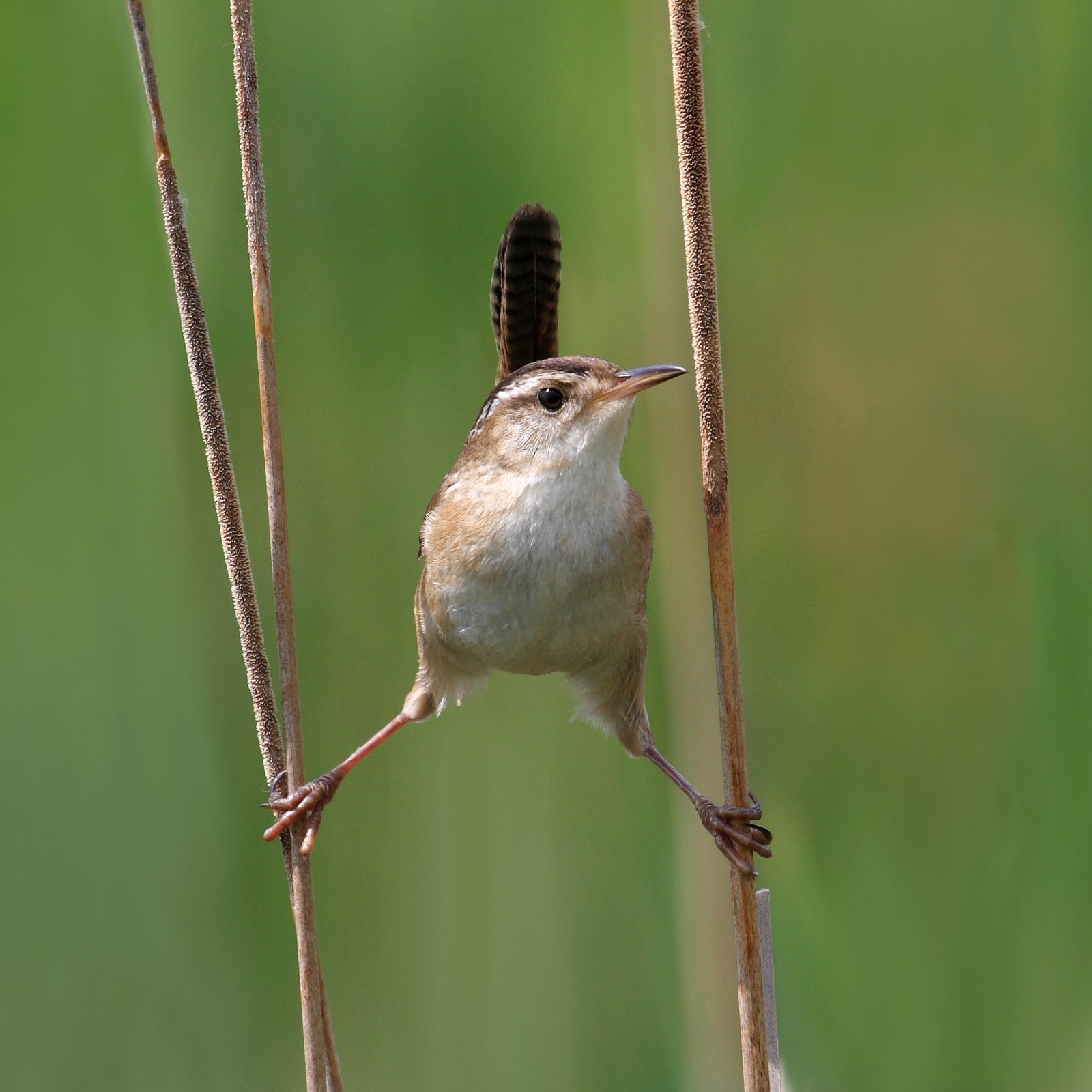
The Marsh Wren is a small, lively wren of reed and cattail marshes. In the guide area it is mainly a winter visitor from North America to northern and central Mexico; there are also local resident birds, among others in the marshes of the central highlands.
Voice
A fast, gurgling and rattling song that starts with a few ticks and ends in a dry trill; also sings at night. The call is a dry chek or tuk.
Recording: Andrew McCafferty — CC BY-NC-SA 4.0 · shortened to the first 60 s, mono · xeno-canto
Identification
10–14 cm. Crown dark brown to blackish, unstreaked, with a clear white supercilium. Upper back with a black patch streaked white; rest of upperparts warm brown, rump rufous. Throat and breast white to off-white, flanks buff to ochre-brown. Wings and tail brown with dark bars. The tail is often cocked. There is much variation between populations: western birds are often paler. The sexes are alike.
Confusion species
Grass Wren Cistothorus platensis has a streaked crown, a faint supercilium and lives in grassland and sedge meadows rather than reeds. Bewick's Wren Thryomanes bewickii has a long tail with white corners and an unstreaked back. Northern House Wren Troglodytes aedon lacks the white supercilium and the streaked back.
Habitat
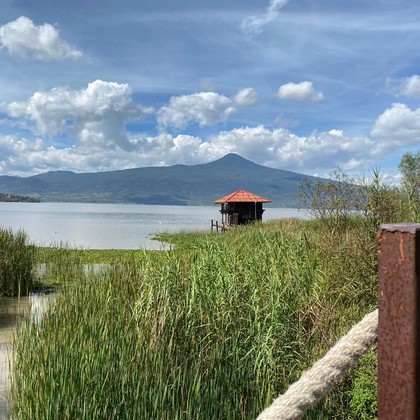
Reed and cattail marshes, bulrush beds, shores of lakes and lagoons, and coastal salt marshes. It searches for insects and spiders low among the stems. The nest is a ball woven between reed stems; males build several nests.
Where the bird is most at home, classified by the vegetation units of Mexico and Central America.


Range and movements
Winter visitor to Baja California and much of northern and central Mexico, south to the centre of the country. Resident birds live locally, among others in the marshes of the central highlands around the upper Lerma. Also breeds across much of North America.
- Winter visitor (c. Oct–Mar)
- dark = core range, pale = thinly spread
How and when to look
In winter more often heard than seen; with patience at the edge of a reedbed it sometimes comes up briefly. The Lerma marshes near Toluca hold resident birds.
Conservation status
Not threatened. Widespread and numerous in North America. The resident birds of the central highlands of Mexico live in small, fragmented marshes that are under pressure from drainage and pollution.
Scientific name
Cistothorus palustris | (Wilson, 1810)
Wilson described the species in 1810 as Certhia palustris; because it was later moved to another genus, the author and year stand in brackets. The genus Cistothorus was introduced in 1851 by Cabanis. Cistothorus is Greek, from kistos 'shrub, rock-rose' and thoos 'nimble, quick': 'nimble shrub-bird'. palustris is Latin for 'of the marsh' (from palus 'marsh'), after its reedbed habitat. The specimen the first description was based on came from Philadelphia, Pennsylvania (United States).