All species › Passerines › Manakins › Long-tailed Manakin
Position in the tree Birds Aves › Birds with a flexible palate Neognathae › All other modern birds Neoaves › Landbirds Telluraves › Falcons, parrots and passerines Australaves › Falcons and passerines Eufalconimorphae › Parrots and passerines Psittacopasserae
Long-tailed Manakin | Chiroxiphia linearis
Langstaartmanakin | Manaquín cola larga
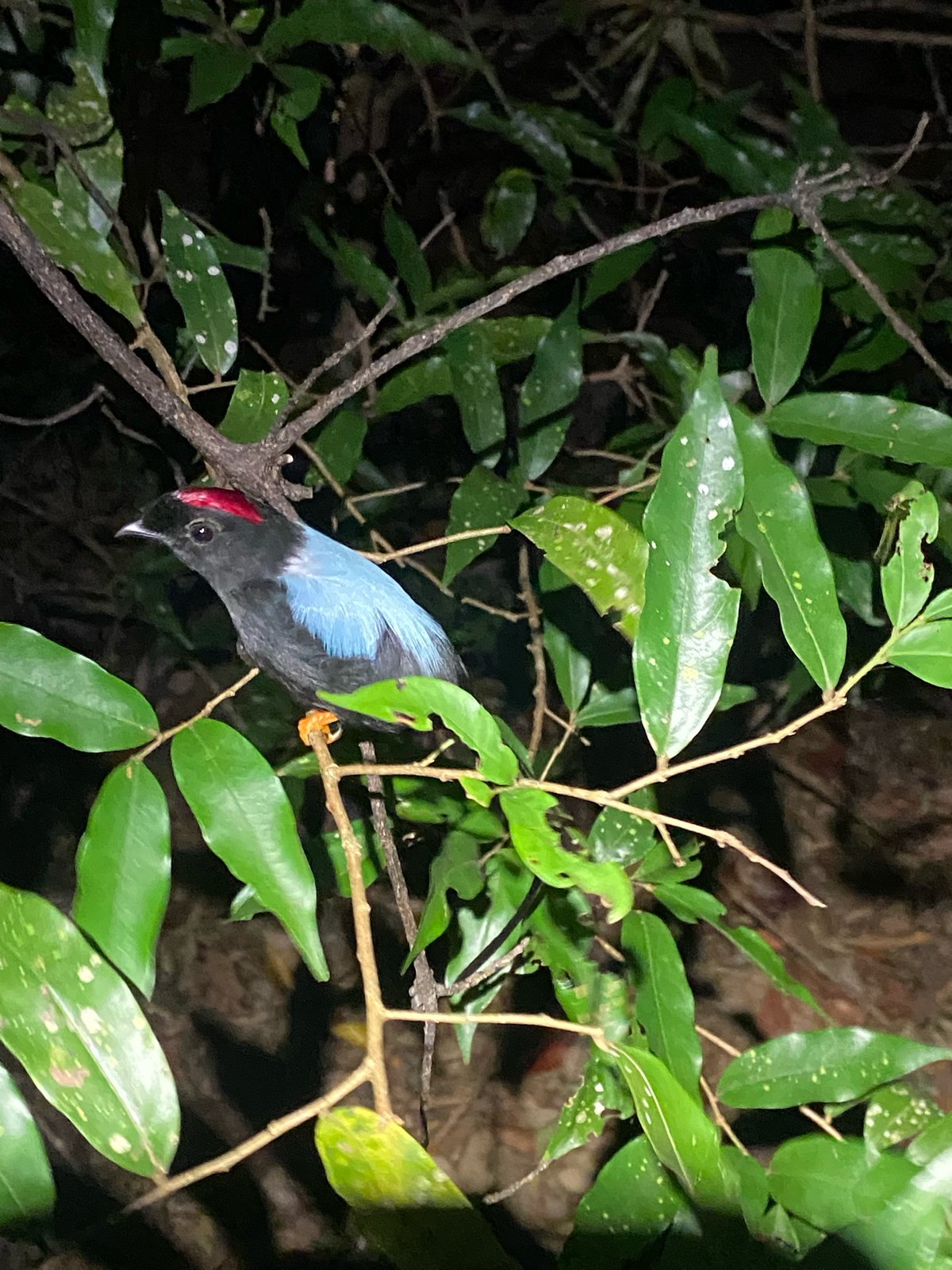
The Long-tailed Manakin is a Chiroxiphia manakin of dry and semi-humid forest on the Pacific slope from Mexico to Costa Rica. The male is black with a sky-blue back, a red crown and two wire-like central tail feathers longer than the bird itself. Two males sing and dance together. The species occurs only in the guide area.
Voice
A clear, whistled to-lay-do, sung almost simultaneously by two males and repeated endlessly. Also nasal, mewing calls and buzzing notes during the dance.
Recording: Pichard Olivier — CC BY-NC 4.0 · shortened to the first 60 s, mono · xeno-canto
Identification
11 cm without the elongated tail feathers; in the adult male the two central tail feathers project a further 10–15 cm, bringing the total length to over 20 cm. Male black with a sky-blue mantle, a red crown and orange legs. Female olive-green, paler below, with orange legs and shorter but also slightly elongated central tail feathers. Young males are olive-green, first with a red crown, and acquire black and blue gradually over several years, the tail feathers lengthening as they do so.
Confusion species
Lance-tailed Manakin Chiroxiphia lanceolata (south-western Costa Rica and Panama) has central tail feathers that are pointed but project only a short way; the two species meet at most in southern Costa Rica. Females of other manakins have a rounded tail without elongated feathers and mostly dark or grey legs.
Habitat
Dry and semi-humid deciduous forest, gallery forest, mature second growth and shade coffee, mainly in the understorey and lower mid-storey, from sea level to about 1500 m. It eats small fruits and insects. Two males form a team that often stays together for years; they sing in duet and dance for a female on a low branch, leapfrogging over each other in turn. Only the dominant male mates.
Where the bird is most at home, classified by the vegetation units of Mexico and Central America.





Range and movements
Pacific slope of southern Mexico (Oaxaca and Chiapas) through Guatemala, El Salvador, southern Honduras and Nicaragua, where it also occurs in the interior, to north-western and central Costa Rica, south to about the middle of the Pacific coast.
- Resident
- dark = core range, pale = thinly spread
How and when to look
Regularly seen at Carara and Palo Verde and on the lower Pacific slopes around Monteverde in Costa Rica. The to-lay-do gives the males away; the dance perch is low in dense forest.
Conservation status
Not threatened. Common in dry and secondary forest and in shade coffee; the main threat is further fragmentation of Pacific dry forest.
Scientific name
Chiroxiphia linearis | (Bonaparte, 1838)
Bonaparte described the species in 1838 as Pipra linearis; because it was later moved to another genus, the author and year stand in brackets. The genus Chiroxiphia was introduced in 1847 by Cabanis. Chiroxiphia is Greek, from kheir 'hand' and xiphos 'sword', after the narrow, sword-shaped outer primaries of the males. linearis is Latin for 'line-like', after the male's very long, thread-like central tail feathers. The specimen the first description was based on came from Santa Efigenia, Oaxaca, Mexico.