All species › Swifts › Hummingbirds › Long-billed Starthroat
Position in the tree Birds Aves › Birds with a flexible palate Neognathae › All other modern birds Neoaves › Birds of the elements Elementaves › Nightjars and swifts Strisores
Long-billed Starthroat | Heliomaster longirostris
Langsnavelsterkeelkolibrie | Colibrí pico largo
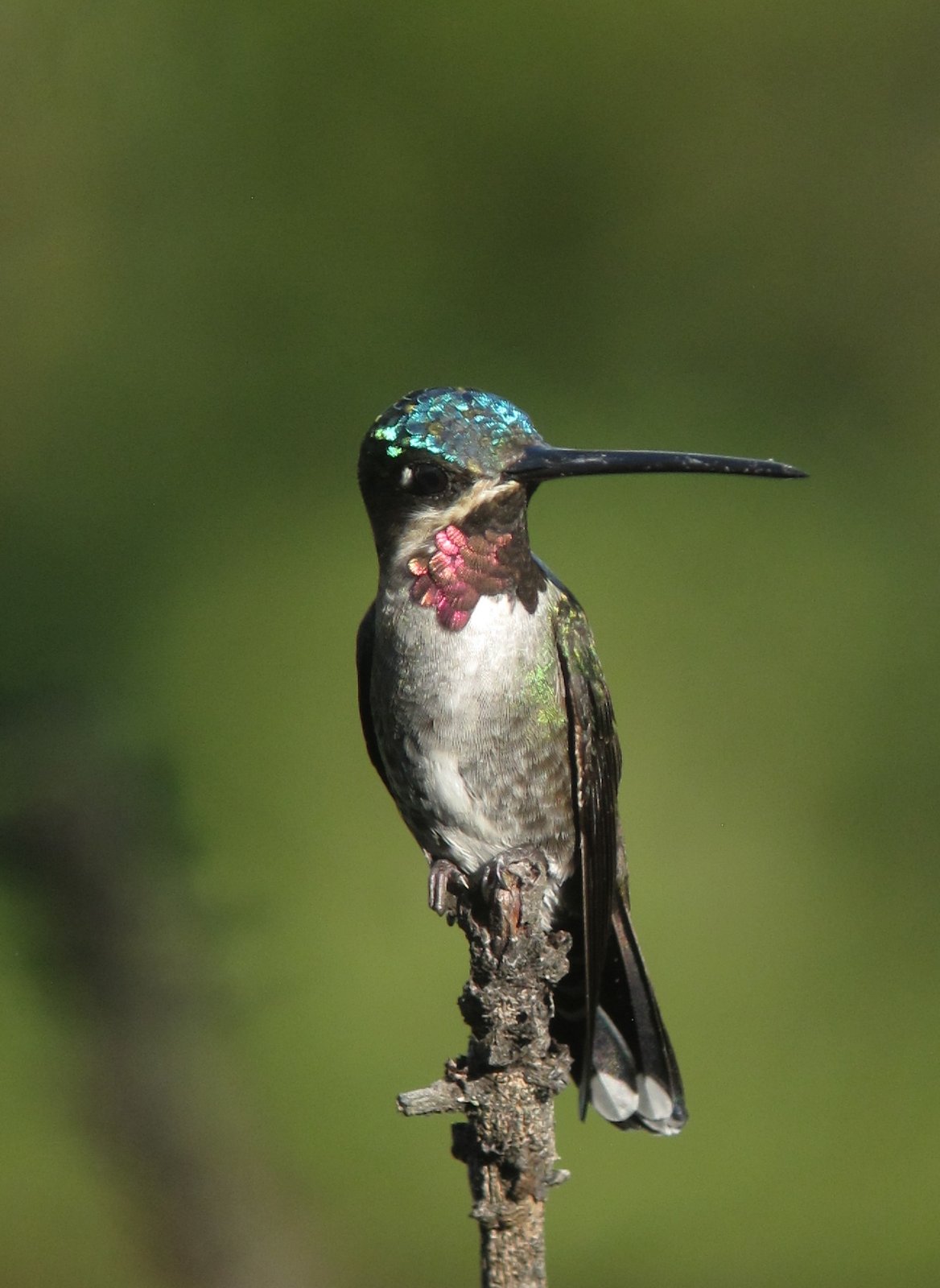
The Long-billed Starthroat is a hummingbird of forest edges and clearings in humid lowlands, from southern Mexico far into South America. It has a very long, straight bill. It often perches high on a bare branch, from where it catches insects in flight.
Voice
Usually silent. A sharp tseek or chip, sometimes repeated a few times.
Recording: JAYRSON ARAUJO DE OLIVEIRA — CC BY-NC-SA 4.0 · converted to mono · xeno-canto
Identification
11–13 cm, with a very long, straight black bill. The upperparts are bronze-green, with a white spot behind the eye and a white stripe on the back, visible mainly in flight. The male has a glittering blue-green crown, a magenta-red throat bordered by white malar stripes, and grey underparts with white tufts on the flanks. The female has a less glittering crown and a smaller, duller throat patch.
Confusion species
Plain-capped Starthroat Heliomaster constantii has a dull, non-glittering crown, a distinct white stripe behind the eye and lives in drier regions. Females of hermits, such as Long-billed Hermit Phaethornis longirostris, have a curved bill and a long tail with white tips. Purple-crowned Fairy Heliothryx barroti has snowy white underparts and a short bill.
Habitat
Forest edges, clearings with scattered trees, gallery forest, shade coffee, plantations and gardens in humid lowlands and foothills, from sea level to about 1300 m. It feeds at flowering trees and vines in the canopy, and catches insects in flight from a high perch.
Where the bird is most at home, classified by the vegetation units of Mexico and Central America.






Range and movements
In Mexico from Guerrero and southern Veracruz southwards, and on through Guatemala, Belize, El Salvador, Honduras, Nicaragua and Costa Rica to Panama, on both sides of the mountains. Outside the guide area in South America south to Bolivia and central Brazil.
- Resident
- dark = core range, pale = thinly spread
How and when to look
At forest edges and in gardens in Carara National Park on the Pacific coast of Costa Rica, and along forest edges around the Panama Canal. Often high in a flowering tree or on a bare branch above the canopy.
Conservation status
Not threatened. Fairly common, but inconspicuous because of its scattered occurrence. It benefits from forest edges and semi-open landscapes.
Scientific name
Heliomaster longirostris | (Audebert & Vieillot, 1801)
Audebert & Vieillot described the species in 1801 as Trochilus longirostris; because it was later moved to another genus, the author and year stand in brackets. The genus Heliomaster was introduced in 1850 by Bonaparte. Heliomaster is Greek, from hēlios 'sun' and mastēr 'seeker': 'sun-seeker'. longirostris is Latin, from longus 'long' and rostrum 'bill', after the long bill. The specimen the first description was based on came from Trinidad.