All species › Woodpeckers and allies › Woodpeckers › Lewis's Woodpecker
Position in the tree Birds Aves › Birds with a flexible palate Neognathae › All other modern birds Neoaves › Landbirds Telluraves › Raptors, owls, kingfishers and woodpeckers Afroaves › Mousebirds, rollers and woodpeckers Coraciimorphae › Trogons and cavity nesters Cavitaves › Hornbills, kingfishers and woodpeckers Picocoraciae › Kingfishers, bee-eaters and woodpeckers Picodynastornithes
Lewis's Woodpecker | Melanerpes lewis
Lewis' specht | Carpintero de Lewis
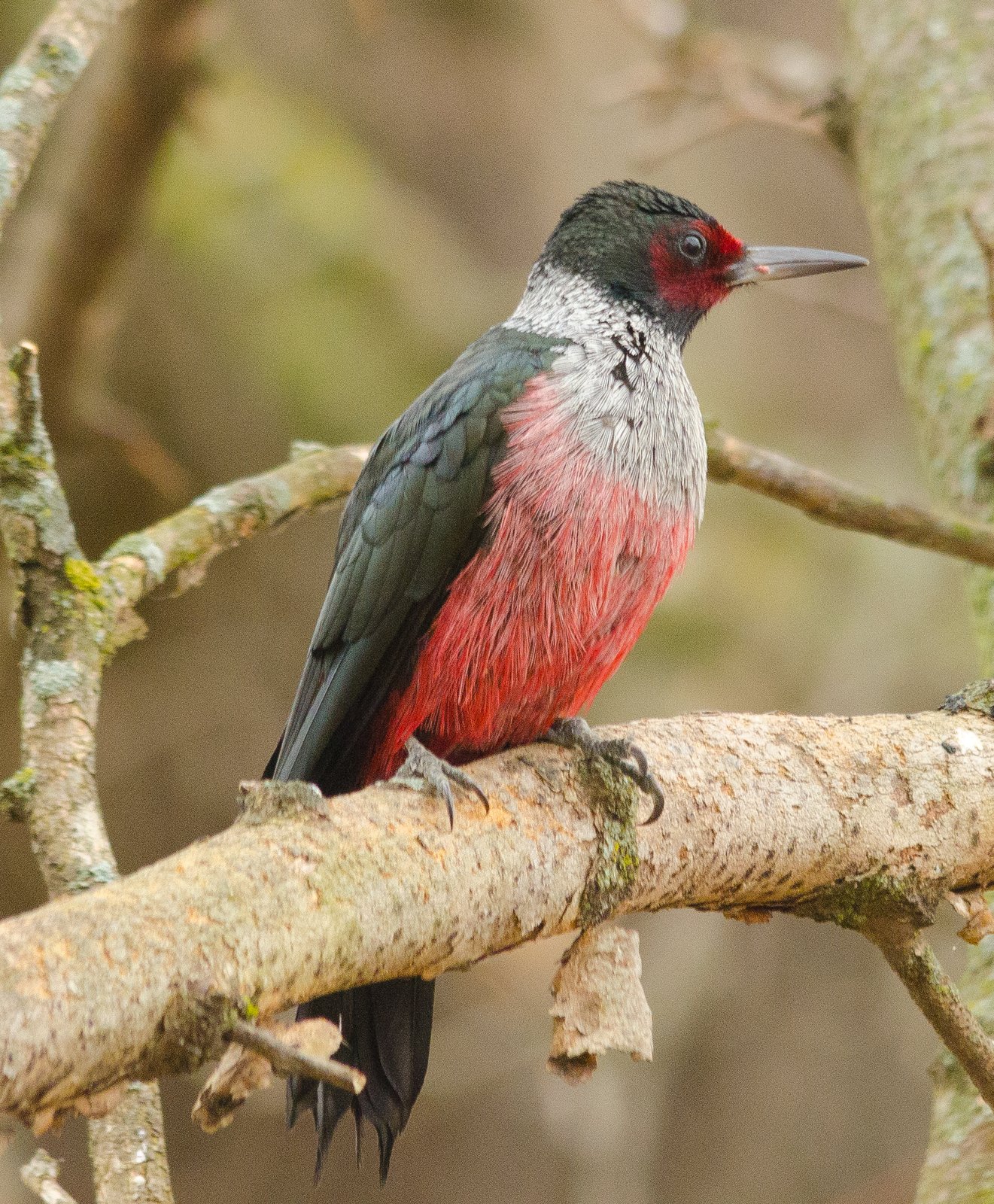
Lewis's Woodpecker is a large, dark woodpecker of open woodland in western North America which in flight looks more like a crow than a woodpecker and catches many insects in the air. In the guide area it is an irregular winter visitor to northern Mexico, in some years in small groups and in others hardly at all. Its name honours Meriwether Lewis, who collected the species in 1805 during his expedition to the west.
Voice
Mostly silent. Occasionally a soft, harsh churr or a short dry series of chik notes; the drum is weak and short and seldom heard.
Recording: Ed Pandolfino — CC BY-NC-SA 4.0 · converted to mono · xeno-canto
Identification
26–28 cm, a large woodpecker with broad, rounded wings. The head, back, wings and tail are dark greenish black with a metallic gloss. The face is dark red, the neck and breast silvery grey like a broad collar, the belly pinkish red. Male and female are alike. Young birds are browner, without the red face and grey collar, and have a faint pinkish belly. In flight the uniformly dark upperparts stand out, without a white rump or white wing patches; it flies with slow, steady wingbeats.
Confusion species
No other woodpecker in the guide area is so dark and uniformly coloured. Acorn Woodpecker Melanerpes formicivorus also catches insects in the air but has a black-and-white face, a white rump and white wing patches. In flight at a distance it can be confused with a crow or a small raptor; the grey collar and pink belly then settle it.
Habitat
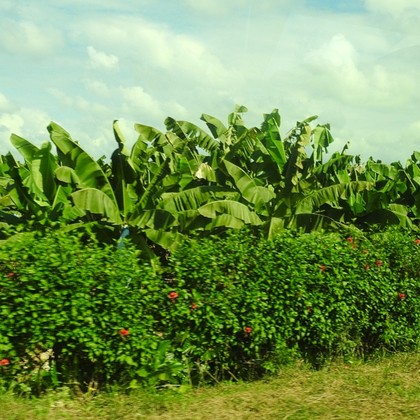
In winter open oak and pine-oak woodland, riparian woodland with cottonwoods and walnuts, orchards and pasture with scattered trees. It likes to sit on a lookout on a dead branch or post and catches flying insects in the air. In winter it eats mainly acorns, nuts and fruit, which it stores in bark crevices or in posts and defends.
Where the bird is most at home, classified by the vegetation units of Mexico and Central America.



Range and movements
An irregular winter visitor to northern Baja California, Sonora and Chihuahua, and rare further south to Durango, Sinaloa and Coahuila. Numbers vary greatly from year to year. Outside the guide area it breeds in the western United States and southern British Columbia and winters mainly in the south-western United States.
- Resident
- Winter visitor (c. Oct–Mar)
- Passage (Mar–Apr, Oct–Nov)
- dark = core range, pale = thinly spread
How and when to look
In winters with a good acorn crop in oak woodland and orchards in northern Sonora and Chihuahua, where it often sits high on a dead branch. In flight it can be recognised at a distance by its dark silhouette with broad wings and its straight, crow-like flight.
Conservation status
Not threatened, but it has declined in parts of its breeding range through the loss of open woodland with old and dead trees and a shortage of suitable nest trees.
Scientific name
Melanerpes lewis | (Gray, 1849)
Gray described the species in 1849 as Picus Lewis; because it was later moved to another genus, the author and year stand in brackets. The genus Melanerpes was introduced in 1832 by Swainson. Melanerpes is Greek, from melas 'black' and herpēs 'creeper': 'black creeper'. lewis honours the American explorer Meriwether Lewis (1774–1809) of the Lewis and Clark expedition, which collected the first specimens. The specimen the first description was based on came from Montana (United States).