All species › Passerines › Tyrant flycatchers and allies › Least Flycatcher
Position in the tree Birds Aves › Birds with a flexible palate Neognathae › All other modern birds Neoaves › Landbirds Telluraves › Falcons, parrots and passerines Australaves › Falcons and passerines Eufalconimorphae › Parrots and passerines Psittacopasserae
Least Flycatcher | Empidonax minimus
Kleine feetiran | Mosquero mínimo
The Least Flycatcher is the smallest Empidonax flycatcher of eastern North America. It breeds in deciduous forest in Canada and the northern United States and winters in the lowlands of Mexico and Central America, where it is one of the commonest Empidonax flycatchers at forest edges, in scrub and in gardens.
Voice
The call is a dry, sharp whit. In spring the song may already be heard: a forceful, often repeated che-BEK.
Recording: Stanislas Wroza — CC BY-NC-SA 4.0 · shortened to the first 60 s, mono · xeno-canto
Identification
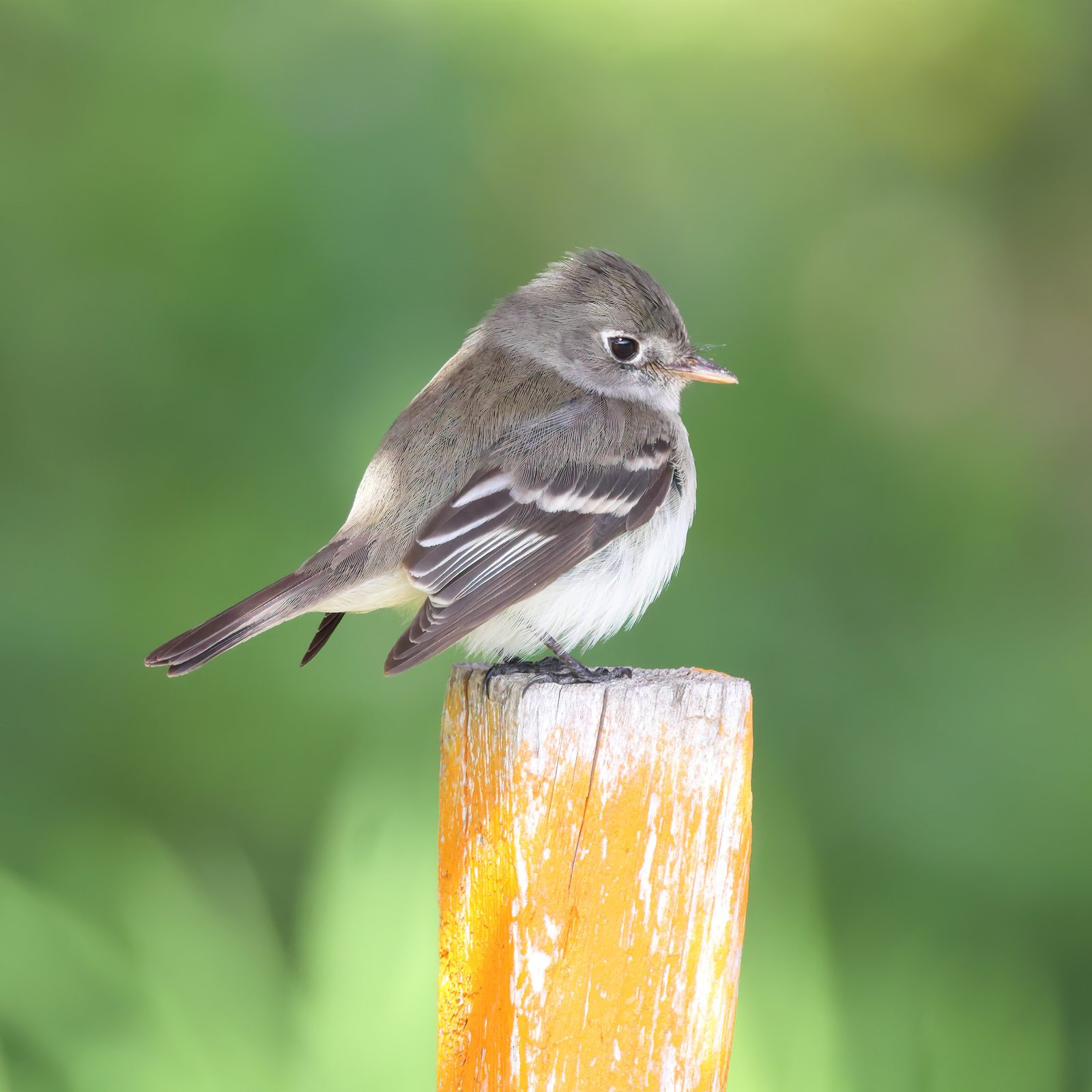
12–14 cm, with a large, round head, a short tail and a short, broad bill with a pale lower mandible. Upperparts greyish olive, head slightly greyer. Throat white, breast pale grey, belly whitish, sometimes tinged pale yellow in fresh plumage. A bold, complete white eye-ring. Wings dark with two distinct white wing-bars; the primaries project only a short way beyond the secondaries. Male and female are alike.
Confusion species
Hammond's Flycatcher Empidonax hammondii has longer wings, a narrower, darker bill and a greyer throat, and in winter lives mainly in highland forest. Willow Flycatcher Empidonax traillii and Alder Flycatcher Empidonax alnorum are larger and browner, with a longer bill and a weak or absent eye-ring. Acadian Flycatcher Empidonax virescens is larger and greener, with a longer bill and longer wings. Yellow-bellied Flycatcher Empidonax flaviventris has a yellow throat and belly.
Habitat
In winter at forest edges, in secondary forest, scrub, gallery forest, mangroves, pasture with trees, plantations and gardens, mainly in the lowlands and lower mountains. It hunts insects from a low to mid-level branch and often flicks its wings and tail. It does not breed in the guide area.
Where the bird is most at home, classified by the vegetation units of Mexico and Central America.







Range and movements
Breeds in Canada and the northern and eastern United States. Winters from northern and central Mexico, on both coasts and on the Yucatán Peninsula, through Belize, Guatemala, Honduras and El Salvador to Nicaragua; scarcer in Costa Rica and rare in Panama.
- Winter visitor (c. Oct–Mar)
- dark = core range, pale = thinly spread
How and when to look
In winter one of the most frequently seen Empidonax flycatchers in Belize, on the Yucatán Peninsula and in the lowlands of Guatemala and Honduras, low at forest edges and in gardens. The bold eye-ring, short bill and dry whit are the best features.
Conservation status
Not threatened. Common and widespread, although the breeding population has declined in parts of the breeding range.
Scientific name
Empidonax minimus | (Baird & Baird, 1843)
Baird & Baird described the species in 1843 as Tyrannula minima; because it was later moved to another genus, the author and year stand in brackets. The genus Empidonax was introduced in 1855 by Cabanis. Empidonax is Greek, from empis 'gnat' and anax 'master': 'gnat-king', after its insect hunting. minimus is Latin for 'smallest', after its small size. The specimen the first description was based on came from near Carlisle, Pennsylvania (USA).