All species › New World vultures › New World vultures › King Vulture
Position in the tree Birds Aves › Birds with a flexible palate Neognathae › All other modern birds Neoaves › Landbirds Telluraves › Raptors, owls, kingfishers and woodpeckers Afroaves › Hawks and owls Hieraves
King Vulture | Sarcoramphus papa
Koningsgier | Zopilote rey
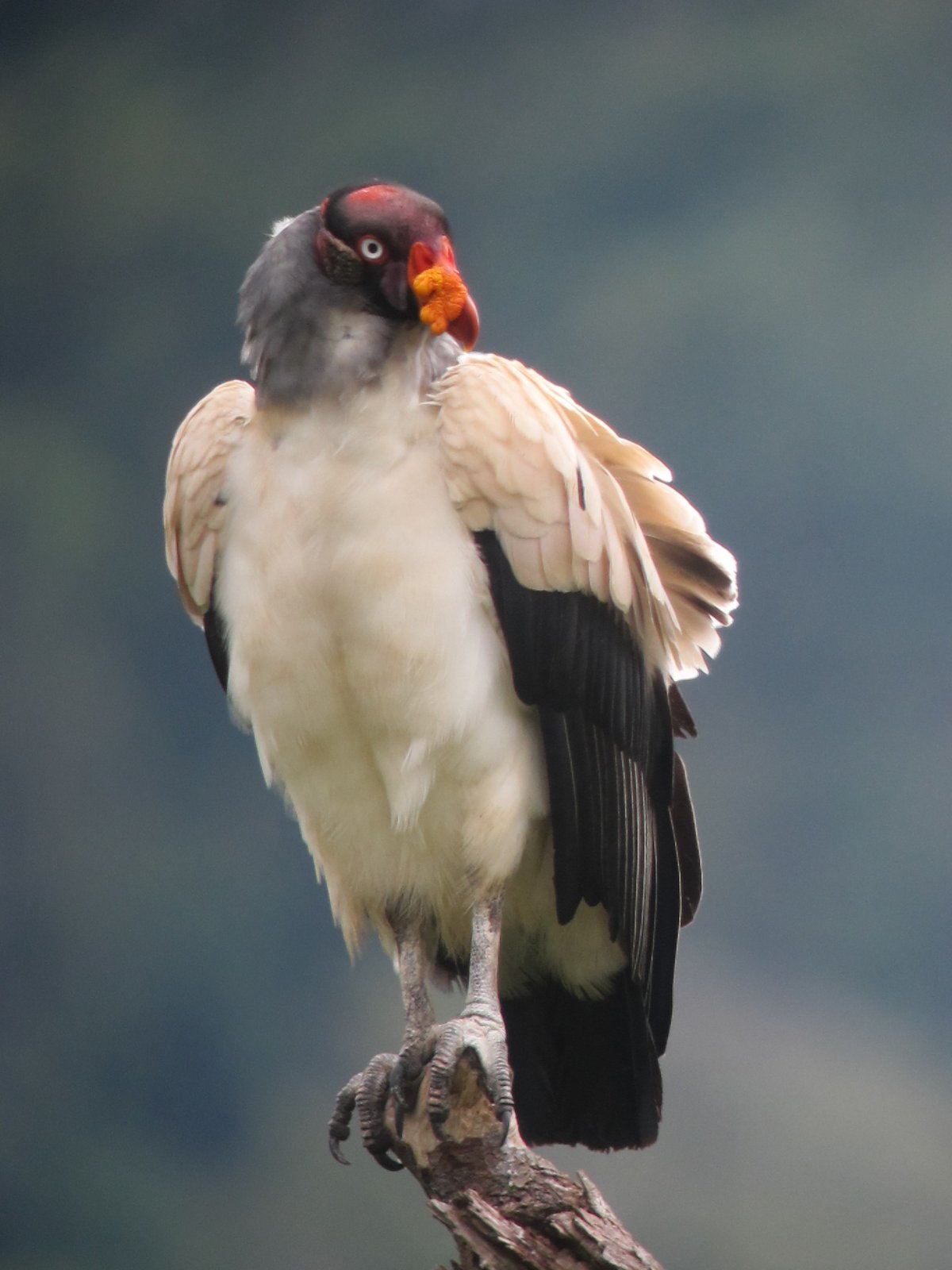
The King Vulture is the largest and most colourful vulture of the American tropics. It lives in large, undisturbed lowland forests and soars high above the canopy. At a carcass it displaces the smaller vultures; with its powerful bill it opens hides that they cannot tear. In the guide area it occurs from southern Mexico to Panama, but in much of Mexico it has become rare.
Voice
Lacks a syrinx; almost silent. At carcasses sometimes soft croaks and hisses.
Recording: Arthur Monteiro Gomes — CC BY-NC-SA 4.0 · shortened to the first 60 s, mono · xeno-canto
Identification
67–81 cm, with broad wings and a short, square tail. Adults are creamy white with black flight feathers, a black tail and a grey ruff around the neck. The bare head and neck are multicoloured: orange, red, yellow and purple, with an orange caruncle on the bill and a white iris with a red eye-ring. In flight from below, white underwing coverts and body contrast with black flight feathers and tail. Juveniles are uniform slate grey to blackish with a dark head; over four to five years they gradually turn white, first on the belly and underwing coverts. Soars on flat wings and hardly rocks.
Confusion species
The Wood Stork Mycteria americana and the Jabiru Jabiru mycteria have a similar black-and-white wing pattern, but fly with outstretched neck and legs. The Black-and-white Hawk-Eagle Spizaetus melanoleucus has a white head, a banded tail and barred flight feathers. Young King Vultures resemble the Black Vulture Coragyps atratus, but are larger, have broader wings and lack the white patches at the wingtip.
Habitat
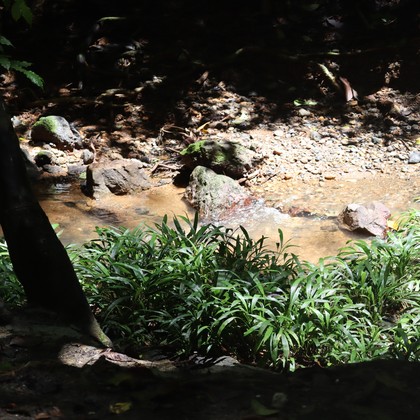
Large, unbroken tropical lowland forest, both rainforest and dry forest, gallery forest and savanna with woodland patches; mostly below 1500 m, locally higher. Nests in a hollow trunk, a stump or on the forest floor. Finds carcasses mainly by following the Turkey Vulture and the Lesser Yellow-headed Vulture, which locate carrion by smell.
Where the bird is most at home, classified by the vegetation units of Mexico and Central America.






Range and movements
On the Gulf slope of Mexico from Veracruz and Oaxaca south through Tabasco, Chiapas and the Yucatán Peninsula, on the Pacific slope locally from southern Sinaloa. Further throughout Central America to Panama, mainly in the large forest blocks of Belize, northern Guatemala, the Mosquitia of Honduras and Nicaragua, southern Costa Rica and eastern Panama. Largely gone from the northern part of its Mexican range. Outside the guide area in South America to northern Argentina.
- Resident
- dark = core range, pale = thinly spread
How and when to look
Good sites are the Calakmul forest in Campeche, the Lacandon forest in Chiapas, Tikal in Guatemala, the Chiquibul forest in Belize, the Osa Peninsula in Costa Rica and Darién in Panama. Birds rise on thermals from mid-morning; viewpoints and temple tops above the canopy give the best overview.
Conservation status
Not threatened, but greatly declined through deforestation; rare or gone in much of Mexico and in densely populated parts of Central America. It depends on large, unbroken forest and hardly occurs in strongly fragmented landscapes.
Scientific name
Sarcoramphus papa | (Linnaeus, 1758)
Linnaeus described the species in 1758 as Vultur Papa; because it was later moved to another genus, the author and year stand in brackets. The genus Sarcoramphus was introduced in 1805 by Duméril. Sarcoramphus is Greek, from sarx, sarkos 'flesh' and rhamphos 'bill': 'fleshy bill', after the fleshy caruncles on the bill. papa is Late Latin for 'pope', from Latin papa 'father, bishop'; the name goes back to Edwards (1737) and alludes to the stately appearance. The specimen the first description was based on came from Suriname.