All species › Swifts › Swifts › Grey-rumped Swift
Position in the tree Birds Aves › Birds with a flexible palate Neognathae › All other modern birds Neoaves › Birds of the elements Elementaves › Nightjars and swifts Strisores
Grey-rumped Swift | Chaetura cinereiventris
Grijsstuitgierzwaluw | Vencejo lomigrís
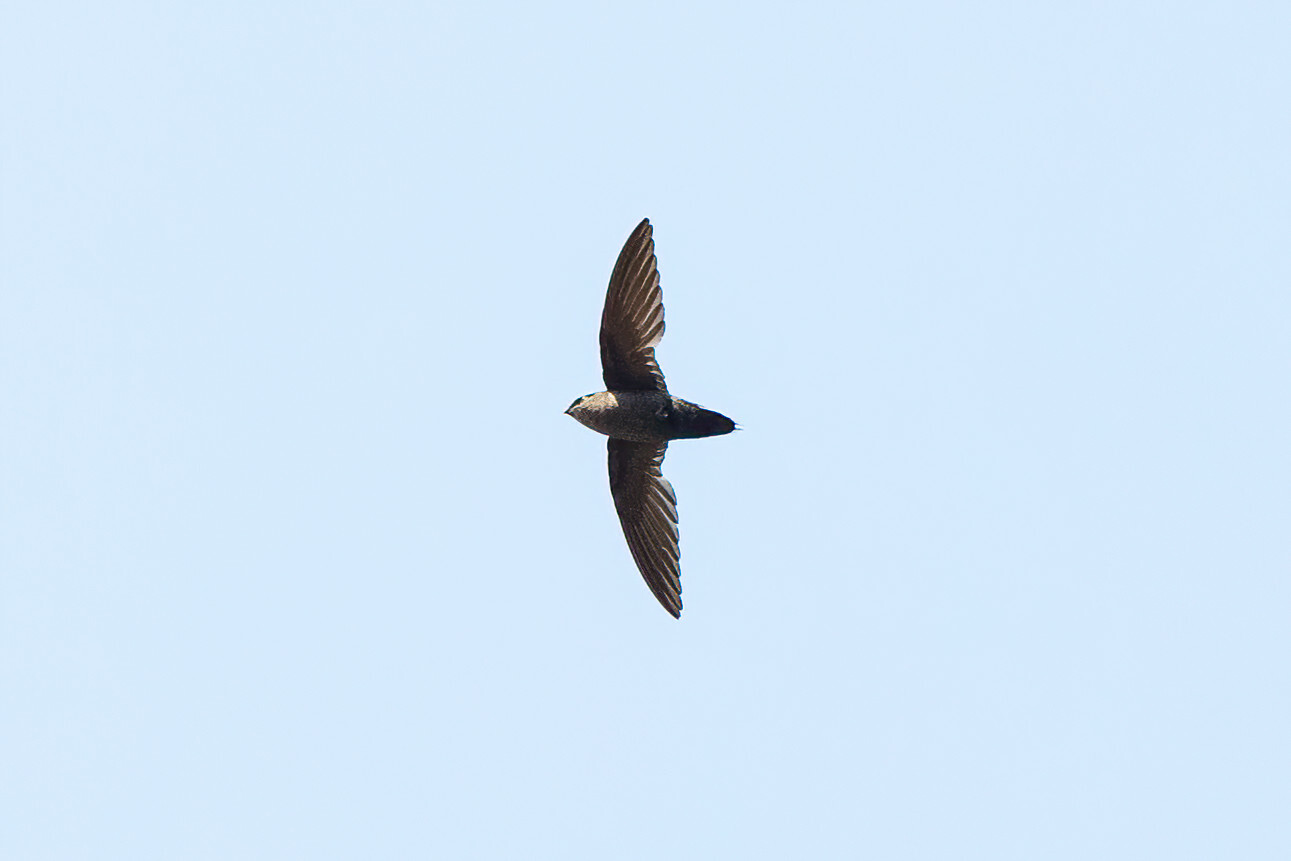
The Grey-rumped Swift is a small, dark swift of the humid forests on the Caribbean side of southern Central America. Small groups hunt with fast, fluttering wingbeats over the canopy, along forest edges and over clearings, often together with other swifts. In the lowlands of Costa Rica it is one of the most frequently seen swifts.
Voice
A repeated, clear tsip and a series of three or four slightly descending, rasping notes, trrreeyew-trrreeyew-trrreeyew.
Recording: Juan Freile — CC BY-NC-SA 4.0 · converted to mono · xeno-canto
Identification
10–11 cm, small, with a short, square tail with protruding shafts that form spines. Upperparts glossy blue-black, with a broad, pale grey rump and uppertail coverts that contrast sharply. Throat and underparts are grey, the throat slightly paler; the undertail coverts are darker. The sexes are alike. In flight the pale grey rump and grey underparts stand out in good light.
Confusion species
Vaux's Swift Chaetura vauxi is browner, with a brownish-grey rump that contrasts less and a paler throat contrasting with a darker belly. Costa Rican Swift Chaetura fumosa, mainly on the Pacific side of southern Costa Rica and western Panama, has darker underparts and a less grey, more brownish rump. Band-rumped Swift Chaetura spinicaudus in Costa Rica and Panama has a narrow, whitish band across the rump and dark underparts. Short-tailed Swift Chaetura brachyura in Panama is browner, has a very short tail and a pale rump and undertail that merge into one pale area.
Habitat
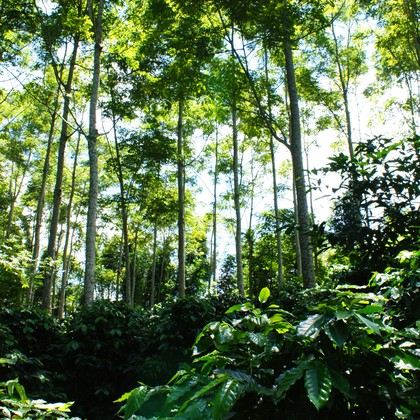
Over humid lowland rainforest, foothill forest, secondary forest, forest edges, riverine forest and plantations with shade trees, from sea level to about 1200 m. Hunts small flying insects, often fairly low over the canopy and over rivers. Nests in hollow trees and sometimes in chimneys, wells or similar structures, with a half-cup of twigs glued to the inner wall with saliva.
Where the bird is most at home, classified by the vegetation units of Mexico and Central America.




Range and movements
On the Caribbean side from eastern Honduras (Gracias a Dios and Colón) through eastern and south-eastern Nicaragua and Costa Rica to western Panama, in Bocas del Toro, the Ngäbe-Buglé comarca and northern Veraguas. In Costa Rica mainly in the lowlands and foothills of the Caribbean slope, with smaller numbers into northern Guanacaste and along the edges of the Central Valley. Outside the guide area in much of South America, from Colombia and Venezuela to Brazil and north-eastern Argentina, and on Trinidad, Tobago and Grenada.
- Resident
- dark = core range, pale = thinly spread
How and when to look
In Costa Rica over forest edges and clearings in the Caribbean lowlands, for example around Sarapiquí and at the research stations and lodges in Heredia and Limón, and in Panama in Bocas del Toro. A flock of swifts is best viewed from the side or against a forested slope, so that the grey rump and grey underparts can be seen.
Conservation status
Not threatened. The species has a very large range and is common in the Caribbean lowlands of Costa Rica. Large-scale deforestation may reduce numbers locally, but the species also uses secondary forest and farmland with trees.
Scientific name
Chaetura cinereiventris | Sclater, 1862
Sclater described the species in 1862 and placed it straight away in the genus where it still stands. The genus Chaetura was introduced in 1826 by Stephens. Chaetura is Greek, from khaitē 'hair, bristle' and oura 'tail', after the spiny projecting shafts of the tail feathers. cinereiventris is Latin, from cinereus 'ash-grey' and venter 'belly', after the grey underparts. The specimen the first description was based on came from Bahia, Brazil.