All species › Passerines › Tyrant flycatchers and allies › Grey Kingbird
Position in the tree Birds Aves › Birds with a flexible palate Neognathae › All other modern birds Neoaves › Landbirds Telluraves › Falcons, parrots and passerines Australaves › Falcons and passerines Eufalconimorphae › Parrots and passerines Psittacopasserae
Grey Kingbird | Tyrannus dominicensis
Grijze koningstiran | Tirano gris
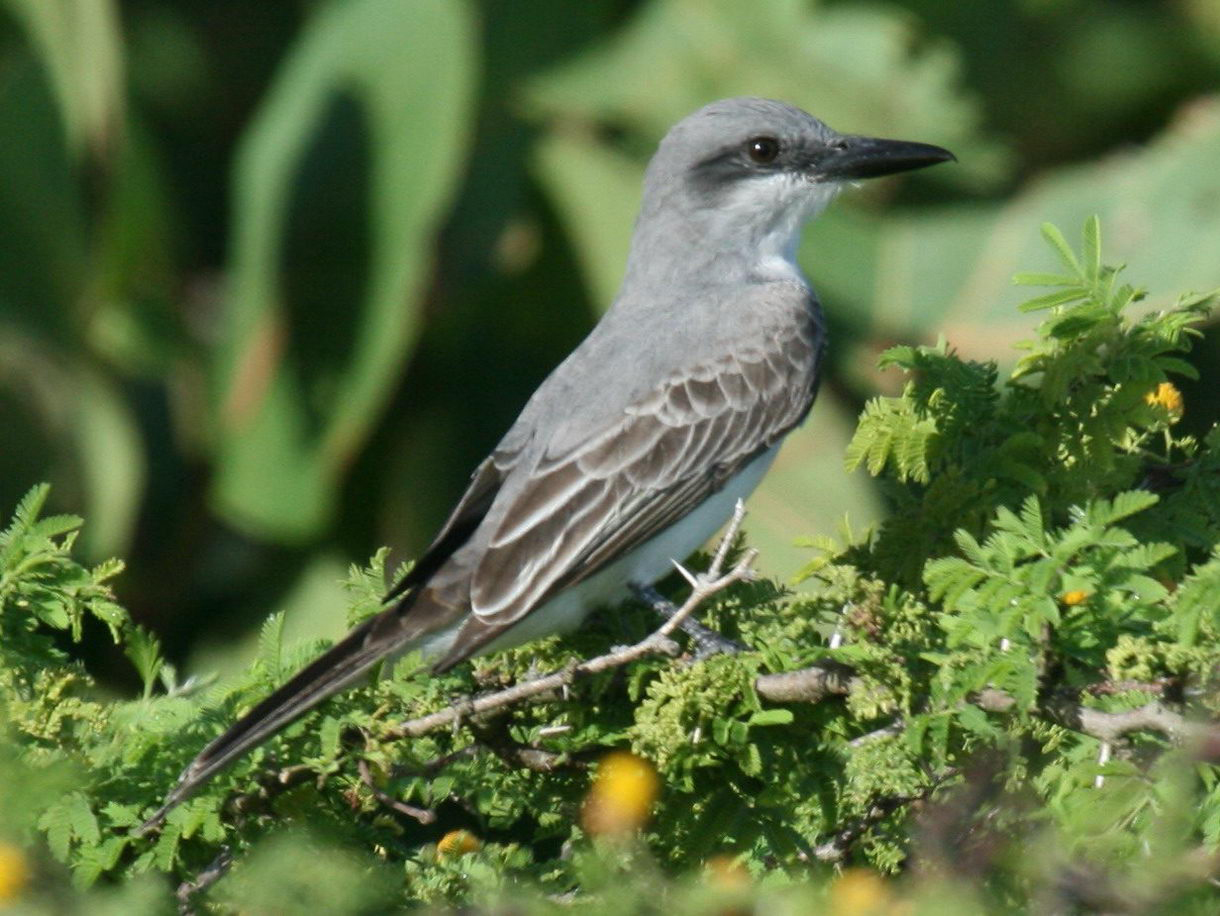
The Grey Kingbird is a large, grey-and-white kingbird with a dark mask and a long, heavy bill. It breeds mainly on the islands of the Caribbean and in Florida and reaches the guide area as a passage migrant and winter visitor, mainly along the coast of the Yucatán Peninsula and the Caribbean coast of Central America.
Voice
A loud, rolling pi-teer-ree, the origin of its Spanish name pitirre on the Caribbean islands; often silent outside the breeding season.
Recording: Rory Nefdt — CC BY-NC-SA 4.0 · converted to mono · xeno-canto
Identification
23–24 cm, with a large head, a long, heavy, straight black bill and a fairly long, notched tail. Upperparts grey, wings and tail dark greyish brown. A blackish mask runs from the bill through the eye to the ear coverts. Underparts white, the breast washed greyish. A yellow to orange crown patch is usually concealed. The tail has no white tip or white outer edges. Male and female are alike; juveniles are browner above, with rusty edges to the wing coverts and tail.
Confusion species
Eastern Kingbird Tyrannus tyrannus, also a passage migrant, has a blackish head and back, a shorter bill and a white terminal band on the tail. Tropical Kingbird Tyrannus melancholicus and Couch's Kingbird Tyrannus couchii have a yellow belly and a greenish back. Thick-billed Kingbird Tyrannus crassirostris also has a heavy bill, but a darker brownish-grey head and pale yellow underparts, and lives mainly on the Pacific slope of Mexico.
Habitat
Open country near the coast: mangroves, beach woodland, lagoons, coastal villages, gardens, pasture and forest edges with tall, bare perches. It hunts large flying insects from a high, exposed perch and also eats fruit.
Where the bird is most at home, classified by the vegetation units of Mexico and Central America.






Range and movements
In the guide area mainly along the coast of the Yucatán Peninsula and the Caribbean coast of Central America to Panama; scarce inland. Outside the guide area it breeds in the south-eastern United States, the Bahamas and the Antilles and locally along the north coast of South America; it winters mainly in northern South America.
- Winter visitor (c. Oct–Mar)
- dark = core range, pale = thinly spread
How and when to look
Look for it on wires and bare branches along the coast of the Yucatán Peninsula, especially during spring and autumn migration.
Conservation status
Not threatened. It has a large range and is common in its breeding area; in the guide area a rather scarce passage migrant and winter visitor.
Scientific name
Tyrannus dominicensis | (Gmelin, 1788)
Gmelin described the species in 1788 as [Lanius Tyrannus] dominicensis; because it was later moved to another genus, the author and year stand in brackets. The genus Tyrannus was introduced in 1799 by De Lacépède. Tyrannus is Latin (from Greek turannos) for 'tyrant, despot', after the aggressive way these birds drive off even raptors. dominicensis means 'of Santo Domingo', the old name for Hispaniola, where the species was collected. The specimen the first description was based on came from Santo Domingo (Hispaniola).