All species › Woodpeckers and allies › Woodpeckers › Grey-breasted Woodpecker
Position in the tree Birds Aves › Birds with a flexible palate Neognathae › All other modern birds Neoaves › Landbirds Telluraves › Raptors, owls, kingfishers and woodpeckers Afroaves › Mousebirds, rollers and woodpeckers Coraciimorphae › Trogons and cavity nesters Cavitaves › Hornbills, kingfishers and woodpeckers Picocoraciae › Kingfishers, bee-eaters and woodpeckers Picodynastornithes
Grey-breasted Woodpecker | Melanerpes hypopolius
Grijskeelspecht | Carpintero pecho gris
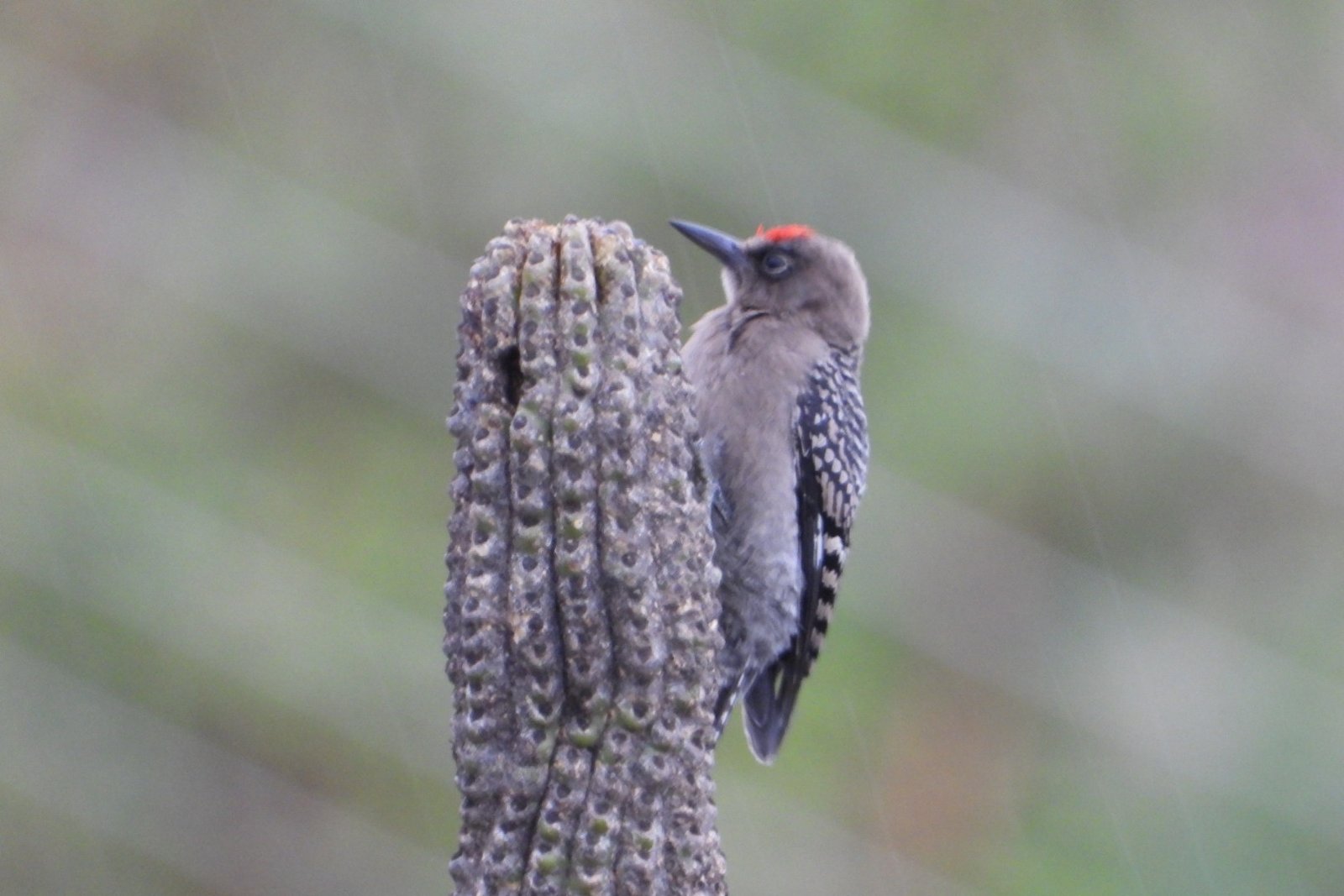
The Grey-breasted Woodpecker is a rather drab Melanerpes woodpecker of the dry interior of south-western Mexico. It lives in country with columnar cacti and scattered trees and is often seen in pairs or small groups. It occurs nowhere outside its small range.
Voice
A loud, aggressive-sounding rattle, a short chuck and an emphatic, nasal yak.
Recording: Andrew Spencer — CC BY-NC-SA 3.0 · converted to mono · xeno-canto
Identification
19–21 cm. Head, neck and underparts plain greyish brown, paler towards the lower belly, with a variable number of black arrowhead marks on the lower belly. Forehead white to dull white. A narrow black ring around the eye with a few red feathers below it. The male has a red patch in the centre of the crown; the female has a plain grey head. Back and wings densely barred black and white, rump white. Juveniles are browner and less contrastingly barred.
Confusion species
Within its range there is no species that closely resembles it. Golden-cheeked Woodpecker Melanerpes chrysogenys, which lives lower and in more humid forest, has a yellow nape, a black patch around the eye and a yellow-orange belly patch. Ladder-backed Woodpecker Dryobates scalaris is smaller, with a black-and-white striped head. Acorn Woodpecker Melanerpes formicivorus has a plain black back.
Habitat
Dry scrub with columnar cacti and scattered trees, thorn scrub, open dry forest and riverside groves, also in villages; mostly between 900 and 2100 m. Along rivers mainly where Golden-cheeked Woodpecker is absent. It forages in groups of three to ten birds and roosts communally in cacti.
Where the bird is most at home, classified by the vegetation units of Mexico and Central America.





Range and movements
Endemic to south-western Mexico: the interior of northern Guerrero and Morelos through southern Puebla to central Oaxaca, including the Balsas basin and the Tehuacán valley.
- Resident
- dark = core range, pale = thinly spread
How and when to look
Regularly found in the dry valleys around the city of Oaxaca, for example at Monte Albán and Yagul, and in the Tehuacán valley in Puebla. Small groups often perch on top of columnar cacti.
Conservation status
Not threatened. Fairly common within its limited range, but its biology is poorly known.
Scientific name
Melanerpes hypopolius | (Wagler, 1829)
Wagler described the species in 1829 as Picus hypopolius; because it was later moved to another genus, the author and year stand in brackets. The genus Melanerpes was introduced in 1832 by Swainson. Melanerpes is Greek, from melas 'black' and herpēs 'creeper': 'black creeper'. hypopolius is Greek, from hupo 'below' and polios 'grey', after the grey-brown underparts. The specimen the first description was based on came from Tehuacán, Puebla, Mexico.