All species › Woodpeckers and allies › Woodpeckers › Golden-cheeked Woodpecker
Position in the tree Birds Aves › Birds with a flexible palate Neognathae › All other modern birds Neoaves › Landbirds Telluraves › Raptors, owls, kingfishers and woodpeckers Afroaves › Mousebirds, rollers and woodpeckers Coraciimorphae › Trogons and cavity nesters Cavitaves › Hornbills, kingfishers and woodpeckers Picocoraciae › Kingfishers, bee-eaters and woodpeckers Picodynastornithes
Golden-cheeked Woodpecker | Melanerpes chrysogenys
Goudwangspecht | Carpintero enmascarado
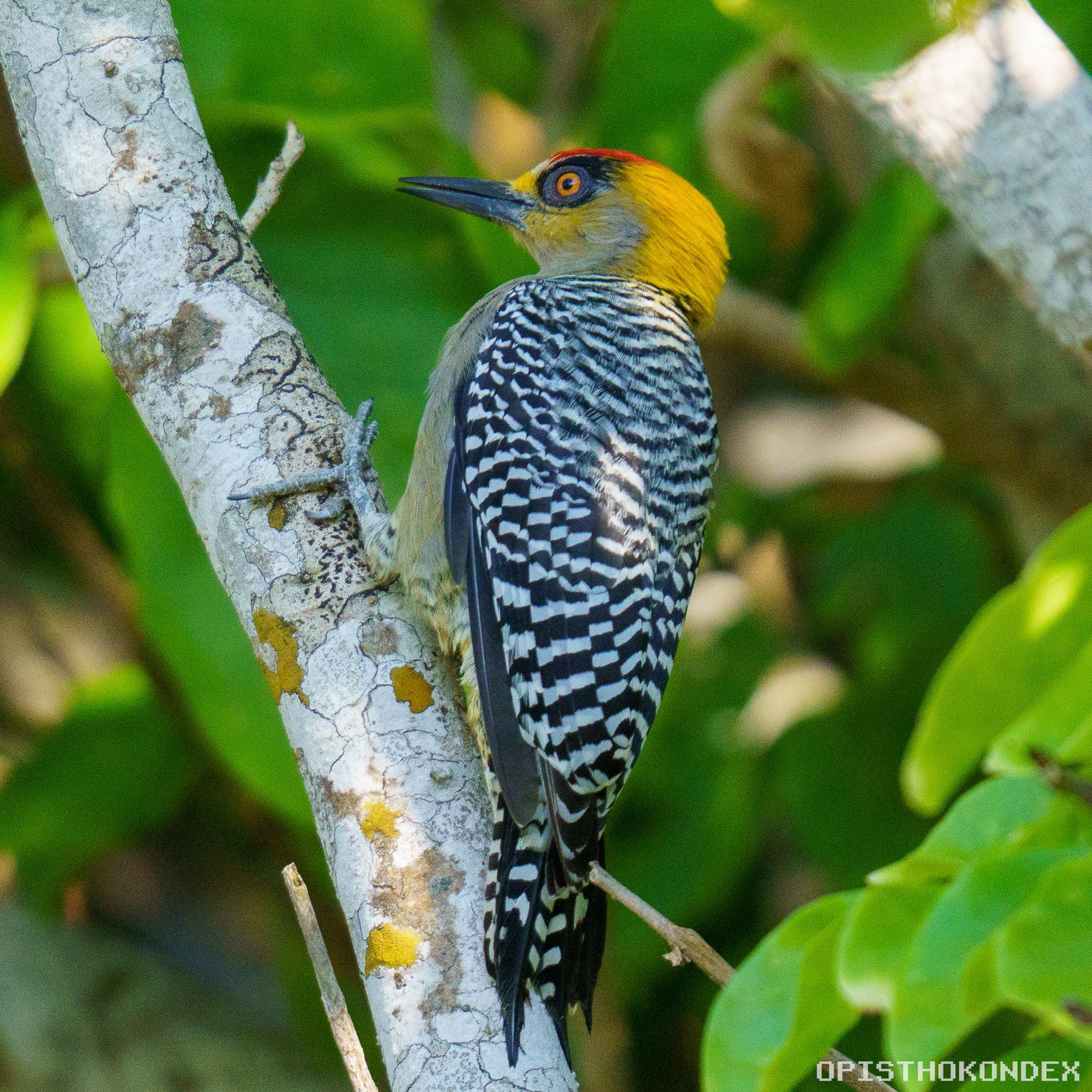
The Golden-cheeked Woodpecker is a medium-sized Melanerpes woodpecker found only in western and south-western Mexico. It is recognised by the black patch around the eye, the yellow to orange nape and the black-and-white barred back. It lives in dry forest, gallery forest and plantations on the Pacific slope.
Voice
A nasal ki-di-dik and a loud, nasal series such as cheek-oo, cheek-oo, cheek-oo, keh-i-heh-ek; also a softer keh-i-heh. Drums in short rolls.
Recording: Manuel Grosselet — CC BY-NC-SA 4.0 · converted to mono · xeno-canto
Identification
19–22 cm. Forehead pale, a black patch around the eye, cheeks and sides of the head yellowish. The male has a red crown and golden-yellow nape; the female has a greyish-buff crown and a yellow to orange-red nape. Back and wings finely barred black and white, rump white. Underparts brownish buff with an olive-yellow wash and a yellow-orange patch in the centre of the belly. The southern subspecies flavinuchus is slightly larger and duller, with less yellow on the face and greyer underparts.
Confusion species
Gila Woodpecker Melanerpes uropygialis (north-west, south to Nayarit and Jalisco) has a plain greyish-brown head without a black eye patch and no yellow on the nape. Grey-breasted Woodpecker Melanerpes hypopolius of the dry interior of the south-west is greyer, with a whitish forehead and no yellow. Golden-fronted Woodpecker Melanerpes aurifrons lives mainly further east and south and lacks the black eye patch. Acorn Woodpecker Melanerpes formicivorus has a plain black back and a black-and-white face.
Habitat
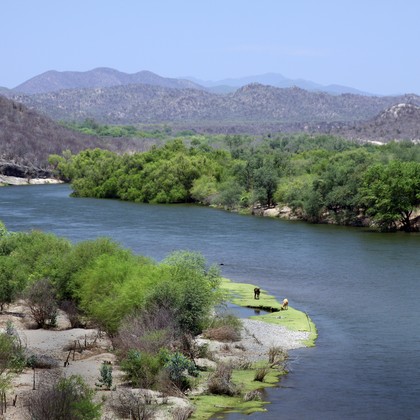
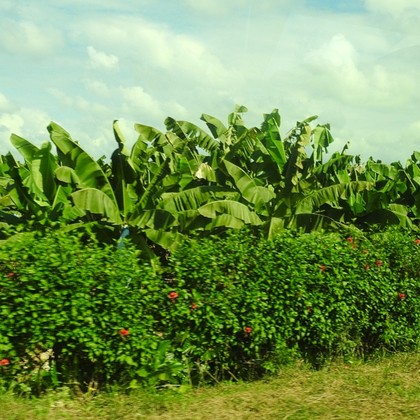
Interior and edges of semi-humid to dry forest, gallery forest along rivers, forest patches, savanna with scattered trees, plantations and villages with gardens, from sea level to about 1500 m. It eats insects, fruit and seeds. The nest hole is excavated in a dead tree or a palm.
Where the bird is most at home, classified by the vegetation units of Mexico and Central America.




Range and movements
Endemic to Mexico. The nominate form lives on the Pacific slope from Sinaloa to Nayarit; the subspecies flavinuchus from Jalisco south along the coast to Oaxaca and inland, through the Balsas basin, to Puebla.
- Resident
- dark = core range, pale = thinly spread
How and when to look
Often seen around San Blas in Nayarit, in the Puerto Vallarta and Colima areas and further south near Huatulco in Oaxaca. The loud, nasal calls usually give the bird away before its plumage does.
Conservation status
Not threatened. Common within its limited range and tolerant of partial deforestation.
Scientific name
Melanerpes chrysogenys | (Vigors, 1839)
Vigors described the species in 1839 as Picus chrysogenys; because it was later moved to another genus, the author and year stand in brackets. The genus Melanerpes was introduced in 1832 by Swainson. Melanerpes is Greek, from melas 'black' and herpēs 'creeper': 'black creeper'. chrysogenys is Greek, from khrusos 'gold' and genus 'cheek', after the golden-yellow patch behind the eye. The specimen the first description was based on came from Nayarit or Sinaloa, western Mexico (not specified).