All species › Parrots › African and New World parrots › Green Parakeet
Position in the tree Birds Aves › Birds with a flexible palate Neognathae › All other modern birds Neoaves › Landbirds Telluraves › Falcons, parrots and passerines Australaves › Falcons and passerines Eufalconimorphae › Parrots and passerines Psittacopasserae
Green Parakeet | Psittacara holochlorus
Groene aratinga | Perico mexicano
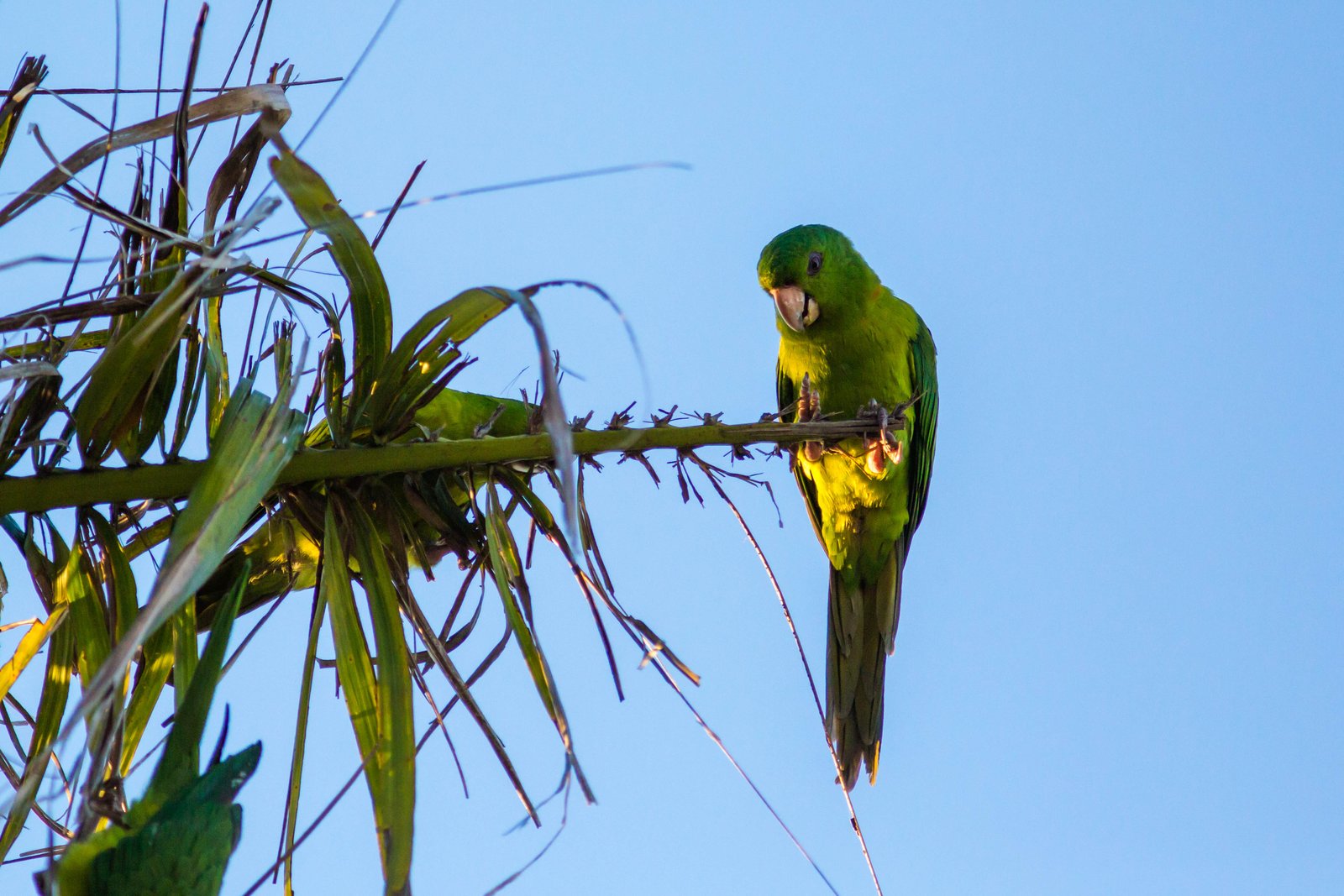
The Green Parakeet is a medium-sized, all-green parakeet with a long, pointed tail. As currently defined, the species includes the forms of eastern and northwestern Mexico and the red-throated form of the highlands from Guatemala to Nicaragua; the Socorro Parakeet and the Pacific Parakeet are treated as separate species. In Monterrey and other cities in northeastern Mexico groups of hundreds of birds roost in parks and street trees.
Voice
Loud and shrill; a high, grating kreek or a rolling krree-krree, often rapidly repeated in flight. At roosts and in feeding trees a constant screeching and chattering.
Recording: Rodolfo Salinas-Villarreal — CC BY-NC-SA 4.0 · converted to mono · xeno-canto
Identification
32 cm, with a long, pointed tail. All green, slightly paler and more yellowish below; sometimes with a few scattered red feathers on the head or throat. The underside of the flight feathers and tail is olive-yellow. The eye is orange-red with a narrow, bare, pale eye-ring; the bill is horn-coloured. Birds of the highlands from Guatemala to Nicaragua (P. h. rubritorquis) have an orange-red throat and foreneck; those of northwestern Mexico (P. h. brewsteri) are slightly darker. Male and female are alike.
Confusion species
The Pacific Parakeet Psittacara strenuus, on the Pacific side from Chiapas to Nicaragua, is very similar and is separated in the field mainly by range; it has a heavier bill and a slightly shorter tail. The Olive-throated Parakeet Eupsittula nana and the Orange-fronted Parakeet Eupsittula canicularis are smaller, with an olive-brown throat and breast or an orange forehead. The Red-crowned Amazon Amazona viridigenalis and other amazons are stockier, with a short, square tail and a red speculum.
Habitat
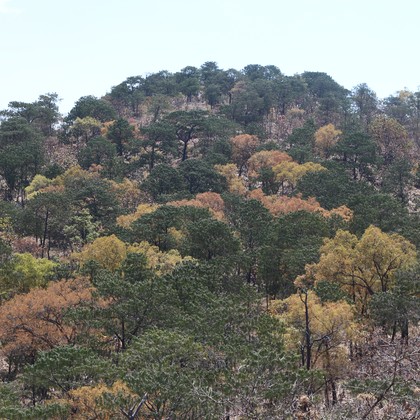
Semi-deciduous and deciduous forest, gallery forest, wooded ravines, forest edges, pine-oak forest in the mountains and semi-open country with scattered trees; also cities, parks and gardens. Mostly between 500 and 2000 m, in northeastern Mexico also lower. It eats seeds, fruit, nuts and flowers. It nests in a tree cavity, a rock crevice or a building.
Where the bird is most at home, classified by the vegetation units of Mexico and Central America.






Range and movements
In Mexico in the northwest in the Sierra Madre Occidental (southern Sonora, southwestern Chihuahua, northern Sinaloa); in the east from Nuevo León and southern Coahuila through Tamaulipas, San Luis Potosí, Querétaro and Hidalgo to Veracruz, Puebla and northern Oaxaca; and in Chiapas. Further in the highlands of Guatemala, El Salvador, Honduras and northern Nicaragua. Groups in Mexico City and Morelos probably derive from escaped cage birds. Outside the guide area a small population in southern Texas, of uncertain origin.
- Resident
- dark = core range, pale = thinly spread
How and when to look
In Monterrey and other cities in Nuevo León and Tamaulipas groups fly calling loudly towards communal roosts in parks and street trees at sunset, where they can be seen at close range. In the mountains groups often pass high and fast, recognisable by the long pointed tail and the shrill calls.
Conservation status
Not evaluated separately; the IUCN also includes the Socorro Parakeet and the Pacific Parakeet in this species and considers the whole not threatened. Locally declined through trapping for the cage-bird trade and forest loss, but common in parts of northeastern Mexico, also in cities.
Scientific name
Psittacara holochlorus | (Sclater, 1859) (GBIF: Aratinga holochlora)
Sclater described the species in 1859 as Conurus holochlorus; because it was later moved to another genus, the author and year stand in brackets. The genus Psittacara was introduced in 1825 by Vigors. Psittacara joins Greek psittakos 'parrot', Latin psittacus, with the genus name Ara, the macaws. holochlorus is Greek, from holos 'entire' and khlōros 'green', after the almost wholly green plumage. The specimen the first description was based on came from Xalapa, Veracruz, Mexico.